

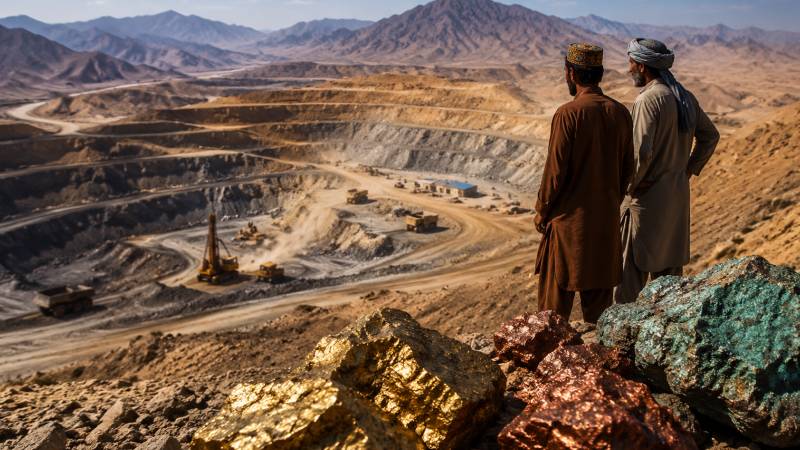
Chaghi, an area that lies under the scorching sun with almost non-existent vegetation, caught investors' attention when it revealed its untapped assets: a massive copper and gold deposit worth $1–3 million. This resource has the potential to be a game-changer for Pakistan’s economy. Unfortunately, when the economic promises of Reko Diq are discussed in Islamabad briefings, they rarely stop to consider Baloch sentiments regarding this immense valuation. This absence of Baloch voice is the real crisis breeding under Baluchistan’s sand.
According to Frances Stewart, conflict is not birthed by poverty alone, but from inequalities within groups. Meaning groups residing within the same state feel themselves consistently deprived in political power, social services, and economic opportunity compared to other groups. Baluchistan is a classic case for this. Natural Gas discovered in Sui in 1952 lit the stoves of people residing in Lahore and Karachi decades before the Baloch who dwelled a few kilometers from the wellhead. Similarly, Irrespective of its strategic and monetary value, the Chaghi district –the home of Reko Diq –has no college or vocational institute, a hospital that can accommodate only two, and no X-ray facility. Moreover, only 6% of the population has access to clean drinking water. This is not a consequence of location. Rather, it is horizontal inequality created by design, gradually and persistently since 1948.
Grievances never remain quiet. Since 1948, the Baloch have stood up five times against the center, only demanding one thing: Give us a right over what lies beneath our own feet. When political promises were constantly broken, and political avenues seemed unapproachable, some Baloch resorted to bullets instead of ballots. To strengthen the Baloch grievances, movements like the Baloch Liberation Army and, more recently, the Baloch Yakjehti Committee emerged. The faith of Baloch people was further shaken when the caretaker government signed away 75% of Reko Diq’s share to a foreign country in 1993, with Baluchistan receiving only 25% and 2% royalty. They felt that for decades the state had negotiated for Baluchistan rather than with it.
Peacebuilding must be prioritized over material gain so that Reko Diq becomes a story of mutual gain rather than a story of mere extraction.
These unresolved grievances are costing human life, and the numbers are rising. According to the Pakistan Institute for Conflict and Security Studies (PICSS), July 2026 was the deadliest month for Pakistan, and Baluchistan suffered the hardest hit. The death toll in Baluchistan rose by 241%, from 109 in June to 372 in July. Escalation in violence resulted in a 933% increase in security forces fatalities. Civilian deaths almost doubled from 28 to 54; added to this, 18 members of the peace committee were also killed. These are not just numbers; this is a depiction of a crippled relationship between the state and Baluchistan. The report made it clear that insurgency in Baluchistan is far from cresting.
Neither denial nor force can be the way forward. Positional bargaining –where the state will assert and Baloch will resist- will definitely produce a fragile outcome. For about thirty years, negotiations have been carried out on Reko Diq only as a transaction between the state and foreign companies. Baloch people have often been excluded from the core decisions made in Islamabad. Applying Fisher and Ury’s concept of separating people from the problem is not a mere philosophy; rather, an explicit policy solution. Decades-old insecurities, mining disputes, security operations, and dispossessions are webbed in Balochis’ minds. Pakistan’s leadership must treat the ‘people problem’ because if it is not dealt with as seriously as substantive issues (royalties, jobs, etc.), no matter how many agreements are signed in Islamabad, they will face impediments on the ground in Chaghi.
Hence, confidence-building measures with Baloch have become a necessity before any wise agreement. It would require a change from positions, i.e., Reko Diq belongs to the state, towards interest: What are the wants of Baloch people? Robina Shah, a resident of Chaghai, was a testimony that the Baloch people were not against the Reko Diq project; all they asked was that they should also benefit from the revenues generated from the project and have a say in decision-making. A wise agreement meets the legitimate interests of each side. Backroom deal-making should end, and local communities should be included in decision-making regarding the project. Measurable parameters should be introduced in the Reko Diq project, like public royalty structures, green audits, job guarantees for locals, and democratically elected Baloch voices.
It’s like Fisher and Ury commented on negotiation-the beauty lies in the differences between the parties; instead of eradicating the differences, negotiators should work on them to strive for an ideal deal that is profitable for everyone. Giving Baloch people a voice in the matter of Reko Diq would be giving acknowledgment to their distinct identity –language, tribal cultures, their right to be consulted in the country’s affairs. It is a chance for the state to redirect not only its economic progress, but also a chance to eliminate or reduce Baloch grievances to create sustainable peace in the region. Because trillion-dollar reserves are not enough to sustain peace.