

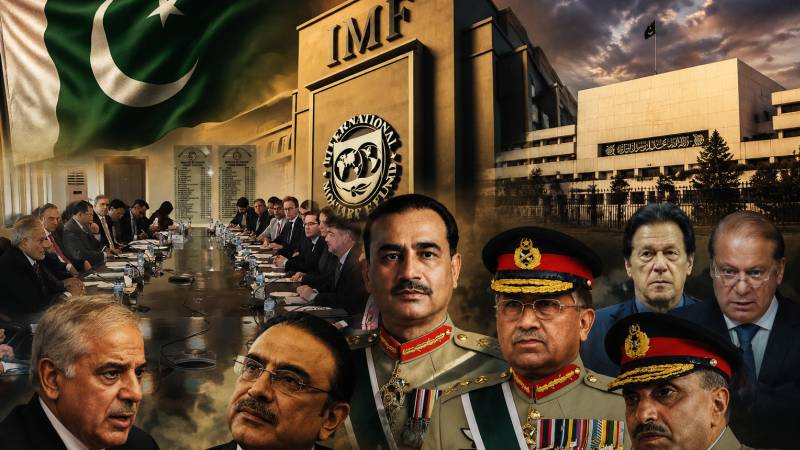
Pakistan’s tragedy is no longer simply that its major players fail to understand that the system is dysfunctional. Infact, many of them understand it perfectly and still find it rational to preserve it. For nearly eight decades now, the country has repeatedly changed rulers without changing the underlying game: generals have replaced politicians, politicians have replaced generals, elected governments have operated alongside unelected centres of power, judges have entered the political arena, bureaucrats have adapted to whoever prevailed, and business elites have learned to prosper under almost every arrangement. Constitutions have been amended, governments dismissed, slogans reinvented and economic rescue programmes repeated, yet Pakistan keeps returning to the same outcomes of weak and ineffective institutions, policy discontinuity, low productivity, low exports, inadequate human development, narrow taxation, elite privilege and recurring crises. The players change, the alliances shift and the rhetoric evolves, but the game survives and so does the outcome.
The striking development though is that criticism of the system is no longer confined to its opponents. Interior Minister recently said publicly that Pakistan's existing governance system had effectively “collapsed” and argued that structural changes and political consensus were required. The IMF, using very different language, continues to stress that durable growth requires deeper reforms in governance, market distortions and the structure of the economy. Pakistan has also recently achieved genuine macroeconomic stabilization and a sovereign rating upgrade, demonstrating that governments can improve parts of the machine. But stabilizing the machine is not the same thing as redesigning it. The tougher question, therefore, is no longer merely what is wrong with Pakistan, but who changes the system once enough people recognize that it is not delivering. It is really who and how the system may change.
That is fundamentally a game theory problem. Pakistan's predicament can be understood as a bad equilibrium in which the principal players frequently behave rationally from their own perspective while collectively producing an irrational national outcome. The military protects institutional influence because surrendering it carries risks. Political parties seek establishment support because refusing it unilaterally can allow a rival to obtain it. Bureaucrats accommodate power because professional resistance can damage careers. Judges can be drawn into political contests because constitutional boundaries are themselves contested. Business groups seek exemptions and access because competitors do the same. Citizens dislike the arrangement but often discover that individual resistance imposes high costs while producing little benefit unless millions act simultaneously. The result is not necessarily irrational players. It is rational behaviour inside an irrational game, and that distinction changes almost everything.
The logic becomes clearer if Pakistan's political game is reduced to two representative players. The establishment, meaning primarily the military's political role, and the civilian political order, meaning all political parties collectively rather than any one party. Each has two broad choices, cooperate with a new constitutional settlement or continue competing for dominance. If both cooperate, Pakistan potentially moves toward a stable constitutional equilibrium built around credible elections, civilian responsibility for government, military professionalism, policy continuity and institutional accountability. Both surrender some discretionary power, but both gain from greater stability, legitimacy and a stronger state.
The problem emerges when only one side cooperates. If the military withdraws from political management while politicians continue using state institutions against opponents, pursuing vendettas and governing badly, the military bears the risks of restraint while civilians capture the immediate advantage. If politicians collectively renounce establishment patronage while the establishment continues political intervention, whichever party behaves constitutionally may lose to whichever party does not. If neither side trusts the other, both continue defecting. That fourth outcome is inferior for Pakistan but safer for the individual players. This is the essence of a Nash equilibrium wherein no player wants to change strategy alone because unilateral restraint can make that player worse off. Pakistan therefore suffers from something more complicated than a governance failure. It suffers from a first mover problem in which every major actor has reason to ask why it should move first.
Pakistan’s tragedy is no longer simply that its major players fail to understand that the system is dysfunctional. In fact, many of them understand it perfectly and still find it rational to preserve it.
The armed forces are the obvious place to begin because they possess something no other Pakistani institution possesses in comparable measure, organizational cohesion, coercive capacity, administrative reach and the ability to alter the political environment quickly. Yet the institution also has perhaps the greatest difficulty moving first. Over decades, political influence has become self reinforcing. Civilian institutions are regarded as weak, which becomes justification for military intervention. Intervention prevents civilian institutions from acquiring full responsibility and maturity, producing further weakness, which then becomes justification for further intervention. The cycle becomes one in which weak civilian institutions invite intervention, intervention weakens civilian autonomy further, and that weakness is then used to justify continuing intervention.
Recent analysis suggests that military authority has become more consolidated rather than less over the past several years. The current Chief of Defence Forces and Field Marshal has acquired an unusually central position domestically while Pakistan's military diplomacy has simultaneously increased the country's strategic relevance abroad. That would appear to make voluntary retreat improbable. Yet game theory produces a counter intuitive possibility. An institution does not need to become altruistic to withdraw from politics. It needs only to conclude that the cost of political involvement has become greater than its benefit.
For decades, the perceived payoff from intervention may have included control, protection of institutional interests, influence over foreign and security policy and the ability to prevent political outcomes deemed dangerous. Political dominance, however, carries accumulating costs too. Responsibility without explicit accountability, association with economic failures, partisan hostility, reputational damage, distraction from professional military functions and the danger that every national failure eventually becomes attributed to the institution that appears to possess ultimate power. At some point the equation can reverse. When the cost of political ownership becomes greater than the benefit of political control, withdrawal becomes rational. That may ultimately be one of the most important variables in Pakistan's future. The armed forces might one day begin political disengagement not because they have lost power, but because preserving institutional power, cohesion and reputation requires using less of it outside their constitutional sphere.
There is, however, a formidable obstacle. The deeper an institution becomes embedded in a system, the more interests develop around the status quo. Withdrawal also creates uncertainty. A future civilian government might not respect legitimate institutional interests. Political leaders might pursue revenge. Accountability might become prosecution, and prosecution might become persecution. The same problem exists in reverse. If political parties agree not to seek revenge, what prevents the establishment from intervening again once political circumstances change? This is a classic credible commitment problem. Neither side trusts tomorrow's promises because tomorrow's balance of power will be different.
Change from within the armed forces is therefore possible, but not necessarily in the dramatic manner people imagine. The important internal change may not be a coup within a coup, institutional fragmentation or junior officers rebelling against seniors. Such developments could be profoundly destabilizing for a nuclear armed state and should not be romanticized. The more consequential possibility would be an evolution in institutional doctrine. There is an enormous difference between changing an army chief and changing the Army's conception of its role. If enough of the institution eventually concludes that prolonged political management is harming professionalism, cohesion, public standing and national security, the Army's internal payoff calculation changes. Pakistan has previously experienced periods in which military leadership attempted to create greater distance from day to day politics. But such retreats proved temporary because the underlying incentives remained. Pakistan does not merely need another withdrawal. It needs a new equilibrium that makes withdrawal durable.
Ordinary citizens represent another possible source of change, but here another branch of game theory becomes relevant: the collective action problem. Millions of citizens may individually dislike a political order and nevertheless fail to change it because each citizen asks whether enough others will participate. If only a few thousand protest, the personal risk may be high and the probability of systemic change low. If millions act simultaneously across social classes, provinces and cities, the calculation changes completely. This helps explain one of history's recurring mysteries. Why political systems can appear immovable for years and then suddenly become vulnerable. Dissatisfaction need not suddenly appear. What changes is people's belief about what everybody else will do.
Popular eruption, however, is not the same thing as successful transformation. Egypt provides a particularly sobering illustration. Massive mobilization could help remove Hosni Mubarak in 2011, but it did not fundamentally remove the military's structural primacy. Eventually the strongest organized institution again dominated the political order. The ruler changed, but the deeper game survived. For Pakistan, with more than 250 million people, nuclear weapons, terrorism, provincial grievances, an unsettled neighbourhood and significant economic vulnerabilities, revolutionary rupture would be an extraordinarily high risk route to institutional reconstruction. Citizens can make an equilibrium impossible to sustain, but they cannot by themselves guarantee what replaces it.
The most likely short term scenario is therefore also the least transformative, continuity with adaptation. Pakistan's existing structure survives, occasionally reforms itself, delivers periods of macroeconomic stability, exploits geopolitical opportunities and adjusts enough to avoid collapse. Recent improvements under the IMF programme and Pakistan's rising diplomatic relevance show that this scenario can produce meaningful temporary successes. Yet it risks preserving Pakistan's historic low equilibrium trap, in which there is enough stability to survive but insufficient institutional transformation to prosper.
A second scenario is a military led recalibration. The armed forces themselves gradually reduce involvement in political management because the reputational and institutional costs begin exceeding the benefits. This would be important, but unless accompanied by new rules it could simply recreate an earlier hybrid cycle in which military withdrawal proves temporary and civilian governments remain dependent on informal patronage and intervention. A third scenario is a negotiated elite compact, perhaps triggered by economic pressure, political deadlock, security challenges or recognition across institutions that the existing game has become too dangerous. This route is less dramatic but potentially far more transformative because it addresses the rules rather than merely the rulers. The fourth scenario is rupture from below, in which mass mobilization makes the existing arrangement unsustainable. It is possible, especially in a young country where technology dramatically reduces the cost of political coordination, but it is also the scenario with the widest distribution of outcomes, ranging from democratic renewal to renewed authoritarianism, prolonged disorder or another elite rearrangement masquerading as revolution.
The most plausible pathway, therefore, may be a combination of pressure from below and recalculation from above rather than either one alone. Citizens change the cost of maintaining the equilibrium, while elite actors create the mechanism for leaving it. This is where the usual debate becomes misleading. Pakistan keeps searching for the actor who will save it. A general, a prime minister, a judge, a revolutionary leader or perhaps a new political movement. But a system created by interacting incentives cannot be repaired by replacing one player. The solution to a prisoner's dilemma is not finding a nicer prisoner. It is changing the conditions under which cooperation becomes rational.
That requires something approaching a National Compact and not another elite declaration filled with agreeable aspirations, but a negotiated change in the country's political payoff matrix. The armed forces would commit to political neutrality and constitutional boundaries in exchange for predictable national security institutions and protection from partisan vendettas. Political parties would renounce establishment patronage against one another in exchange for credible elections and constitutional transfers of power. Governments would refrain from using state institutions to destroy opponents, while opposition parties would accept legitimate electoral defeat rather than seeking extra constitutional removal of governments. The judiciary would remain independent but institutionally restrained. Civil servants would gain professional protection in exchange for measurable performance and accountability. Provinces would receive meaningful devolution while accepting fiscal responsibility. Economic elites would lose discretionary privileges while gaining predictable taxation, regulation, contracts and property rights. None of these bargains works if only one player observes it. Together, however, they can create a different equilibrium.
Repeated game theory also offers another uncomfortable lesson. Pakistan's political players possess extraordinarily long memories. PPP remembers Zia. PML-N remembers Musharraf and its subsequent removals. PTI remembers the events following 2022. The military remembers political confrontations and attacks on its installations. Baluchistan carries grievances stretching across generations. Almost every major player can construct a historical case explaining why it is entitled to distrust another. If every defection is answered permanently with another defection, conflict becomes self perpetuating. Successful repeated games generally require reciprocity, but they also require some capacity for forgiveness.
That does not mean amnesia, blanket immunity or abandoning accountability for serious crimes. It means distinguishing justice from revenge and recognizing that no new political order can survive if its primary purpose is settling every account accumulated under the old one. Pakistan cannot build tomorrow entirely through prosecution of yesterday. A durable settlement must punish serious future violations credibly while allowing political competitors enough security to participate in the new system without believing that defeat means destruction.
The decisive question over the coming years may therefore not be whether one political party becomes more popular or another government falls. The more important question is whether the payoff matrix itself begins to change. Does political involvement begin costing the military more institutional legitimacy than the influence is worth? Do political parties finally realize that establishment patronage is valuable only until the patron switches partners? Do business elites conclude that predictable rules are worth more than privileged access? Do citizens overcome their collective action problem? Most importantly, does a credible mechanism emerge through which all the major actors can move simultaneously rather than demanding that their rivals surrender first?
Pakistan today presents an unusual paradox. The state has recently strengthened its international strategic position and stabilized important macroeconomic indicators even while the deeper argument over political legitimacy and governance remains unresolved. That combination may prolong the existing equilibrium. It could also make eventual reform less dangerous by allowing change to occur from a position of relative stability rather than collapse.
For nearly eighty years, Pakistan has kept asking who should rule. Civilian or soldier, this party or that one, parliamentary or presidential, strongman or democrat. The more fundamental question is under what rules everybody should be forced to play. Pakistan's real transformation will begin when enough of its major players understand that restraining themselves does not have to mean losing. Under the right institutions, everybody can surrender some arbitrary power and become safer.
The armed forces may ultimately have the greatest ability to open that door. Citizens may ultimately create the pressure that makes opening it necessary. Political leaders will have to negotiate what lies beyond it. No one actor can complete the journey alone. The real breakthrough will come when Pakistan moves from a system in which rational players produce an irrational country to one in which the rules make national success the rational strategy for every player. That would not merely change the government. It would finally change the game.