

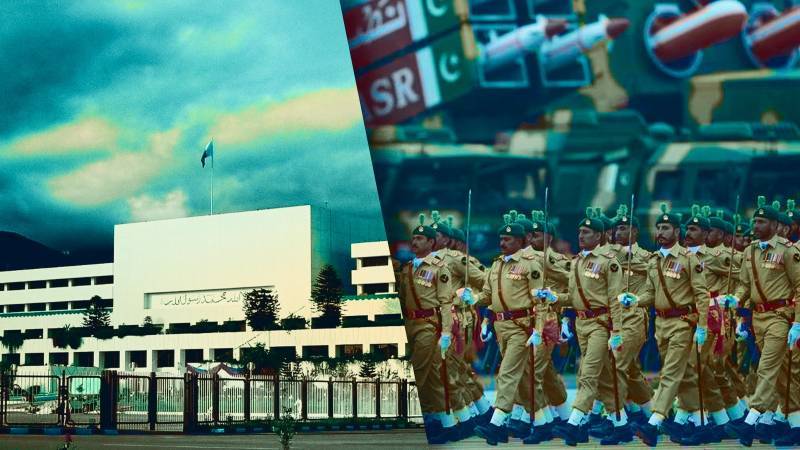
Pakistan’s history has been marred by a seemingly endless game of musical chairs between civilian, military and hybrid regimes. All different arrangements of power have remarkably produced similar outcomes. The endless cycle of experimentation with these arrangements of power have only led to familiar cycles of institutional conflict, policy discontinuity and economic crisis. It brings to mind often used definition of insanity: doing the same thing over and over again while expecting a different result. Perhaps Pakistan’s problem then, is not simply who occupies the chairs, but the game they are all playing.
After nearly eight decades, the recurrence of broadly similar outcomes under different regimes suggest that the problem may lie deeper than the type of regime. Military governments have promised stability and reform. Civilian governments have promised democracy and development. Hybrid arrangements have promised the supposed advantages of both. Yet Pakistan repeatedly returns to political confrontation, institutional interference, policy discontinuity, weak investment, fiscal stress and another search for a new political formula.
Game theory offers another way of understanding this puzzle. Developed in its modern form by mathematician John von Neumann and economist Oskar Morgenstern and later transformed by John Nash, game theory studies situations in which the outcome for one player depends not merely on what that player does, but on what others are expected to do. Its unsettling insight is that rational behaviour by individual actors can produce an outcome that is irrational for everyone collectively.
Pakistan increasingly looks like such a game. Consider its principal players: political parties and their leaders, the military establishment, civil bureaucracy, judiciary and lawyers, media, economic elites and, ultimately, citizens. Each has interests it seeks to protect, risks it tries to avoid and expectations about how the other players will behave. Political parties seek office and survival. Individual politicians worry that losing power could mean not merely opposition but prosecution, exclusion or political extinction. The military seeks national security, institutional autonomy and influence over areas it regards as strategically vital. Bureaucrats value career security and discretion. Judges protect judicial authority and independence. Media organizations need audiences, advertising, access and freedom to operate. Businesses seek profits and predictable rules but may also benefit from protection or preferential access. Citizens want security, prosperity, justice and public services but face enormous difficulties acting collectively.
The critical point is that none of these actors chooses its strategy independently. A political party contemplating institutional restraint must ask whether its opponents will show the same restraint and how may the military establishment react. The military considering withdrawal from politics must ask whether civilian leaders will govern effectively and respect what it regards as vital national security interests. Politicians considering an end to establishment patronage wonder whether their competitors will secretly continue seeking it. A bureaucrat contemplating resistance to political interference must calculate whether doing so will earn protection or an undesirable transfer. A media organization deciding how aggressively to challenge powerful interests must consider whether competitors willing to cooperate will gain access and commercial advantage.
As such, this begins to resemble the famous prisoner’s dilemma. Two players would both benefit from cooperation, but each fears that cooperating while the other defects will leave it worse off. Consequently, both defect and reach an outcome inferior to what cooperation could have produced. Pakistan’s political parties repeatedly face something similar. All major parties would benefit from credible elections, predictable transfers of power and institutions that cannot be weaponized against whichever party is temporarily out of office. Yet each party fears unilateral restraint. If one refrains from cultivating unelected power centres while its opponents do not, it may lose not merely an election but its ability to compete effectively. The rational short term response is therefore to preserve every available instrument of political advantage.
The result is paradoxical. Political leaders may denounce interference when excluded from power and tolerate or even welcome similar intervention when it advantages them. This need not be explained entirely by hypocrisy. It can also reflect rational adaptation to a political game in which the perceived cost of being the only player obeying informal restraints is very high. The civil-military relationship represents an even more consequential credible commitment problem. Civilian politicians may believe the military will never fully relinquish its political influence and therefore attempt to create countervailing power while they can. The military may believe political leaders cannot be trusted to safeguard stability, governance or national security interests and therefore retains the capacity to intervene. Each side's behaviour then validates the other's original suspicion. Civilian weakness appears to justify military influence, military influence inhibits civilian institutional development, weak civilian institutions then make future intervention appear necessary. Pakistan moves between civilian, military and hybrid arrangements without escaping the underlying game.
Civilian weakness appears to justify military influence; military influence inhibits civilian institutional development, weak civilian institutions then make future intervention appear necessary.
This is also Pakistan's institutional Catch 22. The military may be the only institution powerful and cohesive enough to help coordinate a move toward a different equilibrium, yet its disproportionate political role is itself one of the factors preventing such an equilibrium from emerging. If it uses its power simply to impose another political arrangement, it strengthens the existing game. Its potentially transformative role would be quite different in terms of helping establish rules that ultimately make extraordinary military political intervention unnecessary.
The civil bureaucracy faces another familiar game theoretic problem which is the principal-agent dilemma. Governments formally formulate policy while bureaucracies implement it, but civil servants possess institutional knowledge and control information and execution. A bureaucrat may understand perfectly what reform requires yet also know that ministers change, policies are reversed, governments fall and officials taking risks are not necessarily protected. In such an environment, delay, procedural caution and avoidance of personal responsibility may be rational career strategies even though collectively they create the execution deficit Pakistan has struggled with for decades.
Similar incentives affect the judiciary. When political disputes cannot be resolved through trusted political institutions, they migrate into the courts. Politicians increasingly ask judges to settle fundamentally political contests. Judicial decisions then affect the distribution of political power, encouraging politicians and other institutions to anticipate judicial behaviour. The judiciary becomes more politically consequential precisely because politics has become less capable of regulating itself. Lawyers, meanwhile, acquire additional influence as political struggles become legal struggles. Institutions begin substituting for one another rather than performing clearly bounded functions.
The media operates within incentives of its own. Journalism ideally rewards truth and scrutiny, but media organizations also compete for audiences, advertising, access and survival. Polarized societies reward emotionally committed audiences. Access journalism can become commercially useful. Challenging powerful actors can impose costs that competitors willing to cooperate may avoid. Again, behaviour that appears collectively harmful may remain individually rational under the existing incentive structure. Citizens present perhaps the greatest paradox. Collectively they are Pakistan’s strongest potential player, individually they are often its weakest. Tens of millions may desire better schools, taxation, justice, policing and economic opportunity, yet the benefit to any single citizen from organizing for these outcomes is small compared with the immediate personal cost. This is the classic collective-action problem. By contrast, a comparatively small group defending a particular tax exemption, subsidy, regulatory privilege or institutional interest has concentrated benefits and therefore powerful incentives to organize. Well organized minorities can consequently defeat an unorganized majority.
This helps explain Pakistan's political economy as well. Almost everyone agrees that the tax base should broaden. Yet every sector asks why it should surrender its concessions while others retain theirs. If one business pays all taxes while competitors evade them, the compliant firm may become less competitive. If one industry gives up protection while another retains tariffs or subsidies, the first bears the adjustment cost. The predictable response is not universal voluntary reform but lobbying for one's own exception. The state then taxes those easiest to tax, further encouraging everyone else to resist inclusion.
Business behaviour follows the same logic. Pakistan collectively needs firms to invest in technology, productivity, exports and human capital. But an individual company may obtain a higher and faster return by lobbying for tariff protection, cheap financing, preferential regulation or government contracts. If competitors engage in rent seeking, refusing to participate can place a firm at a disadvantage. Resources consequently shift from innovation toward influence. Private rationality generates public inefficiency.
Even Pakistan's recurring external crises contain a game-theoretic dimension. A country facing the full consequences of repeated economic mismanagement would eventually have overwhelming incentives to change course. Pakistan, however, occupies an unusually important geopolitical position and possesses nuclear weapons, relationships with China and Gulf states, a large diaspora and strategic significance to several major powers. At critical moments, combinations of IMF programmes, bilateral deposits, debt rollovers and external support have repeatedly created breathing space.
Such assistance has often been necessary and beneficial, but it can unintentionally alter domestic incentives. If political actors believe catastrophic collapse will probably be prevented, the expected penalty for delaying difficult structural reforms becomes smaller. Pakistan can then undertake enough adjustment to survive rather than enough transformation to escape the cycle. External actors are not causing Pakistan’s predicament rather their rational desire to avoid instability changes the payoff matrix confronting Pakistan’s domestic players.
Perhaps the most revealing feature of this system is that almost everybody can be dissatisfied with it and yet continue reproducing it. Politicians complain about the establishment. The establishment complains about politicians. Bureaucrats complain about political interference. Businesses complain about government. Citizens complain about everyone. Judges complain about executive encroachment, while executives complain about judicial activism. Yet the equilibrium persists because a stable equilibrium does not require participants to like it. It merely requires each to believe that changing strategy unilaterally would leave it worse off. This is close to what economists call a Nash equilibrium. Given the expected behaviour of everyone else, each major actor's existing strategy may appear individually defensible. Pakistan's tragedy is that the resulting equilibrium is collectively poor. This also explains why repeatedly changing the people at the top has accomplished less than Pakistan expected. The country has searched successively for transformative politicians, generals, judges, technocrats and administrators. But place different people inside essentially the same incentive system and their behaviour may converge. Good intentions matter, but systems eventually reward some behaviours and punish others. Pakistan therefore does not principally need better players. It needs to change the game.
The first requirement is to lower the cost of political defeat. In a functioning repeated political game, losing an election means becoming the opposition and having a credible opportunity to return later. If losing power instead threatens imprisonment, economic destruction, exclusion or political extinction, incumbents will fight desperately to avoid losing and opponents will seek extraordinary means to dislodge them. Making defeat survivable may therefore be among Pakistan's most important democratic and institutional reforms.
Second, major actors need simultaneous rather than unilateral commitments. Political parties cannot credibly disarm if they believe opponents retain access to extra-political instruments. Civilian leaders cannot build trust if they believe the military retains an unlimited political veto, while the military will hesitate to withdraw if it expects civilian institutions to behave unpredictably. A durable settlement therefore has to constrain all major players together.
Third, Pakistan must alter economic payoffs. Tax evasion must become more costly than compliance. Competition should offer higher returns than political protection. Bureaucratic advancement should depend more on performance than patronage. Independent regulators, transparent procurement, predictable taxation and enforceable contracts can transform behaviour without relying upon moral appeals.
Fourth, actions must become more observable. Game theory changes when players know cheating will be detected. Transparent election administration, public procurement, independent statistics, disclosure of government performance and measurable national indicators reduce information asymmetry and make accountability more credible.
Finally, Pakistan needs to lengthen everyone's time horizon. Stable institutions change behaviour because tomorrow becomes valuable. A political party that expects to compete again has more incentive to preserve institutions it may one day need while in opposition. A bureaucrat protected by professional rules can take longer term decisions. An investor confident that tax and regulatory regimes will persist can commit capital. A military confident that legitimate civilian institutions will protect national interests has less reason to hedge politically.
Pakistan's deepest political-economic problem may therefore be less mysterious than it appears. It is not that its major players are uniquely irrational. Quite the opposite, many may be behaving rationally within a badly designed game. The challenge is to create a new equilibrium in which politicians gain more from delivering than destroying opponents, the military gains institutional security from a stronger state rather than political management, bureaucrats advance through execution, judges gain authority through predictability, businesses prosper through competition, media succeeds through credibility and citizens gain enough confidence in institutions to participate rather than retreat into private survival. Pakistan has spent much of its history changing players while preserving the game. The next transformation must reverse that logic. Change the game, and eventually the players will change their behavior too.