

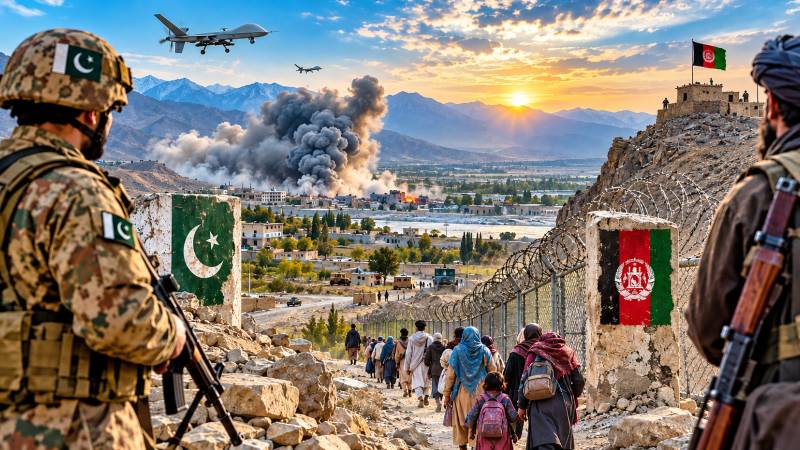
On September 24, Pakistan's Information Minister announced air and drone strikes on ten locations in Afghanistan. The statement carried a heading most readers will have passed over: Ghazab lil Haq. That is the name Pakistan gave to the operation it launched against the Afghan Taliban in February. Seven months later, after a hospital strike, several rounds of mediation and almost three months of calm, Pakistan is still announcing strikes under the same name, which tells you the operation never really ended.
The trigger this time was a bombing at a mosque in the Kohat Police Lines during Friday prayers, which killed at least 23 people, most of them policemen. Pakistan says drones were later launched at it from Afghan territory on September 23, and that its strikes the next day hit the sites used to launch and store them. Kabul says the strikes landed in Kandahar, Paktia and Khost and killed four civilians, and it has promised an appropriate response. On September 25, fighting was reported again along the border.
For Pakistan, the central issue is the continued attacks inside the country by militants it says are operating from Afghan territory. For Afghanistan's Taliban authorities, the issue is sovereignty and the rejection of Pakistani military action inside Afghanistan. Between these two positions are thousands of families living on both sides of the border who have little influence over the decisions being taken in Islamabad and Kabul but carry much of the cost when those decisions fail.
This is not the conflict I was analyzing in 2016. At that time, Afghanistan was still in the middle of an internationalized internal conflict between the Afghan government and the Taliban insurgency. At the University of Sydney's Centre for Peace and Conflict Studies, I proposed an Interactive Conflict Resolution process that would bring representatives of the opposing sides into a neutral setting and work through the interests and needs behind the conflict.
The Taliban's return to Kabul in August 2021 changed the entire structure of that conflict. The Taliban were no longer an insurgency fighting the Afghan government. They became the governing authority of Afghanistan. At the same time, the Tehreek-e-Taliban Pakistan, or TTP, became more active from bases and networks on the Afghan side of the border. Pakistan argues that the Afghan authorities have allowed the TTP to operate from their territory. The Afghan authorities reject the accusation and have repeatedly objected to Pakistani strikes as violations of their sovereignty. Both sides have a point that the other side cannot simply wish away.
Pakistan has suffered heavily from militant violence. According to the Global Terrorism Index released this week, the TTP carried out 595 attacks in Pakistan in 2025 and killed 637 people, its highest annual toll since 2011. More than 400 of those killed were soldiers and policemen. This is why Islamabad continues to place militant sanctuaries at the centre of its policy towards Afghanistan.
Afghanistan sees Pakistani airstrikes very differently. From Kabul's perspective, the presence of militants cannot give another state an unlimited right to conduct military operations inside Afghan territory. Afghan officials have consistently described Pakistani strikes as aggression. This is where the dispute becomes more complicated than a question of who is right. In conflict resolution, the distinction between a position and an underlying need is important. A position is what a party says it wants. An underlying need is what it believes it must have in order to feel secure.
Pakistan's position is clear: the TTP must stop attacking Pakistan, and Afghan territory must not be used for attacks against Pakistan. Beneath that position is a very basic requirement: security for Pakistani citizens, especially those living in Khyber Pakhtunkhwa and the former tribal areas. Afghanistan's position is equally clear: its sovereignty must be respected and Pakistani forces must not strike inside the country. Beneath that position are concerns about national dignity, internal control and the survival of the Taliban's own governing arrangement.
The armed groups add another layer. It is tempting to describe the TTP simply as an Afghan Taliban proxy. That is too simple. The two movements share an ideological background and had close relations during the war against the United States and NATO, but they are separate organisations with separate leadership and different political objectives. The TTP's fight is with the Pakistani state. The Afghan Taliban, having taken control of Afghanistan, have their own interest in maintaining authority inside the country and avoiding another internal war.
This creates a difficult problem for Kabul. Any serious confrontation with the TTP could cause defections or push militants towards Islamic State-Khorasan Province, which is itself a serious threat to the Taliban authorities. Refusing to deal with the TTP leaves Pakistan facing attacks that it says originate from Afghan territory. And the TTP is not the only group. The Kohat bombing was claimed by Ittihadul Mujahideen Pakistan, led by Hafiz Gul Bahadur, who is also based in Afghanistan. An agreement between two governments cannot automatically control every armed group operating across the border. The militant problem requires a separate track.
The history of the region also matters. The border between Pakistan and Afghanistan has never been merely a line on a map. Families, tribes, languages, trade routes and political relationships have existed across it for generations. The Durand Line has remained politically sensitive in Afghanistan, while Pakistan has increasingly fenced and militarised the frontier in response to its security concerns. For someone sitting in Islamabad or Kabul, the border can be discussed as a matter of sovereignty and security. For someone living near it, the border is also about whether a person can reach a market, visit relatives, cross for medical treatment or continue a trade that may have existed for decades. Border communities are too often treated as a security problem rather than as part of the solution.
There is also a governance gap on our side of the line. The former tribal areas were merged into Khyber Pakhtunkhwa in 2018 with the promise of regular courts, police, local government and development funds. Much of that has arrived late or only in part. Where the state arrives late, armed groups find it easier to recruit and to present themselves as the only authority people can reach. No agreement with Kabul will fix that. It has to be fixed in Peshawar and Islamabad.
Pakistan and Afghanistan continue to cycle between ceasefires and confrontation because diplomacy lacks a durable mechanism to address cross-border militancy, sovereignty concerns, and the competing security needs of both sides.
My earlier work drew heavily on John Burton's theory of basic human needs, Edward Azar's work on protracted social conflict and John Paul Lederach's emphasis on local ownership. Burton argued that conflicts become difficult to resolve when needs such as security, identity and recognition are denied. Azar showed how long-running conflicts grow out of the interaction between community grievances, state structures and regional politics. Lederach stressed that peace cannot be built only by political leaders sitting at the top. The relevance of these ideas has grown with the present conflict.
Look at Pakistan and Afghanistan through that lens and the problem becomes easier to understand. There is a state-to-state conflict between Islamabad and Kabul. There is a security conflict involving the TTP and other militant organisations. There is a border conflict involving communities whose lives are directly affected by military operations, border closures and restrictions on movement. There is an economic dimension involving transit trade, cross-border commerce and connectivity. And there is a regional dimension involving China, Qatar, Türkiye, Saudi Arabia and Iran. Trying to solve all of these through meetings between senior officials is unlikely to be enough.
There has been no shortage of mediation. Qatar and Türkiye helped broker a ceasefire in October 2025. Saudi Arabia later joined the effort. China brought both sides to Urumqi for talks in April this year. Throughout, Pakistan has said that progress depends on verifiable action by Kabul against groups using Afghan soil, and this week's statement repeated that demand. Yet the pattern is familiar. Violence decreases, discussions take place, an understanding is reached, and then another attack or disputed incident brings the relationship back to confrontation. The problem is not the absence of diplomacy. It is the absence of a mechanism capable of dealing with the different parts of the conflict at the same time. In public policy I have called this the gap between policy and action. Diplomacy suffers from the same gap. Ceasefires and understandings are announced, but no institution is given the job of carrying them through the next bad week.
The first track has to remain state to state. Pakistan and the Afghan authorities need a reliable channel for de-escalation, border incidents and verification. If every incident is immediately followed by competing claims, denials and retaliation, the space for diplomacy disappears.
The strike on the Omid drug rehabilitation hospital in Kabul on March 16 shows why verification matters. The Afghan authorities put the dead at more than 400. The UN Assistance Mission in Afghanistan verified at least 269. Human Rights Watch reported at least 143. Pakistan's military spokesman said the aircraft had hit an ammunition depot. One incident produced four accounts, and there was no trusted body to establish which was true. A practical first step would be a joint incident cell with observers from the states already mediating, China, Qatar and Türkiye, working alongside UNAMA, which already documents cross-border civilian casualties under its Security Council mandate. This would not solve the political dispute, but it could stop disputed incidents from automatically becoming the next military escalation.
The second track should deal specifically with the militants. This does not mean negotiating away Pakistan's security concerns. It means recognising that the TTP and groups like it are actors in their own right. Any serious framework would need to distinguish between commanders who remain committed to violence and lower-level fighters whose motivations may include displacement, marginalisation, local grievances or lack of political voice. Other conflicts have used disarmament, demobilisation and reintegration programmes for precisely this reason.
The third track should involve communities along the border. The jirga remains an important institution in Pashtun society, especially for resolving disputes through consensus. It would be unrealistic to expect traditional institutions to solve a conflict involving states, armed groups and regional powers. It would be equally unrealistic to ignore institutions that have historically helped communities settle disputes. People living in the border areas know things that officials hundreds of kilometres away often do not. They know how people move across the border and what a closure does to a household. They also know which local relationships calm tension and which inflame it. They should not be invited simply to endorse decisions already made elsewhere. They should have a real say.
China can also do more than host meetings. It has economic interests in both countries, including connectivity and regional stability. Its economic relationship with Pakistan gives it a different kind of leverage from Qatar or Türkiye, while its relations with Kabul give it another channel of communication.
What is needed is a system in which the next attack does not automatically produce the next war. Another document announcing peace will not do that. It requires both sides to recognise that the other has security concerns that cannot simply be dismissed. Pakistan cannot be expected to ignore attacks on its citizens. Afghanistan cannot be expected to accept repeated military strikes on its territory as a permanent arrangement. Neither side has to accept the other's entire narrative, but both have to understand the other's minimum requirements.
The alternative is already visible. In March, the fighting reached Kabul, and by early April close to 100,000 people had been displaced. Now, after a period of relative calm, the cycle has started again. Retaliation can explain the next strike. It cannot explain how the cycle ends. The conflict I studied in 2016 changed when the Taliban returned to power in 2021. It has changed again with the escalation of 2025 and 2026. The lesson from conflict resolution theory is not that one side is right and the other is wrong. It is that a conflict with several actors, several grievances and several levels cannot be solved at only one level. The border may be where the fighting is taking place. It is not where the conflict begins, and it is certainly not where it will end.