

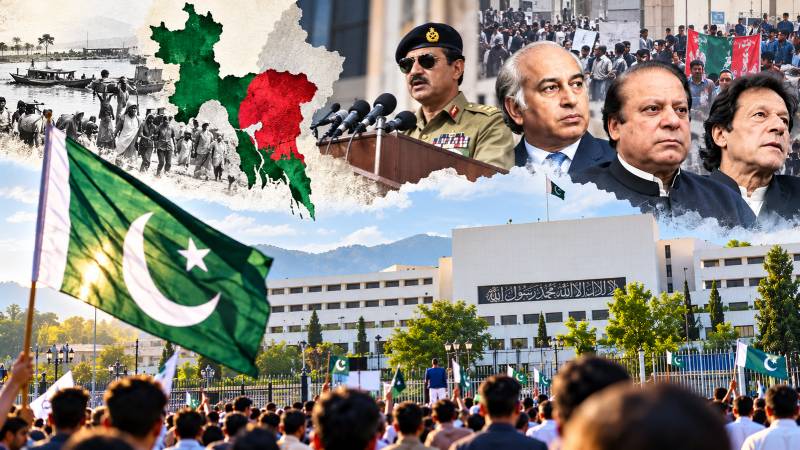
Elections offer a peaceful way to correct a political crisis. But what happens when a country fails to use that opportunity?Pakistan’s political history offers a painful lesson. When political conflict reaches an extreme, elections provide an opportunity to correct the country’s course. They do not solve every problem, but they allow people to change their government, settle political disputes peacefully, and restore public trust. They offer a chance to learn from past mistakes and build a better political system.
The problem is that Pakistan has repeatedly failed to use these opportunities. Governments have changed, elections have been held, and the Constitution has been amended, yet many of the same conflicts return. The question is why we fail to turn political crises into opportunities for improvement. The clearest example is East Pakistan. In the 1970 general election, the Awami League won an overall majority in the National Assembly. The electoral mandate should have led to the transfer of power. Instead, political negotiations failed, military action followed, and East Pakistan became Bangladesh in 1971.
The separation had several causes, including political exclusion, disputes over autonomy, economic grievances, and the use of force. Yet the central lesson remains: the people had spoken through their votes, but their choice was not translated into political power. The failure to accommodate a democratic mandate contributed to a tragedy that divided the country. Pakistan received another opportunity after General Zia-ul-Haq’s death in 1988. Elections returned, but the period until 1999 was marked by repeated changes of government and conflict between the PPP, PML-N, and other centres of power. Elections continued, yet stable constitutional government remained difficult to establish. In 1999, another military takeover interrupted the political process.
The crisis of 2007 and the elections of 2008 offered another opening. Constitutional reforms, particularly the Eighteenth Amendment, strengthened parliamentary government and provincial autonomy. These were real gains. However, the struggle over political authority and the limits of state power remained unresolved. The system had improved in some respects, but it had not fully learned how to manage political disagreement.
A recurring feature of this history is the treatment of major political opponents. The Awami League was not accommodated despite its majority. The PPP faced repeated confrontations with the state, while Nawaz Sharif and the PML-N faced military rule in 1999. Imran Khan’s removal from office in 2022 was followed by further political conflict, restrictions on political activity, and disputes over the February 2024 elections. These cases are not identical, and each must be judged on its own facts. Political parties are not above the law. But a serious question remains: can democracy become stable if weakening or excluding major political opponents repeatedly becomes part of the political process?
A party may lose power, but its supporters do not disappear. When a large section of the population feels politically excluded, the conflict continues beyond election day. The numerical strength of a political movement matters because its exclusion may affect millions of citizens. The Awami League’s victory in 1970 gave it an overall majority in the National Assembly. In 2024, PTI-backed independent candidates won the largest number of directly elected National Assembly seats, although they did not secure an outright majority. The situations are different, and their outcomes need not be the same. Yet both raise an important question: what happens when a political force with substantial public support is not effectively accommodated within the constitutional system?
Democracy improves when political opponents can compete peacefully, governments accept criticism, and institutions respect constitutional boundaries.
The danger becomes greater when the state fails to distinguish between a political opponent, a critic of the government, and an enemy of the state. Not every critic supports PTI, and not every PTI supporter opposes the state. Citizens may disagree with the government for many reasons. They remain members of the same political community. This is where the present situation differs from 1971. East Pakistan was a separate geographical wing. Today, political conflict exists within an integrated country. There is no territorial line separating supporters of the government from its critics. If the state treats political disagreement as hostility, it risks alienating the very people it is supposed to serve.
The state must protect dissent while dealing with actual offences through lawful procedures. The government is temporary, but the state is enduring. Its responsibility is to all citizens, not merely those who support the ruling party. The February 2024 election offered another opportunity to rebuild political trust and restore constitutional stability. Elections alone could not solve Pakistan’s economic and social problems, but they could have started a process of improvement. That process requires more than forming a government. It requires respect for political representation, meaningful dialogue, and confidence that votes can influence who governs.
The most important question is whether we have evolved. Have we become better at respecting electoral mandates, protecting dissent, and keeping state institutions within constitutional limits? Or have we simply moved from one crisis to another without correcting the habits that produce them? An election is not a complete reset. It is the beginning of a process. Democracy improves when political opponents can compete peacefully, governments accept criticism, and institutions respect constitutional boundaries. If these opportunities are wasted, unresolved tensions may grow until the eventual correction becomes far more painful and difficult to control.
The lesson of 1971 is not that every political crisis will end in territorial separation. It is that the refusal to resolve political disputes through constitutional means can produce consequences far beyond those originally expected. The strength of a state is not measured only by its ability to control its opponents, but also by its ability to accommodate them within the Constitution. Pakistan does not need every election to solve everything. It needs each election to move the country closer to constitutional stability, public trust, and democratic maturity. The question is simple: are we learning from our history, or merely repeating it?