

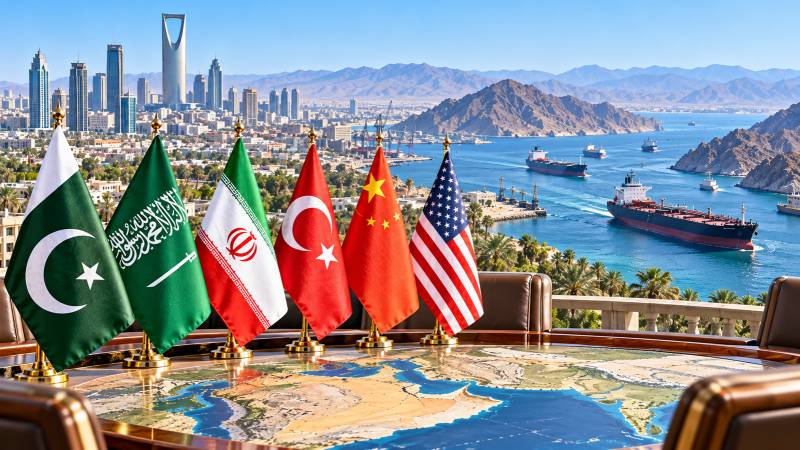
Pakistan has worked feverishly to contain a regional crisis that threatens not only the Middle East but also Pakistan’s economic interests, energy security and domestic cohesion. Its efforts to facilitate a US-Iran understanding, and its participation in the Mecca Joint Defence Agreement with Saudi Arabia and Turkey, demonstrate diplomatic energy and regional ambition. Both efforts have merit. But Pakistan can and must do better. The world needs it.
The US-Iran memorandum showed both the value and the limits of crisis diplomacy. It created space for a pause and set out a framework for further talks. Yet its central questions, sanctions, Iran’s nuclear programme, the regional military balance and guarantees of implementation, remained unresolved. A memorandum can postpone conflict; it cannot by itself settle the political differences that caused it.
A durable agreement requires more than skilful mediation. It requires a credible destination that both sides can see, however difficult the path towards it may be. With the destination unknown and difficult to visualize, the MOU was bound to fail. The Mecca agreement raises a similar question. Pakistan, Saudi Arabia and Turkey have described it as defensive. But regional security arrangements must be judged not only by what they say, but also by how they are perceived.
Pakistan’s opportunity to shape a durable Gulf security order lies in bridging Saudi-Iranian differences, fostering non-aggression and regional cooperation, and building an inclusive framework with China’s support and constructive US engagement.
If Iran views the agreement as another effort to encircle it, the pact may reinforce the very insecurity it seeks to address. If it is seen instead as an arrangement that can eventually become more inclusive, one based on non-aggression, respect for sovereignty and protection of civilian life, it could become the beginning of a different regional order. This is where Pakistan has an opportunity that few other countries possess.
Pakistan has close and longstanding ties with Saudi Arabia. It also has close ties with Iran and a compelling interest in stable relations with it. It has a relationship with China that is deeper than those of most states in the Muslim world. And it has demonstrated, through recent diplomacy, that it can communicate with Washington without allowing its regional policy to become an extension of any outside power’s agenda.
Pakistan should use these advantages to advance a more ambitious objective: a Saudi-Iran understanding that makes peaceful dispute resolution the organising principle of Gulf security. This does not mean pretending that Saudi-Iran differences are trivial. They involve legitimate and difficult questions: security in the Gulf, attacks on critical infrastructure, the conduct of armed groups, Yemen, maritime security, and the role of outside militaries. These differences are not beyond diplomacy. The alternative, a region permanently organised around rival alliances, proxy conflict and external military guarantees, is ruinously expensive and inherently unstable as we have now seen.
Pakistan should therefore propose a phased regional security initiative. Its first aim should be a direct Saudi-Iran commitment to refrain from attacking each other’s territory, energy facilities, ports and civilian infrastructure. Second, both countries should establish a permanent mechanism for dialogue and crisis management, able to address incidents before they become retaliatory cycles. Third, they should work with other Gulf states on guarantees for the safety of commercial shipping and the uninterrupted movement of energy through the Strait of Hormuz.
The longer-term aim should be to open the Mecca security arrangement to Iran as a participant in a broader compact whose central purpose is collective security. Such an evolution would be transformative. Iran would gain a recognised place in a regional order rather than see itself defined only as its target. Saudi Arabia would gain security based increasingly on binding regional commitments rather than fear and permanent dependence on external protection. The Gulf states would gain a stake in a framework that protects trade, infrastructure and development. Pakistan would gain a constructive role worthy of its history, geography and relationships.
China can help. Its value lies as a major purchaser of Gulf energy, an economic partner of Iran and Saudi Arabia, and a country with an interest in secure sea lanes and regional stability. It can be a convenor, an economic stakeholder and a supporter of implementation. The United States, too, has a role to play. It remains central to the conflict, to sanctions policy and to maritime security. But it should be kept engaged as part of a settlement, not allowed to be the author of the region’s security order. A stable Gulf cannot be built against the United States; nor can it be built around its military presence and pressure.
Pakistan’s real achievement would be to help Saudi Arabia and Iran replace mutual fear with binding rules of coexistence. That is the shift Pakistan should make: from crisis mediator to architect of regional security; a Saudi–Iran pledge to resolve disputes peacefully, followed by Iran’s inclusion in an expanded Mecca security framework. That would address one of the region’s most consequential fault lines and offer Pakistan a more constructive geopolitical role than any short-lived diplomatic breakthrough can provide.