

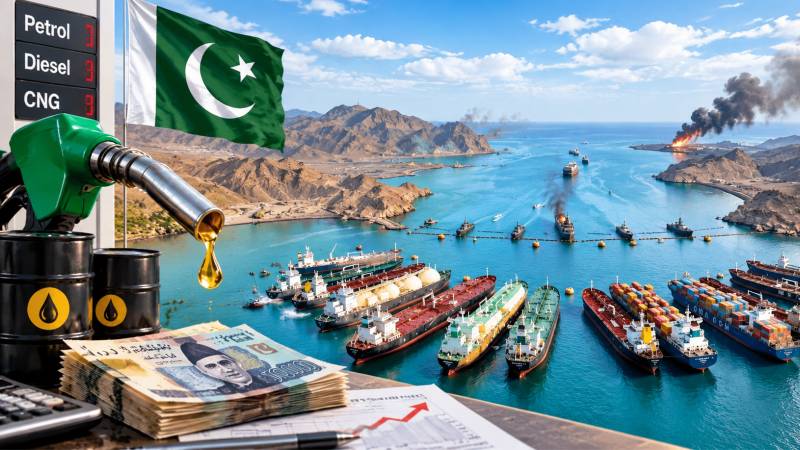
Look at the screen long enough, and the numbers stop being prices. They become a verdict. Murban near 120 dollars, Urals at 121, the China marker at 122, Dated Brent scraping 126. WTI sits at 100, Brent at 103. The gap between those two sets of figures is not market noise. It is the premium the world now pays for the fact that the United States and Iran have turned the Strait of Hormuz into a contested killing ground. Every barrel that still leaves the Gulf carries a war tax. Every barrel that cannot leave forces the rest of the planet to improvise.
This is not a temporary spike. It is a structural rupture. Six months into a conflict that was supposed to be short and decisive, the waterway that once moved a fifth of global oil remains partially closed, intermittently mined, and permanently expensive. Saudi pipelines have been hit. Ship-to-ship transfers off Oman have become routine. Insurance rates have rewritten the economics of every voyage. The result is a two-speed market: American crude trades at a relative discount because it never has to run the gauntlet; Middle Eastern grades trade at a premium because they do. That spread is the purest expression of the new reality. Geography has reasserted itself with a vengeance.
The next three months will not bring relief. If the current pattern of strikes, partial reopening and diplomatic theatre continues, Brent will average between 105 and 118 dollars through the fourth quarter. Dated Brent and Gulf grades will spike higher whenever a convoy is delayed, or another piece of infrastructure is damaged. A sharper escalation, sustained mining, another major attack on Saudi facilities, or a direct Iranian response that forces more tankers to stay in port could push the complex past 130 for days or weeks. A genuine diplomatic breakthrough that restores even two-thirds of pre-war flows would pull prices back toward the mid-90s by early 2027. Neither path is certain. What is certain is that volatility itself has become the baseline. Freight, insurance and opportunity cost now form a larger share of the landed price than the crude itself.
The world outside the Gulf is already adjusting in its own uneven ways. Europe is paying up for Atlantic Basin barrels and watching diesel margins tighten. India is chasing Russian cargoes that sometimes now arrive at a premium to Brent on a delivered basis, a quiet humiliation for a country that once counted on discounted Urals. China’s stockpiles give it more room, yet even Beijing feels the freight premium on every Middle Eastern cargo that still docks. The poorer importers have no such buffers. For them, the arithmetic is simple and brutal. Every ten-dollar rise in the barrel adds hundreds of millions to the annual import bill, drains reserves, and forces governments into the choice between fiscal collapse and street anger.
The real danger is not today’s oil price spike, but the coming months when delayed cargoes, rising insurance costs and shrinking reserves could turn an energy shock into an economic crisis.
Pakistan sits at the sharpest edge of that choice. The country was built on the quiet assumption that the Gulf would always deliver. Four-fifths of its crude and product imports once moved through Hormuz or the Red Sea. Domestic production covers only a thin slice of demand. Refineries run hard yet still leave the country short of petrol and diesel, so finished product must be bought on the spot market at Gulf or Singapore prices plus the full war-risk surcharge. The result is already visible: petrol near 390 rupees a litre, diesel higher. Transport costs feed into food prices. Factories shrink margins. The informal economy that keeps cities moving begins to ration its own mobility.
Looking outward, the real danger is not the present price. It is November and December. Current stocks sit above the regulatory minimum of twenty days, but that cushion disappears quickly when cargoes are delayed or diverted. October crude is largely covered. November is not. The Red Sea route is unreliable. Yanbu loadings carry extra risk. Ship-to-ship transfers are stopgaps, not strategy. If Pakistan is forced to chase barrels from farther afield Singapore, the Mediterranean, or American crude via very large carriers that cannot berth at existing ports, the landed cost rises another five to eight dollars simply in logistics. That is the fuel storm that is already forming on the horizon.
The regional consequences are equally stark. A prolonged high-price regime will deepen the split between energy exporters and energy importers across South Asia and the Middle East. Gulf States will recycle petrodollars into buffers and influence. Pakistan, Bangladesh and others will bleed reserves and accumulate debt. Inflation differentials will widen. Exchange rates will come under pressure. Political stability in the more fragile states will be tested by the simple fact that the cost of moving people and goods has become unaffordable for large parts of the population.
What must Pakistan do? Treat this as a logistics and balance-of-payments emergency, not a temporary price problem. Secure November and December cargoes now, even at a premium. Expand the supplier list beyond the traditional Gulf circle: Russian and Central Asian barrels, American crude via ship-to-ship arrangements, longer-term contracts with non-Gulf producers. The ports and the State Bank must coordinate financing lines with unusual speed. Bureaucratic delay is now a national security risk. Demand management cannot remain a slogan. Targeted fuel quotas for commercial transport, accelerated conversion of public fleets where domestic gas allows, and strict enforcement of efficiency standards in industry will stretch existing stocks further than any subsidy. The recent relief package for motorcycles and small cars is politically necessary but fiscally fragile. It must be ring-fenced and time-bound.
The fiscal and monetary authorities have to speak with one voice. Every dollar spent on imported fuel is a dollar not available for debt or development. The State Bank’s foreign-exchange regime must continue to prioritise energy without starving the rest of the economy. At the same time, the government should accelerate the already-planned expansion of domestic gas and renewables so that the power sector’s dependence on imported LNG and furnace oil declines measurably by next summer. These are not glamorous projects. They are the only durable insurance against the next geopolitical shock.
Finally, diplomacy must match the economics. Pakistan’s voice in regional forums should push for safer maritime corridors and collective purchasing arrangements among South Asian importers. Silence or vague statements of concern will not lower the price of a single barrel. The noose around Hormuz is already tightening. The difference between weathering the coming months and being broken by them will be measured in the cold calculations of cargoes booked, stocks conserved, and political courage expended before the year ends. The rest of the world will adjust in its own uneven way. Pakistan has less margin for error and even less time to waste.