

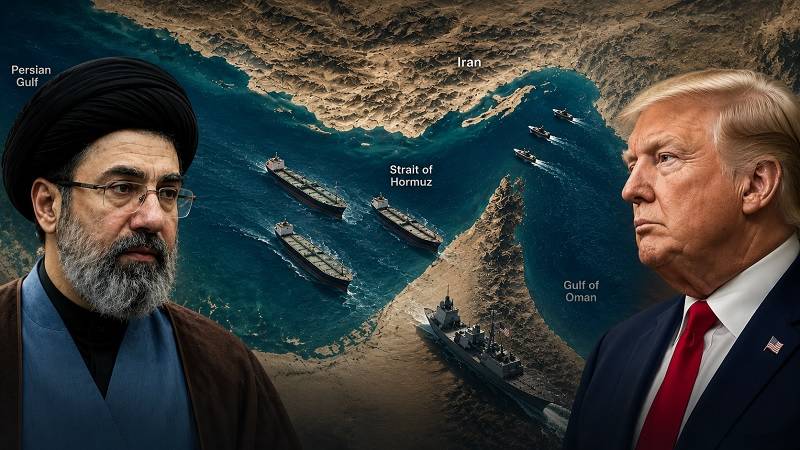
On July 6, Iran’s IRGC Navy targeted three commercial ships sailing under US protection through Omani waters, what is called the southern route or safe route to use CENTCOM’s terminology. The shots were meant to disable the engine function, not to sink the vessels.
The US retaliated the next day by launching a wave of airstrikes against Iranian missile launch sites, coastal radars, and other military assets.
On July 8, while speaking to the media at the NATO summit in Ankara, US President Donald Trump declared that the ceasefire and the MoU were “over”. Predictably, Iran continues to retaliate to US strikes and the situation has since escalated.
Despite the ongoing attacks and counter attacks, neither side has so far formally annulled the MoU. On July 13, Iran’s Foreign Ministry announced that it is suspending its obligations under the MoU, ruling out upcoming rounds of talks. Iran says the memorandum has entered a “crisis phase” but has framed the refusal to comply as a reaction to US violations rather than a formal, permanent termination of the framework itself.
On the US side, Trump has stated that while he personally views dealing with Iran a “waste of time,” he is allowing his diplomatic team to continue talking if they wish. The US State Department and other officials told Al Jazeera that Washington remains formally committed to finding a permanent peace agreement and exploring technical-level discussions.
How does one unpack this situation? Many analysts put the blame for this round of fighting on Iran. Some, including in Pakistan, have argued that Iran should have looked at sanctions relief rather than insisting on controlling the Strait. Others have spoken about the illegality of collecting tolls. Still others blame Iran for being intransigent and point to hardline elements within the IRGC who want to upstage the moderates and were not happy with the MoU.
These analyses miss the point and suffer from a framing bias, which then leads to a flawed causal chain. Put differently, the analyses adopt a geopolitical frame that views the US Navy as a default, passive guarantor of global commons — securing safe passage for ships through the Strait — which blinds them to how that action will act as a catalyst in regional escalation in this case.
To make it clearer, these formulations suffer from both a methodological and an analytical problem. By starting the timeline only at the moment Iran fired at the ships, they exclude the compounding variable (the US naval escort deployment). With this boundary setting, they choose to analyse the “action” (the attack) while systematically omitting the “antecedent” (the escort policy). A proper methodology would require mapping all structural inputs that led to the event — i.e., Iran shooting at commercial ships taking the southern route.
This leads to lack of operational empathy — i.e., understanding how an adversary perceives your actions. When analysts treat US escorting of ships as a neutral act rather than a provocative, forward military posture in Iran’s backyard, they falter. A robust analysis cannot be linear; it must be dialectical and recognise the security dilemma where US projection of power and Iran’s encirclement anxieties constantly feed into each other.
To bring it full circle, the real question to ask is this: why does Iran want to control the Strait and why does the US want to deny Iran that control. The MoU’s clause 5 is clear in its wording (by the way, talk about the MoU being loosely-worded is just that, post-facto talk):
“Upon the signing of this MoU, the Islamic Republic of Iran will make arrangements using its best efforts for the safe passage of commercial vessels, with no charge for 60 days only, from the Persian Gulf to the Sea of Oman, and vice versa. The traffic of commercial vessels will immediately start, and considering the need for removing the technical and military obstacles, and de-mining by the Islamic Republic of Iran, will be instated within 30 days. The Islamic Republic of Iran will conduct dialogue with the Sultanate of Oman, to define the future administration and maritime services in the Strait of Hormuz, in discussions with other Persian Gulf Littoral States, in line with applicable international law and the sovereign rights of coastal states of the Strait of Hormuz."
There are three points here, two in bold letters and the third in italics: Iran will make arrangements, with no charge for 60 days from the Persian Gulf to the Sea of Oman and vice versa. Iran will conduct dialogue with Oman to define the future administration and maritime services in the Strait; any such arrangement will be in line with applicable International Law and the sovereign rights of coastal states.
The first clearly states that Iran will make arrangements (not the US); first 60 days will be free. This links up with the second point: “to define the future administration and maritime services” in consultation with Oman. Implication: beyond sixty days, Iran and Oman will figure out the administration and maritime services. Corollary: after sixty days, there will be a fee and the routes will be coordinated with Oman and Iran.
The after-thought that the clause does not refer to any particular route and therefore the US Navy can escort ships through the southern route is shystering. The US is clearly attempting to dilute Iran’s control in violation of what MoU’s relevant clause states. Whether one applies the principle of effectiveness or the doctrine of implied powers, when an express power or duty is given, the law implies the concurrent assignment of the necessary powers to execute it. The post-facto interpretation by the US contravenes the principle of good faith.
But let’s move on to what’s really at stake.
Iran has discovered control of the Strait as its trump. Operationally speaking, the IRGC had been preparing for this for a long time. But the real test of plans and training comes in a hot war. Iran found that it could when the storm of steel came, to use Ernst Junger’s term. Trump has discovered that he has a rag if he doesn’t control the Strait or allows Iran to continue to exercise that control. This is where analysts get the issue of fees wrong. Iran knows that collecting fees is not going to fill its coffers. It’s not about money. It’s about sovereignty. Sovereign control translates in equal measure in the ability of Iran to not just raise the cost-asymmetry for the US, which is crucial, but to deny the US Navy free access to and fro from its 5th Fleet Headquarters in Manama and more generally in the Gulf.
In other words, Iran’s strategy is geared towards both the immediate and the longer-term: the immediate requires the capability to raise the cost of war for the US, directly and indirectly, by choking off shipping in and out of the Strait; the longer-term is about forcing the US out of Iran’s vicinity. Iran’s attacks on US bases in the Gulf are also part of this strategy. Force the Gulf states to realise the dilemma: US presence and bases do not protect them; they make them a target. They can either choose to court the US or diversify peacefully their oil-based economies through investment in tourism, aviation, AI and technology, logistics and renewables. The UAE is particularly vulnerable because of its near-absolute structural dependence on foreign expertise and massive foreign investment.
A compromise formula, as part of the MoU, was being deliberated and Iran was in consultation with Oman. Trump wasn’t happy and just before the signing of the MoU, on May 27, even threatened Oman. After the MoU, the formula was being discussed but a final agreement was delayed because of Ali Khamenei’s funeral. Reports suggest that it envisaged coordination by the ships with both Iran and a GCC-designated state, Oman, to sail in and out of the Strait. This was meant to take care of the third point in Clause 5 about “sovereign rights of coastal states.”
The US took advantaged of the funeral and began inducing ships to take the southern route where it rides shotgun. It has also pressured Oman into stating that Muscat is not in favour of any fees. [NB: Trump said the US would charge 20%, essentially corroborating the idea of fees! He has since walked back on it.]
Iran’s strategic objectives are therefore completely in conflict with the US’. That is the basis for what’s happening. The question is, would this round of escalation get out of hand or would the two sides return to the table. The US Strategic Petroleum Reserve is at an historic low as a result of significant drawdowns to manage global energy markets in response to the war in Ukraine and ongoing tensions with Iran. Renewed outbreak of military conflict threatens to plunge the vital waterway back into a severe transit crisis.
And this time China is unlikely to help the US. If the crisis escalates into a prolonged conflict, China’s ability and willingness to keep suppressing its domestic demand to shield Western markets from a total price explosion will have reached a critical breaking point.
Iran too needs reprieve. While it has shown the ability to take and absorb pain, it nonetheless wants to exploit the gains it has accumulated at a very high cost. To use Zartman’s framework, further escalation will push the two sides to a mutually hurting stalemate. Whether they can find a mutually enticing opportunity remains iffy.
The essential point in all this is — and I have consistently argued this point — that this is a long war with its many battles and crests and troughs. Even if the two sides reach an uneasy modus vivendi, the structural causes of war will not go away. Iran knows this. But it also knows that to prepare for the next rounds, it needs fiscal relief from sanctions and an interregnum in which it can recoup its losses and establish itself as the dominant power in the region.