

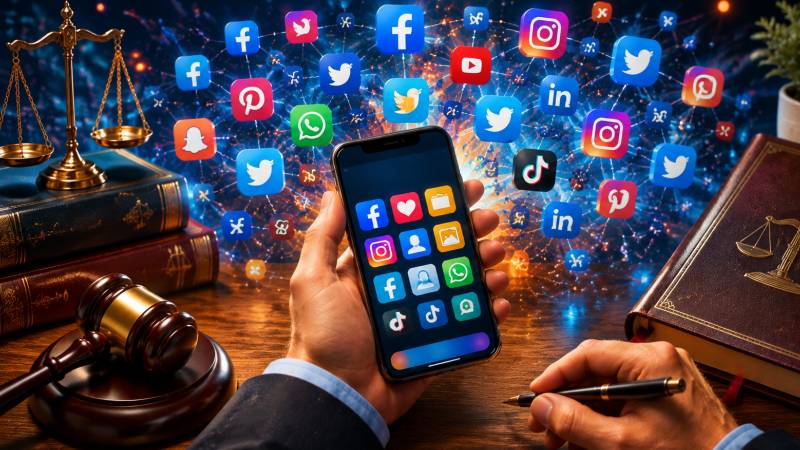
We live in a society where a single post can either allow you freedom or suppress that very freedom. Freedom of expression in the age of social media has become a big question mark over whether social media actually allows everyone to express themselves freely, or whether it only protects some people's freedom of expression. The ideology of a post and the culture of sharing everything in your life and your opinions have become this new trend where people can share almost anything. We post what we eat, where we go, what we believe, what we like, and what we dislike. There is a trend that, whatever everyone believes, we should believe too. A thought that was disputed as quickly as it was spoken can now reach thousands of people within minutes. Social media has transformed expression from something largely private and limited to a small audience into a permanent, performative part of public life. But this raises an uncomfortable question. When does a post stop becoming an expression of opinion and become something the law should restrict?
Freedom of expression is not merely the freedom to say things that everyone agrees with. It is the ability to actually provide viewpoints that protect disagreement, criticism, and unpopular opinions. In a democratic society, the ability to question those in power is essential. A person without access to a newspaper, television channel, or political platform can now just directly speak to an audience and voice their opinions. That is one of the most positive aspects of the digital age. Social media has allowed people to bring attention to issues that might otherwise have been ignored or shunned; a video can now expose an injustice. A post can now draw attention to a missing person. A campaign can turn an issue that was once invisible into a national conversation. For many people, the internet has not weakened their voice. Rather, it has given them one.
Yet, the same technology that gives people a voice can also amplify harm. The culture of constantly updating everyone about our lives has changed our understanding of privacy and responsibility. We no longer simply communicate with friends. We often communicate with an invisible audience whose size we cannot even predict. A personal accusation can now become public. A rumor can become fact if the majority agrees with it or through repetition. A moment of anger can remain online long after the emotion has disappeared. This leads the law to face a very difficult task. It must distinguish between speech that is merely controversial and speech that actually causes harm. Pakistan's recent debate over online regulation demonstrated just how difficult that balance can be.
A person should not be able to hide behind a screen and assume that their lack of physical presence means that their actions have no consequences.
The Prevention of Electronic Crimes Act, 2016, as amended by the Prevention of Electronic Crimes (Amendment) Act, 2025, introduced Section 26-A, which criminalises the intentional dissemination of false or fake information likely to cause fear, panic, disorder or unrest, carrying a possible sentence of up to three years. A recent example is the case of human rights lawyer Imaan Mazari and her husband, who were sentenced by an Islamabad court in January 2026 over social media posts on X, under several provisions of PECA. The case raises an important question about where the law should draw the line between legitimate criticism of the state and online speech that can be considered unlawful. That leads us to the question of whether freedom of expression actually exists in this country.
The legislation was defended as a necessary means to combat misinformation, but journalists and human rights organizations raised various concerns about the vague language and its potential to suppress legitimate criticism and freedom of expression. The disagreement is vital because the answer cannot simply be that everything online should be allowed. Freedom of expression has never meant that it allows for freedom from all consequences. Concerns like defamation, harassment, incitement, and other forms of harmful conduct raise legitimate reasons. A person should not be able to hide behind a screen and assume that their lack of physical presence means that their actions have no consequences. However, the opposite extreme is equally troubling. If people begin to believe that expressing an unpopular opinion can result in legal consequences, the fear might stop them from speaking altogether.
The result is not necessarily a safer society. Rather, a quieter one. Perhaps this is where our understanding of social media needs to change. We have become accustomed to thinking of posting as an automatic activity. We see something, we upload it, and share it. But posting is not simply talking. Once something enters the public sphere, it can be copied, misunderstood, amplified, and detached from its original context. The question then is not whether we should have freedom of expression online. It is apparent that we should. The more important question is whether we understand the responsibilities that accompany it.
Social media has given ordinary people something the previous generation could not even fathom: the ability to speak to a vast audience without first asking a newspaper editor or a television producer for permission. This power can be used irresponsibly, but it can also be used to educate, organize, and demand accountability. We should therefore be careful about treating every controversial post as a threat.
A healthy society needs people who are willing to criticize, question, and disagree. The actual challenge is finding the right line and the right balance. A person should not be able to be treated as a criminal merely because someone finds their expression offensive, inconvenient, or unpopular. At the same time, freedom of expression cannot become an excuse for causing genuine and unlawful harm. Society cannot be seen through unfair lenses. A just society is a society where every voice is heard and considered. Perhaps the real lesson of social media is that freedom and responsibility have become inseparable. We have been given an extraordinary ability to speak, and with that extraordinary ability to speak, we also need to consider the responsibility placed on us. The next step is learning when to speak, how to speak, and, just as importantly, what responsibility comes with being heard.