

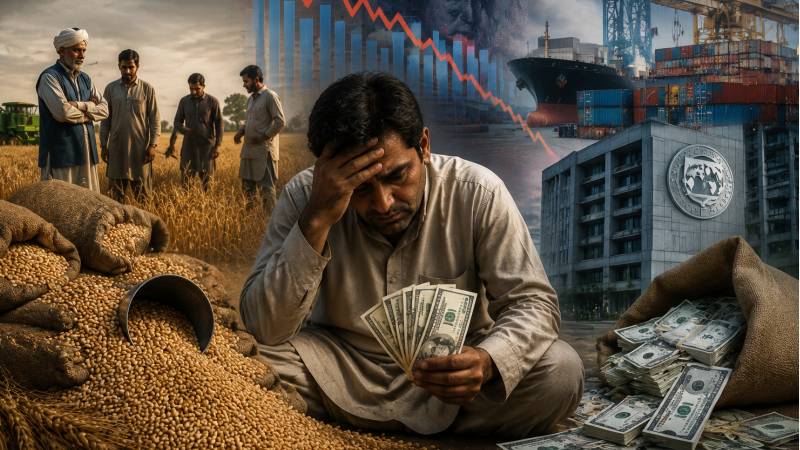
Last week the Food Security Minister announced that Pakistan would import wheat. The decision was presented as market stabilisation. It is better understood as an invoice. This is the accumulated bill for three harvests of policy failure, presented all at once. In April, farmers across Punjab sold wheat at Rs 2,900-3,200 per 40 kilograms against the state's own benchmark of Rs 3,500. By late July the national average had climbed above Rs 4,600. The farmer received less than the state's declared support price. The state paid more than the farmer's asking price, but to foreigners, not to him.
The harvest itself was not a failure. Production is estimated at 29.31 million tonnes. Pakistan consumes roughly 31.9 million tonnes and adds five million mouths each year. The structural deficit is real. But the grain was grown, cut and bagged. What failed was the system's ability to buy it when it was available and cheap in rupees.
Follow the money. Black Sea wheat is trading at roughly 240-270 dollars per tonne FOB. Add freight, insurance, stevedoring, bagging and inland transport and the landed cost in Pakistan reaches Rs 3,400-3,800 per 40 kilograms. At the upper end, this is higher than the Rs 3,500 benchmark declared fiscally unaffordable when the seller was a Pakistani farmer.
If the government imports one million tonnes at these prices, the bill approaches 280 million dollars. If the projected shortfall of 2.55 million tonnes materialises, the import bill climbs toward 700 million dollars. Procuring the same volume domestically at the announced Rs 3,500 benchmark would have cost about Rs 87.5 billion. This money would have been paid in rupees, into rural accounts, against grain already sitting in Pakistani silos. Instead, that money will leave Pakistan in dollars, toward traders in the Black Sea.
This is not new. In 2023-24 the country imported 3.44 million tonnes at a cost of 1.005 billion dollars into a market whose godowns were already full. In 2024 the Food Department failed to honour its own support price. In 2025, under IMF conditionality linked to a 7.1 billion dollar Extended Fund Facility, the state withdrew entirely from procurement. In 2026, with a target of three million tonnes, Punjab's aggregators had secured only 160,000 tonnes by the end of May. By late May, with partial procurement continuing into June, total procurement fell far short of the three-million-tonne target. The pattern is consistent: when the seller is Pakistani, the money is unavailable; when the seller is foreign, the dollars appear.
The farmer received less than the state’s declared support price. The state paid more than the farmer’s asking price, but to foreigners, not to him.
The procurement failure of 2026 was not inevitable. It was a choice to delay. Banks were asked to finance aggregators at terms they found unacceptable. Storage was offered, but agreement on collateral rights dragged past the harvest window. Personnel were assigned, but the system was not operational when the crop arrived. By the time negotiations concluded in late May, the farmer had already sold. His loans were falling due, and his storage was little more than bags under a tarpaulin. The state then turned to imports, not because domestic wheat was unavailable, but because domestic buying required institutional readiness that had not been prepared.
The import ban imposed in July 2024 remained in place through July 2026, even as domestic stocks fell from nearly five million tonnes to around two million. The government insisted reserves were adequate while retail prices climbed. It banned imports when it should have been building stocks, and now imports when it has no choice. That is not strategic reserve management. It is denial followed by panic.
Pakistan's reserves stand at just over 17 billion dollars. Of that, 16.4 billion dollars in external principal falls due within twelve months. The food import bill already stands at a record 9.15 billion dollars for FY2025-26. Into this ledger the wheat programme will write hundreds of millions of dollars for a crop harvested three months earlier at a price the state had declared affordable.
The accountability ledger, meanwhile, remains empty. After the 2023-24 over-import scandal, four mid-level officers were suspended. The inquiry was led by an official who had served the caretaker setup itself. No minister was named. No importer was named. No senior bureaucrat faced consequence for the decision to spend 1.005 billion dollars importing grain into surplus stocks. The lesson absorbed was that failure at scale carries no cost for those who author it.
This is not a failure to forecast. It is a failure to act. Forecasts existed. Warnings existed. The Ministry of National Food Security saw the procurement machinery breaking down. The Ministry of Finance saw the reserves picture. No one with authority chose to accelerate the systems, release the financing, or make the difficult administrative calls that would have enabled the purchase of 2.5 million tonnes at Rs 3,500 per bag.
The grain is in the country. The systems required to buy, store and release it are not. And until accountability exists for the decision-makers who chose dollars over rupees, every future shortage will be met with another import bill. The farmer, watching dollars leave for the Black Sea while his own grain rots for want of a buyer, will do what he has already begun to do. He will reduce his acreage. He will shift his crop. He will exit.