

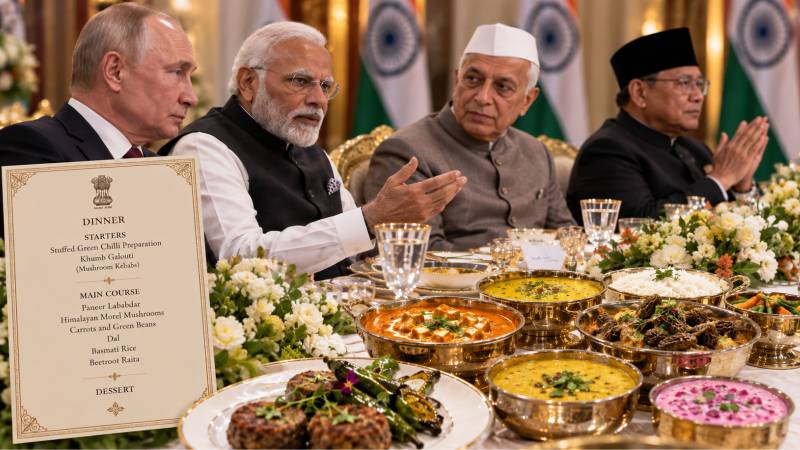
There is nothing inherently political about eating vegetarian food. But when the Government of India invites visiting heads of state to an official dinner and decides that every single item served will be vegetarian, the menu becomes worthy of closer examination. Look at the menu. The starters include a stuffed green chilli preparation and Khumb Galouti — mushroom kebabs. The main course offers Paneer Lababdar, Himalayan morel mushrooms, carrots and green beans, dal, basmati rice and beetroot raita. Dessert follows.
There is no meat. No chicken. No fish. Even the kebab, a dish historically and popularly associated with meat across much of South Asia has been transformed into a mushroom preparation. One could dismiss this as nothing more than the culinary preference of the host. But in the India of Narendra Modi and the BJP, food has become too politically charged for such choices to be viewed entirely in isolation.
The question is not whether vegetarian food should have been served. Of course it could be. The question is why only vegetarian food was served. After all, most Indians are not strict vegetarians. India’s own National Family Health Survey has shown that a substantial majority of those surveyed consume fish, chicken or meat at least occasionally. Meat consumption is therefore not some marginal practice confined to a small minority of Indians.
Yet that reality disappears from the official table. And therein lies the significance of the menu. It represents not necessarily India as Indians actually live and eat, but a particular conception of India increasingly promoted by its current political establishment. Under the BJP and the broader Hindutva movement, food has become another battleground over national identity. Beef consumption, cow slaughter, meat shops and dietary practices have repeatedly been drawn into political and communal disputes.
The underlying argument extends far beyond what anybody happens to eat for dinner. It concerns who has the authority to define what is authentically Indian. The Hindu nationalist project promoted by the BJP has increasingly sought to place a particular conception of Hindu identity at the centre of Indian nationhood. In that conception, minorities may continue to exist, but they are increasingly expected to accommodate themselves to cultural rules determined by the majority.
Food is particularly useful in reinforcing this hierarchy because it enters everyday life. It tells people what can be sold, what can be eaten, where it can be eaten and, indirectly, whose customs constitute the national norm. That makes the vegetarian state banquet more than a curiosity. It takes an ideological tendency visible inside India and places it before foreign leaders.
Official dinners are carefully choreographed acts of political communication. Governments choose the venue, décor, music, guest list, seating arrangement and menu precisely because these events are intended to project an image of the country.
The message becomes: this is the India you will encounter because this is the India the state has chosen to present. There is an important distinction here. Nobody could reasonably object to the Indian government serving Indian food at an official dinner. It would be perfectly normal for a government to serve its own country’s dishes to visiting dignitaries. But Indian food does not mean vegetarian food. That equation is itself political.
Kashmir has longstanding meat dishes. Bengal has a strong fish-eating culture. Hyderabad has its biryanis and meat dishes. Goa has seafood and pork traditions. Kerala has extensive fish and meat consumption. Much of northeastern India has dietary traditions that bear little resemblance to the vegetarian image increasingly projected by India’s political establishment. Muslims, Christians, Dalits, tribal communities and large numbers of Hindus eat meat.
Why should all of them disappear from the table when the Indian state presents itself to the world? There was an obvious alternative. Serve an entirely Indian menu, but provide both vegetarian and non-vegetarian choices. Put paneer on the menu. Put mushrooms on it. Serve dal and vegetables. But also serve fish, chicken or meat dishes representing the dietary practices of the majority of Indians who consume them. Then allow visiting leaders to decide what they wish to eat.
Instead, the decision has already been made for them. That is where the episode becomes an interesting example of the wider attitude of India’s current political establishment towards the outside world: engagement increasingly takes place on India’s terms. The foreign guest is not merely invited to experience India. The guest is presented with the officially approved version of India. It may seem absurd to use the word “hegemony” in connection with a dinner menu. Nobody is suggesting that forcing a visiting president to eat mushrooms rather than mutton represents some grave diplomatic offence.
But political hegemony rarely operates only through dramatic gestures. It also operates through symbols, language, ceremonies and assumptions about whose preferences constitute the norm. And Narendra Modi’s India has become increasingly adept at using symbolism to communicate political messages. Religion has become more conspicuous in state ceremony. Hindu imagery and ritual have increasingly overlapped with official functions. Political arguments surrounding temples, mosques, historical names and religious sites have become central to the BJP’s appeal.
Food belongs to the same political landscape. The politics surrounding beef in particular demonstrates how dietary choices can be transformed into tests of cultural conformity. Cow-protection politics has existed in India for generations, but under the BJP it has acquired renewed political significance. Restrictions on slaughter, controversies surrounding meat sales and violence linked to accusations involving cattle have repeatedly exposed the communal dimension of what is often presented simply as religious sensitivity.
The burden of these politics does not fall equally. It falls disproportionately upon communities whose dietary practices do not conform to the preferences increasingly associated with Hindu majoritarian politics. This is why it would be misleading to treat an exclusively vegetarian diplomatic banquet as though it existed in a political vacuum. Context matters. If the government hosting the dinner had no history of politicising food, the menu might merit little comment. But when the same political movement has spent years associating particular dietary practices with its conception of Hindu identity and national culture, an entirely vegetarian menu at a major international gathering inevitably carries political meaning. It also exposes an obvious contradiction in India’s international rhetoric.
New Delhi frequently objects to Western countries imposing their political assumptions upon the rest of the world. It presents itself as an advocate of a multipolar international system in which different states and societies should not have to conform to rules established by a dominant power. Yet the Modi government’s own political project frequently rests upon establishing cultural norms and expecting others to accommodate them. Domestically, that affects minorities and Indians whose lifestyles do not conform to the preferred majoritarian model. At an international gathering, it can manifest itself in something as seemingly insignificant as deciding that every foreign leader at the table will eat vegetarian because the host leadership prefers it that way. The issue is not hardship.
Heads of state can survive one evening without meat. The issue is the assumption behind the decision. Hospitality traditionally involves some accommodation of the guest. If a visiting leader is vegetarian, vegetarian food should obviously be available. If a Muslim guest does not eat pork, that should be respected. Dietary restrictions, allergies and religious requirements are routinely accommodated at diplomatic functions around the world. But accommodation works both ways.
It means providing choices rather than imposing the host’s personal preferences upon everyone sitting at the table. There is another reason the menu matters. Official dinners are carefully choreographed acts of political communication. Governments choose the venue, décor, music, guest list, seating arrangement and menu precisely because these events are intended to project an image of the country. Nothing about a major state banquet is entirely accidental.
So what does this menu project? It projects an India stripped of a large part of the way its own population actually eats. It projects a more culturally homogeneous India. And it projects an India more closely resembling the ideological preferences of its current rulers than the social reality of the country they govern. That may be precisely the point.
The Modi government’s political project has never merely been about winning elections. Hindutva seeks to redefine the idea of India itself, moving away from a state in which multiple religious and cultural identities theoretically possess equal ownership towards one in which Hindu civilisation occupies an explicitly dominant position. Everyone else may remain. But increasingly, they remain on terms established by the majority. The vegetarian banquet is hardly the most consequential manifestation of that project. But it is a revealing one. Because there was never any need to choose between serving Indian food and serving meat. India could have offered an entirely Indian menu containing vegetarian dishes alongside Indian meat and fish dishes. Instead, one dietary tradition was presented as the national one. The visiting leaders were not given a choice. They were given the India that India’s current rulers wanted them to consume. Literally.