

On August 19, 2026, Pakistan's Economic Coordination Committee sat in Islamabad and approved something so absurd it could only make sense in a country that has stopped keeping track of its own contradictions: the export of 108,000 metric tonnes of sugar. Not new sugar. Not surplus grown this season. This was sugar Pakistan had itself imported only a year earlier, part of a 300,000-tonne shipment brought in when the country ran short, now being sold back onto the international market because global prices had improved and a state trading corporation was sitting on unsold stock. A nation imports sugar, cannot manage its own reserve properly, and then exports the same sugar again. If satire wrote government policy, it would struggle to invent something this precise.
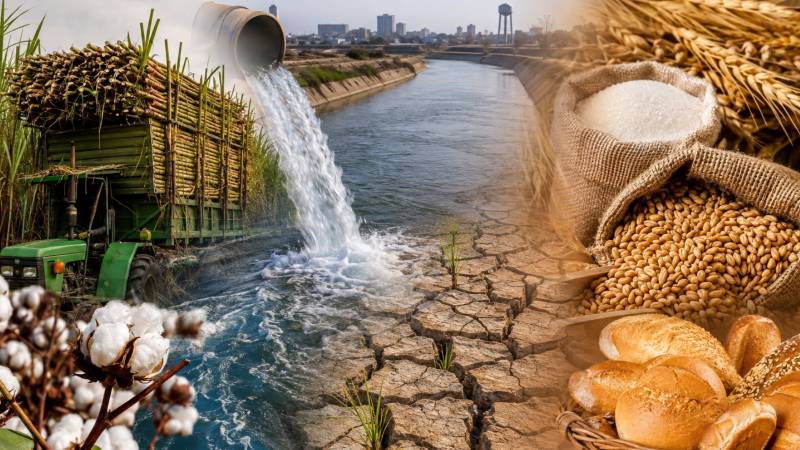
But strip away the comedy and what remains is a chilling arithmetic. Sugarcane, over its long growing cycle, drinks over 2000 millimetres of water. Cotton needs roughly a third of that 500 to 800 millimetres. Wheat, the crop that feeds the nation's bread, needs barely 350 to 450 millimetres. When Pakistan sends sugar abroad, it is not selling a commodity. It is liquidating the one resource it can least afford to lose, from a river system that is already under siege. The Indus Waters Treaty, the arrangement that has governed the basin's waters since 1960 has been under direct threat from New Delhi, whose government has signalled its intent to restrict the flow of water into Pakistan whenever leverage is useful. A country staring down that threat should be hoarding every drop the Indus carries. Instead, it is exporting it in crystallised form, one tonne of sugar at a time, to earn foreign exchange it could have earned more sensibly elsewhere.
The cruelty of the timing is what makes this moment worth dwelling on. In the very same weeks that the government cleared sugar for export, it also approved the emergency import of one million metric tonnes of wheat through the state-run Trading Corporation of Pakistan, after flour prices climbed by more than 70 percent year-on-year and provinces demanded over 2.2 million tonnes to head off a crisis at the roti counter. Punjab, Sindh, Khyber Pakhtunkhwa and Balochistan all came to Islamabad with the same message: the country does not have enough wheat. And yet the same apparatus of state that could not guarantee bread on the table found the administrative energy to authorise a sugar tender within days. This is not a coincidence of scheduling. It is a portrait of where the state's attention, and interests, actually lie.
Then there is cotton, the crop that ought to be the nucleus of any serious Pakistani food and economic security strategy, because it is the one crop that pays for itself many times over in the textile chain. Cotton output has collapsed to roughly five million bales this season, down from a historic peak near fifteen million, a forty-year low. The steady creep of sugar mills into Punjab's cotton belt, most visibly in districts like Rahim Yar Khan, where new mills have been licensed even as officials publicly promise a "cotton revival." Farmers follow returns, not slogans, and when sugarcane offers guaranteed mill prices while cotton offers pest infestations and falling yields, the shift is rational at the farm level and catastrophic at the national one. Pakistan's textile mills, which earn the country its single largest stream of export revenue, are now importing raw cotton of billions of dollars a year — buying from abroad the very fibre the Indus plain was built to grow.
Into this already dysfunctional picture has stepped a domestic advocacy campaign alleging that cotton cultivation, through its heavy pesticide use, carries specific reproductive health risks for both men's and women's fertility. Whatever the campaign's intentions, its scientific basis has not been independently established, and it deserves scrutiny rather than uncritical repetition — but its practical effect, whether founded or not, is to add one more headwind to a crop the country cannot afford to abandon. A nation that cannot even protect its most valuable export crop from misinformation is not a nation with a food security strategy. It is a nation without one.
Farmers follow returns, not slogans, and when sugarcane offers guaranteed mill prices while cotton offers pest infestations and falling yields, the shift is rational at the farm level and catastrophic at the national one.
This is no longer a complaint confined to farmers, economists, or op-ed pages. On July 30, 2026, at the Pakistan Economic Summit in Islamabad, Interior Minister Mohsin Naqvi said aloud what the wheat and sugar numbers had already been screaming: "The system we are living under has collapsed. Whether you agree or not." He did not reach for that word carelessly and, tellingly, when pressed to justify it, he did not point to a stock-market crash or a currency collapse. He pointed at the country importing wheat despite calling itself an agricultural nation. That is not a coincidence of rhetoric. It is an admission, from inside the cabinet room, that the mismanagement of a single staple crop has become proof, in the mind of the state's own interior minister, that governance itself has failed. Commentary in the Pakistani press at the time went further, noting that even the military's own spokesperson, the Director General of Inter-Services Public Relations, was said to concede privately that governance had broken down, a remarkable admission, if accurately reported, from an institution that rarely concedes anything in public. When a country's wheat shortfall becomes ammunition in a debate about whether the state itself still functions, food security has stopped being a technical portfolio and become a matter of national survival.
And that is the deeper indictment. Pakistan possesses a Ministry of National Food Security and Research. It has the Pakistan Agricultural Research Council. It has agricultural universities scattered across every province. On paper, this is an architecture built for exactly this moment, a water crisis, a wheat crisis, a cotton crisis, arriving together. In practice, these institutions have become what can only be called ceremonial. They are, in the truest sense, Madame Tussauds exhibits transplanted from London to Islamabad: figures dressed convincingly as a food security ministry, a research council, a steering committee, each drawing its salary, its official car, its foreign junkets, its protocol, every perk of statehood except the one thing a wax figure cannot do, which is act. Visitors walk past, take a photograph, and leave believing they have seen something alive. Meanwhile the sugarcane keeps spreading into the cotton belt, the wheat stocks keep running down, and nobody inside the exhibit moves to stop it.
The reason the exhibit does not move is not incompetence. It is ownership. Pakistan's sugar industry has, for years, been the subject of parliamentary hearings, Federal Investigation Agency inquiries, and Public Accounts Committee sessions that have named, on the record, in the National Assembly, some of the country's most senior political figures as beneficiaries of the mills whose export permissions the state controls. A 2020 forensic inquiry into the sugar crisis implicated relatives of a sitting federal minister for food security at the time. A 2025 Public Accounts Committee hearing was told that roughly forty-two families control the bulk of the industry's profits, with lawmakers naming, in open session, some of the same political dynasties that have supplied prime ministers, finance ministers, and industry advisers across successive governments. When the people who sit in the PM's secretariat, or within a phone call of it, are also the people whose mills benefit every time an export tender is approved, the ministry tasked with protecting the nation's food supply is not failing by accident. It has been arranged not to succeed. That is the real reason the wax figure never moves: someone in the room prefers it that way.
The uncomfortable truth beneath all of this is elite capture. When the industry that profits most from water-intensive cultivation also holds influence over the policy levers that govern water-intensive cultivation, the outcome is predictable: sugar gets grown, sugar gets exported, and the Indus gets spent while 260 million Pakistanis queue for flour and watch their textile industry starve for lack of homegrown cotton. Pakistan is not short of fertile soil, hardworking farmers, or technical expertise. It is short of a state willing to treat food and water security as matters of survival rather than matters of patronage. Until that changes, the country will keep exporting its river, one sugar tender at a time, and calling it economic policy.