

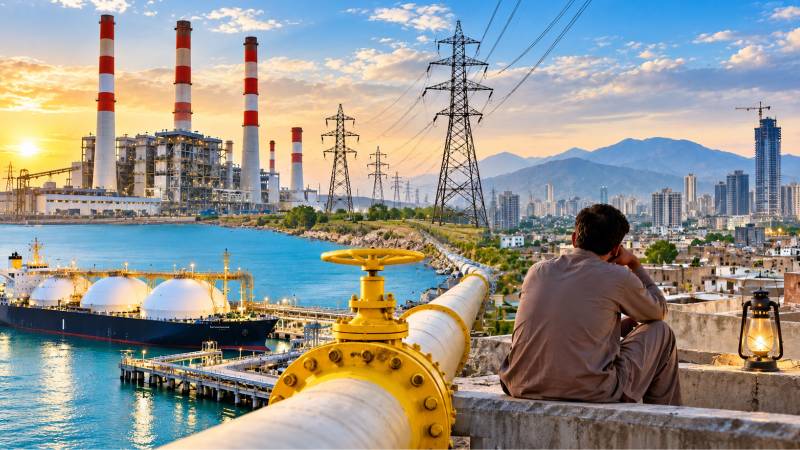
Pakistan’s energy crisis is often described as a shortage of power, gas or fuel. But that is only part of the story. The deeper problem is that we have built an energy economy that is expensive, fragile and poorly coordinated even though the country has power plants, gas infrastructure, LNG terminals, renewable potential and industrial demand. The result is a painful contradiction. Households struggle with unreliable and unaffordable energy, poorer families are pushed toward firewood, coal or LPG, industries lose competitiveness, and the state keeps accumulating liabilities. This is not simply an energy shortage; it is a policy-made economic threat.
That is why Hyman Minsky’s warning about financial instability is so relevant. Minsky argued that long periods of apparent stability can encourage decisions that quietly make a system more fragile. The same logic applies here. Pakistan’s energy sector did not become vulnerable overnight; it became vulnerable through years of choices that looked manageable in isolation but dangerous when added together. Look at how we got here. We built power plants without first ensuring that electricity could be transmitted, sold and paid for. We developed LNG infrastructure while adopting policies that weakened commercial demand. We discouraged investment in domestic gas while becoming more dependent on imports. And by pushing tariffs higher and higher, we nudged many consumers away from the grid, then tried to recover fixed costs from the customers who remained. This is how Pakistan’s energy bubble was created.
The economics of a self-inflicted crisis
Minsky warned that financial systems can reach a point where they need refinancing and fresh borrowing simply to stay afloat. Pakistan’s energy-sector circular debt looks uncomfortably similar. Weak collections and structural inefficiencies keep creating liabilities. Tariff increases and fiscal transfers provide temporary relief, but the underlying economics remain unresolved. Raising tariffs without fixing efficiency often makes the problem worse. Businesses cut production, switch fuels or install solar. Grid sales fall, fixed obligations are spread over fewer units, tariffs rise again, and demand falls further. No business can survive forever by charging more to fewer customers. Yet that is increasingly how our power market behaves.
Natural gas: destroying the value of our inheritance
Domestic gas is not just another commodity. It is a strategic input for power generation, fertilizer, textiles, chemicals and many other sectors. Its value should not be judged only by what producers earn or utilities recover, but by what it makes possible: exports, jobs, industrial output and lower dependence on imports. Exploration needs credible pricing, timely payments and access to customers. When producers cannot count on predictable returns, investment slows. The damage is not always obvious at once; it appears years later in lower exploration, delayed field development and falling output. The answer is not blanket price increases. It is a stable commercial framework, targeted support for vulnerable households and genuine third-party access to pipelines. Producers and independent suppliers should be able to sell directly to willing customers through transparent transportation charges. Gas utilities, in turn, should be rewarded for efficient carriage rather than protected through exclusive control over sales. Unaccounted-for gas and declining throughput should not simply be passed on to customers; they must be tackled through real performance incentives.
We built power plants without first ensuring that electricity could be transmitted, sold and paid for, developed LNG infrastructure while weakening demand, and discouraged domestic gas investment while becoming more dependent on imports.
LNG: infrastructure without coherent demand policy
LNG terminals give Pakistan valuable access to international markets, but they work only when the rest of the chain works with them. Their economics depend on downstream demand, pipeline capacity, contract flexibility and cost recovery. When imported LNG is sold below its delivered cost, the losses do not disappear; they surface somewhere else. And when levies and pricing decisions weaken industrial and captive-power demand, infrastructure built on earlier forecasts becomes harder to finance. That leaves us with a strange contradiction: the country can have underutilised contracted capacity in one period and physical supply shortages in another. Contracted volumes, actual deliveries, seasonal demand and affordability are not the same thing. LNG therefore cannot be managed in isolation from domestic gas production, electricity dispatch and industrial competitiveness. Pakistan needs commercial flexibility, but it must be negotiated in a way that protects contractual credibility and investor confidence.
The electricity paradox
Installed generating capacity is not the same as usable, affordable electricity. Power must be produced when needed, moved to the right place, distributed efficiently and paid for. Transmission congestion can stop cheaper generation from replacing expensive output. Overstated demand forecasts can create unnecessary capacity payments, while forecasts that ignore distributed solar can badly misread future grid sales. That is why every generation, transmission and storage investment should be judged by one practical test: does it reduce the total cost of reliable supply? A power plant may look attractive on paper but become unnecessary once solar and demand response are considered. Conversely, transmission investment that appears expensive may save money by allowing cheaper dispatch. These trade-offs cannot be solved through disconnected project appraisals. This is not only an industrial problem; it is a household problem too. When electricity is unreliable and gas is unaffordable or unavailable, poorer families are often pushed toward firewood, coal, LPG or other costly and unhealthy alternatives for cooking, heating and basic daily needs. That is not an energy transition; it is energy deprivation. A country cannot build a brighter economy while large sections of its population still struggle for clean, dependable energy.
Solar is an opportunity, not an enemy
Solar shows how quickly technology can change the energy equation. It can reduce exposure to imported fuels and expensive grid supply. But if fixed network costs are recovered mostly through per-unit tariffs, self-generation can leave the remaining consumers carrying a heavier burden. The answer is not to block solar to protect inefficient utilities. The better answer is to make solar work for everyone. Transparent network charges, time-of-use pricing, competitive procurement, stronger transmission and properly evaluated storage can turn distributed solar into an asset rather than a threat. Batteries should be compared with flexible generation, demand response and network reinforcement. What matters most is the total cost of dependable electricity, not loyalty to any single technology.
Energy competitiveness is national competitiveness
Energy costs shape the competitiveness of almost every tradable product. Exporters cannot simply pass higher energy prices on to international buyers. A levy may raise revenue in the short term, but it can also reduce demand, cut output and weaken exports. Fuel taxation can influence consumption, but it can also punish industries that have no practical alternatives. These measures should therefore be judged by their combined impact on production, imports, investment and fiscal revenue. Affordable energy does not mean permanently subsidised energy. An unfunded subsidy only shifts the burden to public debt, taxation or deferred maintenance. The goal should be efficient supply at a competitive full economic cost. That means exchange-rate policy, industrial productivity and energy pricing have to be assessed together, not treated as separate administrative files.
The missing institution: an operational integrated energy model
Pakistan needs more than a long-term energy plan. It needs a working model that regularly tests how domestic gas, LNG, petroleum, electricity, renewables, transport, industry and the wider economy interact. A TIMES-based framework can support long-term technology and resource analysis, but it must be linked to detailed power-sector, financial and macroeconomic models. TIMES alone cannot capture every dispatch constraint or utility cash-flow problem. Every ministry and regulator proposing decisions with major cross-sector effects should use this framework and record the results. A petroleum levy should be tested for its impact on electricity, industry, exploration and imports. A generation plan should be assessed against gas availability, solar, storage and demand. A renewable policy should account for transmission, flexibility and recovery of network costs. A quarterly report to the prime minister and the relevant cabinet committee, supported by a comprehensive six-monthly review, should compare projections with actual gas production, LNG use, electricity demand, transmission constraints, industrial energy costs and sector liabilities. When reality differs from forecasts, assumptions should be revised—not defended. A model that only produces another report will add little. A model embedded in approvals and performance reviews could materially improve governance.
From an energy bubble to an energy economy
Pakistan has accumulated liabilities without addressing their causes. It has built infrastructure without coordinating demand, and weakened domestic resource incentives while increasing exposure to international shocks. These are not unavoidable outcomes of geological depletion. They are the result of fragmented institutions and inconsistent policy. Market access, efficient networks, transparent subsidies, domestic resource development, renewable energy and storage all need to be treated as parts of one connected architecture. Private participation can help where competition, regulation and commercial risk allocation are credible. But simply transferring existing inefficiencies to new owners is not reform. The real test of energy policy is whether it supports productivity, exports, investment, employment and household welfare. Pakistan’s energy use and supply are woefully inadequate for the economy we say we want to build. A modern, export-oriented, job-creating economy cannot run on unreliable power, unaffordable fuel and ad hoc policy choices. Nor can social progress rest on households being pushed toward inferior and unsafe options while industry loses competitiveness.
Our greatest energy shortage may not be a shortage of resources at all. It may be a shortage of coherent economic decision-making. Unlike fossil fuels, that shortage is entirely within our power to fix and fixing it is essential if Pakistan is to offer its people a cleaner, fairer and more prosperous future.