


Abstract
Pakistan’s exchange-rate debate is usually reduced to the rupee–dollar rate. That misses the policy variable that matters for trade: the real effective exchange rate (REER), a trade-weighted measure of the currency adjusted for relative prices. The State Bank of Pakistan’s index rose from 103.99 in January 2026 to 106.44 in June, a 2.35 percent real appreciation. The level, however, is not a direct estimate of misalignment: 100 is the 2010 base-year value, not an equilibrium target. This paper therefore distinguishes movement from misalignment and reads the REER alongside export performance, remittances, energy and logistics costs, private credit, and taxation. It shows that Pakistan’s recent external stability remains heavily supported by remittances and import sensitivity while goods exports weakened in July–March FY2026. The paper also identifies a policy contradiction: goods exports face a 1.25 percent minimum tax on gross proceeds, compared with a 0.50 percent adjustable advance tax on sales to active-taxpayer retailers in a narrow transaction-rate comparison. A competitive REER is necessary, but durable export growth requires tax neutrality, lower system costs, deeper private finance and sustained productivity reform.
Executive summary
1. The REER appreciated in the first half of 2026. The SBP index increased from 103.99 in January to 106.44 in June. Under the SBP convention, that is a 2.35 percent real appreciation over five monthly intervals.
2. An index above 100 is not proof of overvaluation. The index is normalized to 2010 = 100. Estimating equilibrium requires a model of the current account, productivity, terms of trade, capital flows and policy distortions. Recent IMF assessments placed Pakistan’s gap near one percent around 2023–24, not eight to eleven percent.
3. External stability is not yet export transformation. In July–March FY2026, goods exports fell 5.8 percent while goods imports rose 7.8 percent. Remittances reached US$30.3 billion and exceeded goods-export receipts; IT exports grew strongly, but the goods base remained narrow.
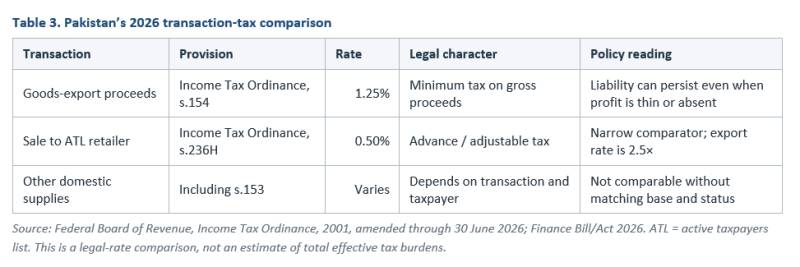
4. Tax policy works against the export objective. After the 2026 change, section 154 collects 1.25 percent of gross goods-export proceeds as minimum tax. Section 236H collects 0.50 percent on sales to active-taxpayer retailers as adjustable advance tax. The export transaction rate is therefore 2.5 times the local-retailer rate in this specific comparison, although the tax bases and legal character differ.
5. REER management cannot substitute for competitiveness reform. A flexible exchange rate and lower inflation can prevent persistent real appreciation, but export supply also depends on reliable energy, automated refunds, modern logistics, private credit, skills, technology and competition.
1. Introduction: the wrong exchange-rate question
Pakistan’s public debate asks whether the rupee is “stable” against the US dollar. Exporters, however, compete against firms in many markets and pay costs set at home. Their relevant price is the real effective exchange rate: a trade-weighted index of the rupee against partner currencies, adjusted for relative inflation. A nominal exchange rate can remain almost unchanged while domestic prices rise faster than those of competitors. In that case, the currency appreciates in real terms and the exporter’s rupee cost base rises relative to foreign rivals.
The distinction matters because Pakistan often treats the exchange rate, subsidies, energy prices, refunds, credit and logistics as separate policy files. Firms experience them as one margin. A real appreciation compresses that margin; a gross-proceeds tax compresses it again; delayed refunds and expensive working capital then turn accounting profit into a cash-flow problem. Trying to support exports while allowing this combined burden to rise is like pouring water into a leaking bucket without fixing the leak.
This paper makes three contributions. First, it corrects the common but misleading claim that a REER index above 100 automatically measures overvaluation. Second, it places the latest REER movement beside the external accounts and structural cost evidence. Third, it integrates the taxation argument into the competitiveness framework using the law as amended through June 2026. The result is a policy diagnosis, not a call for an arbitrary nominal exchange-rate target.
2. Measurement, evidence and limits
The SBP publishes a monthly consumer-price-based REER for 37 trading partners with 2010 = 100. An increase denotes real appreciation and a decrease real depreciation. The measure is useful for tracking direction and cumulative price pressure, but its normalization creates no presumption that 100 is “fair value.” A base-year index answers how the current real trade-weighted rate compares with 2010; it does not answer what rate is consistent with medium-term fundamentals.
Equilibrium or misalignment must be estimated. IMF external-balance assessments combine the current account with policy gaps and fundamentals, and are sensitive to data quality and model choice. The IMF’s 2024 assessment described Pakistan’s external position as broadly in line and reported small REER gaps around 2023. Its 2025 assessment similarly indicated a gap of roughly one percent for 2024. These are not immutable estimates, and import restrictions can distort the current account, but they provide no evidentiary basis for asserting a current eight-to-eleven percent overvaluation merely because the index is above 100.
The analysis therefore uses the REER as a signal and combines it with SBP and Finance Division external-sector data, IMF surveillance, FBR tax law, WTO trade statistics and World Bank competitiveness indicators. Cross-country energy and finance comparisons are presented as directional ranges because tariff classes, tax treatment, reliability and reference years differ. The paper’s causal claims are correspondingly disciplined: the evidence establishes a competitiveness squeeze, not a single-variable explanation of exports.
3. What the latest REER movement actually says
The latest available SBP series shows a clear upward movement in the first half of 2026. The REER fell slightly in February, then rose for four consecutive months to 106.44 in June. The cumulative increase from January was 2.35 percent. This is economically meaningful for exporters operating on thin margins, particularly when price contracts are fixed in foreign currency and imported inputs do not fully offset local wage, energy, tax and financing costs.
Figure 1. Pakistan’s real effective exchange rate, January–June 2026
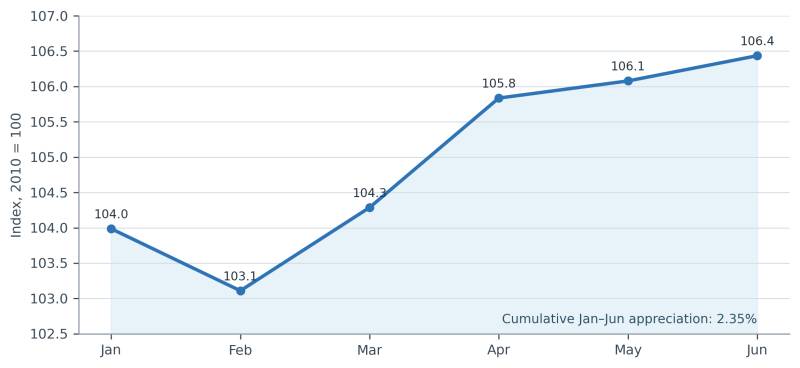
Table 1. Monthly REER observations and changes, 2026
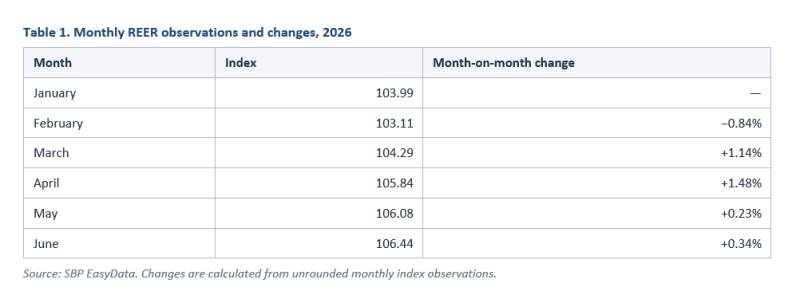
The appropriate interpretation is therefore two-part. The movement shows that relative prices and nominal exchange rates combined to weaken price competitiveness during early 2026. The level does not quantify the equilibrium gap. Policy should react to persistent appreciation and deteriorating export evidence, but it should not manufacture a false precision around a particular index level.
4. External stability without export transformation
Pakistan’s recent external accounts contain both improvement and fragility. In July–March FY2026, the current account recorded a small US$72 million surplus and remittances rose 8.2 percent to US$30.3 billion. Services exports increased 17.2 percent, led by IT exports of about US$3.4 billion, up 19.8 percent. These are real gains. Yet goods exports fell 5.8 percent to US$23.3 billion while goods imports increased 7.8 percent to US$46.8 billion. The merchandise deficit widened materially.
Figure 2. Goods trade and remittances, July–March FY2025 and FY2026
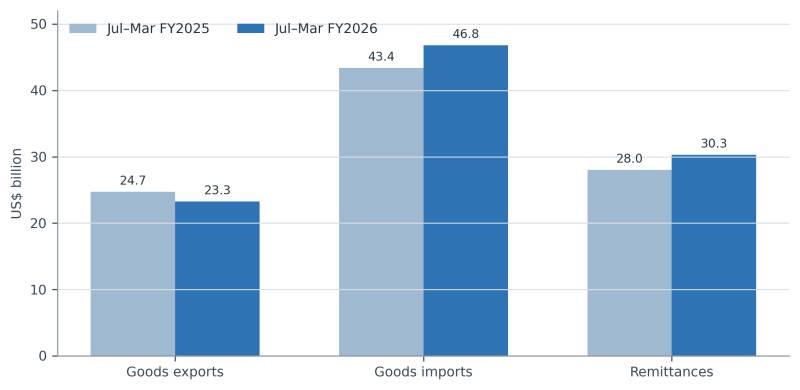
Table 2. Selected external-sector indicators, July–March FY2026
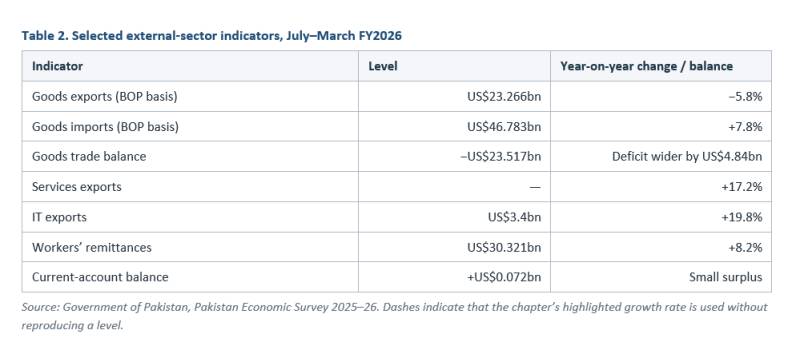
The composition matters. Remittances exceeded goods-export receipts in the period. This cushions the balance of payments and household incomes, but it is not a substitute for tradable-sector productivity. Nor should import compression be confused with competitiveness: restrictions can improve the measured current account while starving industry of inputs and obscuring underlying foreign-exchange demand. A durable external position requires exports that can grow when imports and investment normalize.
5. The competitiveness system behind the index
5.1 Energy, logistics and productivity
REER is best understood as a national scoreboard, not the disease itself. Pakistan’s exporters face industrial electricity and gas charges that are often above those available to Asian competitors, together with reliability costs that headline tariffs miss. World Bank shipment-tracking data for 2022 reported a five-day median port dwell time for Pakistan, compared with 4.1 days in India and 3.2 days in Viet Nam. Customs delays, port dwell time and weak rail freight add inventory and financing costs that the currency cannot permanently offset.
Productivity is the decisive long-run variable. A nominal depreciation can restore price competitiveness temporarily, but imported machinery and intermediate inputs become more expensive; wages and administered prices eventually adjust; and inflation erodes the initial gain. Economies that sustained export growth combined a competitive macro framework with investment in skills, technology, supplier networks, logistics and predictable rules. Pakistan’s export basket remains concentrated, limiting learning, market diversification and resilience.
5.2 Finance and the state’s absorption of credit
The financing channel reinforces the squeeze. IMF surveillance in 2026 again noted that Pakistan’s banking system is oriented toward government credit and that private credit remains small relative to peer economies. High sovereign exposure rewards banks for financing the state rather than screening longer-horizon industrial and export projects. Exporters then rely more heavily on short working-capital cycles, making delayed refunds or a tax collected on turnover especially damaging. The problem is not simply the policy interest rate; it is the structure of financial intermediation.
6. Taxing exports: a contradiction inside competitiveness policy
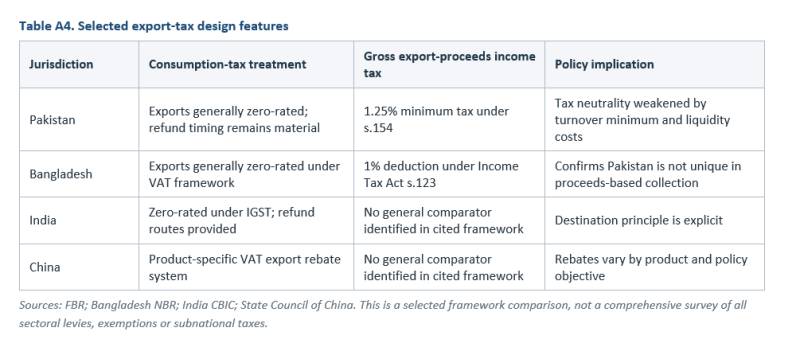
The tax argument should be stated precisely. The Finance Act 2024 moved exporters from a final-tax regime to minimum tax, while the 2026 amendments rationalized the collection. Under the Income Tax Ordinance as amended through 30 June 2026, section 154 collects 1.25 percent of gross proceeds from goods exports as minimum tax. This is a levy on turnover, not profit. A firm with a 3 percent taxable margin would surrender the equivalent of more than two-fifths of that margin before considering other taxes, blocked refunds or compliance costs.
For a narrow domestic comparator, section 236H collects 0.50 percent on sales to retailers that appear on the active taxpayers list, and the amount is advance/adjustable tax. The export transaction rate is therefore 2.5 times the local-retailer rate in that specific comparison. This does not mean every export transaction bears 2.5 times the total effective tax of every domestic sale. The provisions have different bases and legal character, and other domestic withholding sections can carry higher rates. The defensible claim is narrower—and still damaging: the law imposes a higher, non-refundable minimum burden on gross export proceeds than the adjustable transaction collection applied to active-taxpayer retail sales.
Table 3. Pakistan’s 2026 transaction-tax comparison
The international claim also needs qualification. Pakistan is not the only country that collects tax from export proceeds: Bangladesh’s Income Tax Act, for example, directs banks to deduct 1 percent of total goods-export proceeds. The broader international norm is nevertheless clear on consumption taxes: exports are normally zero-rated and input taxes refunded under the destination principle. India’s GST framework expressly zero-rates exports and provides refund routes; China operates product-specific VAT export rebates. Pakistan formally zero-rates many exports for sales tax, but refund delays and a gross-proceeds income-tax minimum weaken neutrality in practice.
Gross-proceeds taxation is poorly aligned with export development for three reasons. It penalizes low-margin and newly entering firms most heavily; it taxes scale before profitability and therefore discourages formal growth; and it absorbs liquidity precisely when exporters must finance inventories, shipping and long payment cycles. Fiscal administration may prefer an easily collected proxy, but administrative convenience should not become a structural tax on foreign-exchange earnings.
7. Why REER alone cannot restore competitiveness
A competitive REER is necessary because no firm-level reform can fully neutralize a persistent economy-wide real appreciation. It is not sufficient because the exchange rate is a relative price, not a productivity programme. If fiscal and monetary policy allow domestic inflation to outpace trading partners, nominal depreciation must recur simply to prevent real appreciation. That cycle raises the local price of imported fuel, machinery and inputs, provoking another round of inflation and political resistance.
The durable route is therefore consistency: a flexible nominal exchange rate that absorbs external pressures; fiscal and monetary policies that compress the inflation differential; and supply-side reforms that lower the real cost of producing and moving goods. Administrative import controls are not a substitute. Nor are open-ended subsidies, which shift cost to the budget without forcing productivity gains. The policy objective should be a tradable sector that remains profitable without repeated emergency devaluations or special exemptions.
This also changes how success should be measured. A single REER threshold invites false precision. A competitiveness dashboard should track the REER’s direction alongside export volumes, unit labour costs, energy reliability, port dwell time, refund days, private credit, firm entry, non-traditional export share and survival in new markets. The question is not whether an index equals 100; it is whether Pakistan can expand exports while investment and imports normalize.
8. A sequenced policy framework
The agenda should start with measures that remove explicit policy contradictions, then address network costs and productivity. Sequencing matters: an exchange-rate adjustment without inflation control quickly dissipates, while subsidized energy without distribution reform creates arrears. The following matrix links each constraint to an implementable instrument and a measurable test.
Table 4. Competitiveness reform matrix
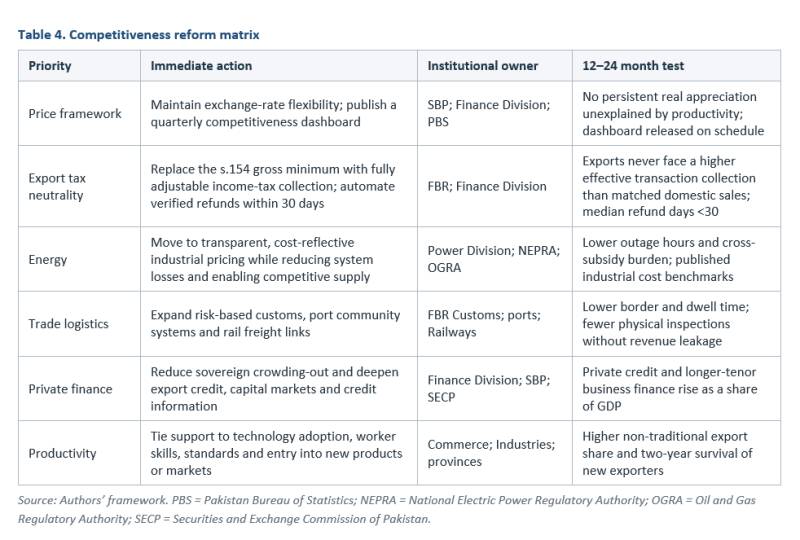
The tax step is deliberately first among structural reforms because it is administratively tractable and sends a clean signal. Export receipts should be brought into the normal income-tax system with collection that is adjustable and refundable, supported by digital reconciliation of customs, bank and tax records. The state need not abandon enforcement; it should stop treating turnover as profit.
Energy reform must likewise distinguish price from system cost. Permanently subsidizing industrial tariffs transfers losses to taxpayers or other consumers. The sustainable route is lower technical and commercial losses, competitive procurement, open access where feasible, transparent surcharges and reliability standards. Similar discipline applies to export support: time-bound, performance-linked instruments are preferable to blanket concessions.
9. Conclusion
Pakistan’s latest REER data signal a real appreciation during the first half of 2026, but the index does not prove a 6.4 percent—or any other precise—overvaluation simply because it stands at 106.4. That distinction strengthens rather than weakens the competitiveness argument. The case for action rests on converging evidence: weak goods exports, a widening merchandise gap, reliance on remittances, high system costs, shallow private finance and a tax structure that places a minimum charge on gross export proceeds.
A credible response must align the macro price with the micro environment. Exchange-rate flexibility and lower inflation should prevent avoidable real appreciation. Tax neutrality, rapid refunds, reliable energy, modern logistics, private credit and productivity investment must then convert price competitiveness into capacity. Pakistan does not need a cosmetically stable rupee or a mechanically targeted REER. It needs a policy system in which earning foreign exchange is easier than taxing, delaying and rationing it.
References
Federal Board of Revenue. (2026a). Income Tax Ordinance, 2001, amended up to 30 June 2026. Official ordinance archive.
Federal Board of Revenue. (2026b). Finance Bill 2026. Official PDF.
Government of Pakistan, Finance Division. (2026a). Pakistan Economic Survey 2025–26: Trade and Payments. Official chapter.
Government of Pakistan, Finance Division. (2026b). IMF Country Report No. 26/101. Official PDF.
International Monetary Fund. (2024). Pakistan: 2024 Article IV Consultation and request for an Extended Arrangement. Pakistan country page.
International Monetary Fund. (2025). Pakistan: Country Report No. 25/332. Pakistan country page.
National Board of Revenue, Bangladesh. (2023, as updated). Income Tax Act, 2023, section 123. Official English text.
State Bank of Pakistan. (2025). Annual Report 2024–25: The State of Pakistan’s Economy. Annual reports archive.
State Bank of Pakistan. (2026). Real Effective Exchange Rate, base 2010. EasyData series.
Central Board of Indirect Taxes and Customs, India. (n.d.). Sectoral FAQs: zero-rated exports under the IGST Act. Official guidance.
State Council of the People’s Republic of China. (2022). Export tax rebates and easier imports. Official policy note.
World Bank. (2023). Connecting to Compete 2023: Trade Logistics in an Uncertain Global Economy. Official report.
World Bank. (2026a). Domestic credit to private sector (% of GDP). World Development Indicators. Indicator page.
World Bank. (2026b). Merchandise exports (current US$). World Development Indicators. Indicator page.
World Trade Organization. (2025). Global Trade Outlook and Statistics 2025. Official report.
Appendix A. Supporting comparative tables
The following tables retain the useful comparative evidence from the working reference file while making differences in definitions and source years explicit. They should be read as scale and direction indicators, not as a harmonized causal dataset.
Table A1. Selected Asian merchandise exports, 2024
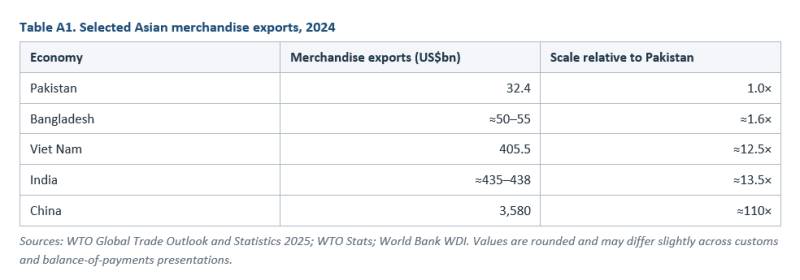
Table A2. Median port dwell time, selected economies, 2022
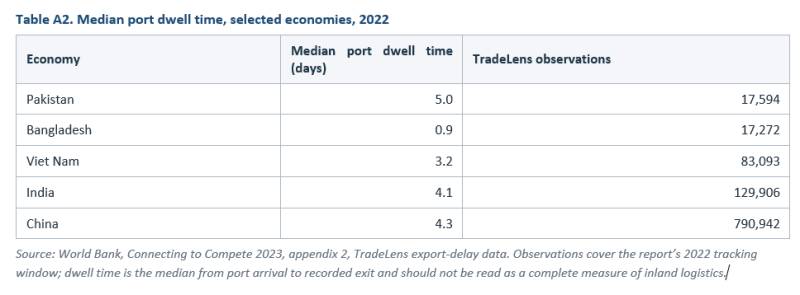
Table A3. Indicative industrial energy-cost ranges
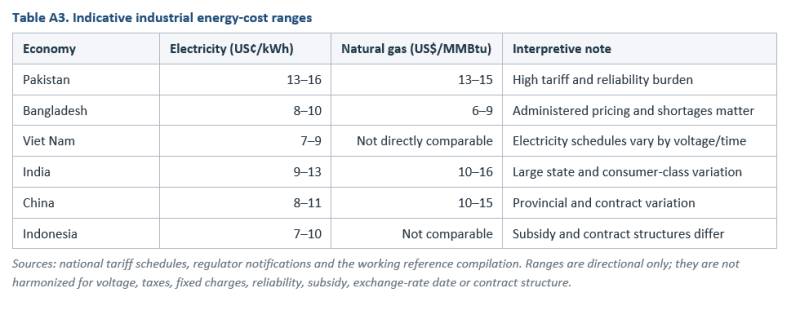
Table A4. Selected export-tax design features
Appendix B. Data definitions and analytical cautions
REER level. The SBP index is normalized to 2010 = 100. Its distance from 100 is not an estimate of currency misalignment. A rise is interpreted as real appreciation under the published convention.
External accounts. Goods trade figures in the main comparison use the balance-of-payments presentation from the Pakistan Economic Survey. Customs-basis trade deficits can differ because of valuation, timing and coverage.
Tax rates. The 2.5-times comparison is between section 154 goods-export proceeds and section 236H sales to active-taxpayer retailers. It should not be generalized to every domestic supply or to total effective tax.
Cross-country evidence. Export, energy, logistics and credit data draw on different statistical systems and reference years. They establish order of magnitude and direction, not a controlled estimate of REER effects.
Causality. The paper is a policy synthesis. It does not estimate an export-demand elasticity or a structural equilibrium exchange rate. Such work would require product-level prices, unit labour costs and a formal model.