

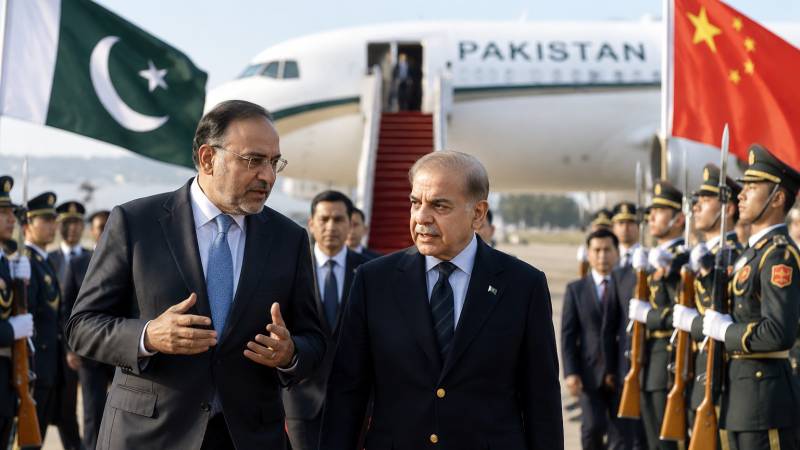
Every few weeks, Pakistan's Minister for Planning, Ahsan Iqbal, and the Prime Minister step off a plane in Beijing and recite the same well-worn tribute to Pakistan-China friendship: an ocean deeper, a mountain higher, honey sweeter. It is a lovely piece of poetry. It is also, at this point, a substitute for policy. Because in nearly a decade of shuttling between Islamabad and Beijing, the one lesson our leadership has conspicuously failed to bring home is the actual lesson of China's own turnaround not the metaphor, the mechanism.
China took what was, within living memory, one of its most volatile internal regions; the Xinjiang Uyghur Autonomous Region, long associated with insurgency, separatism, and religious extremism and re-engineered it through relentless, disciplined economic reform: energy corridors, industrial parks, resource-tax restructuring, mass employment schemes, and a work ethic so demanding it became a national talking point. Whatever one thinks of the human costs of that model and there are serious, well-documented human-rights critiques of it, the economic architecture behind it was coherent. Infrastructure was tied to production. Production was tied to jobs. Jobs were tied to a deliberate, almost punishing culture of output, one Beijing has credited with helping choke off the very unrest the region was once known for.
This was, in its way, a genuinely smart move on China's part, whatever its costs. Beijing did not just build roads through Xinjiang and hope stability followed. It pulled the region's workforce, including the very demographic most vulnerable to radicalization, into factories, textile bases, and industrial parks run on a punishing "996" tempo, long hours, six days a week, output measured relentlessly against targets. Idle time is recruiting time for insurgency; Beijing simply removed the idle time. Whatever one's verdict on the coercion involved, the strategic logic was coherent: an occupied, exhausted, wage-earning workforce has neither the time nor the appetite for insurgency that an idle, resentful, unemployed one does. That is the actual mechanism behind China's much-advertised turnaround, and it is the one lesson our own delegations never bothered to bring home.
Our Planning Commission watched this up close, for years, as the principal Pakistani interlocutor for the China-Pakistan Economic Corridor. And what did it import? Highways. Ports. Power plants. What it never imported was the discipline; the idea that infrastructure spending has to be married to productivity, governance capacity, and a workforce mobilized toward output rather than patronage. CPEC-I built assets that created debt. It did not build a work culture, a bureaucracy, or a tax base capable of sustaining those assets. Now the same Commission is preparing to launch CPEC-II, apparently on the theory that a sequel will succeed where the original left the country holding the bill.
China did not just build roads through Xinjiang and hope stability followed. It pulled the region’s workforce into factories, textile bases and industrial parks, tying infrastructure to production, production to jobs, and jobs to a disciplined culture of output. That is the actual mechanism behind China’s turnaround and the lesson Pakistan’s delegations never brought home.
The clearest evidence of that failure sits in the power sector. The Planning Commission and its partners structured a wave of CPEC coal plants around power purchase agreements that guarantee generators lucrative capacity payments; reportedly indexed to plant utilization assumptions around 80 percent regardless of whether the country actually needs or uses that power. Independent analyses have since documented the consequence: capacity charges that were roughly 384 billion rupees a year before CPEC power plants came online have since risen many-fold, with hundreds of billions of rupees in circular debt now traced directly to CPEC-linked generation. Because Pakistan committed to pay for contracted capacity on a take-or-pay basis, the country pays Chinese independent power producers whether the lights are on or off. Reports citing return-on-equity figures for these projects put Chinese IPP returns well above what domestic producers historically received, a negotiating outcome that should embarrass whoever signed off on it.
Contrast that with Bangladesh, which also turned to Chinese contractors for large coal capacity including the 1,320-megawatt ultra-supercritical plant at Payra, built with Chinese financing and technology. Bangladesh negotiated a project structured around efficient, modern ultra-supercritical technology aimed at lower generation costs and used it to help achieve full national electricity coverage. The technology in both countries came from the same country of origin. The outcome did not, because the terms Islamabad accepted were not the terms Dhaka accepted. That is not an act of geology or geography. That is a negotiating failure, and negotiating is precisely what a Planning Commission exists to do.
It is genuinely remarkable that the minister overseeing this file has, at various points, spoken in stark terms about the state of governance in the country. When the man at the center of the planning apparatus for a decade of CPEC decisions describes governance as being in crisis, that is not an observation offered from the outside. It is closer to a confession. And it raises the obvious question every citizen is entitled to ask: if governance has been this fragile, why does the diagnosis only arrive after the money has already been spent, the debt already contracted, and the coal already burning?
Here is what makes the failure especially painful rather than merely embarrassing. If Pakistan's Planning Commission had actually studied rather than merely praised the mechanics of China's own regional turnaround, the first place to apply those lessons was obvious: Balochistan, the former FATA districts, Azad Kashmir, and Gilgit-Baltistan. These are precisely the regions where grievance, underdevelopment, and instability feed one another, exactly the conditions China's own strategy targeted with industrial jobs, energy infrastructure, and a demanding work culture aimed at absorbing restless youth into productive labor rather than leaving them idle. Instead, CPEC-I's major industrial and energy dividends concentrated overwhelmingly in Punjab and Sindh, while the peripheries that most needed the "development as security" model got transit routes, a handful of announcements, and very little durable employment.
Instead of replicating anything resembling that discipline, the Planning Commission's answer to a decade of stalled growth has been Uraan Pakistan, the five-year National Economic Transformation Plan unveiled with considerable fanfare, promising a three-trillion-dollar economy by 2047 through a "5E Framework" of exports, growth, energy, education, and equality. It is, by the minister's own account, meant to succeed where Vision 2010 and Vision 2025 failed. Yet the World Bank's own Country Partnership Framework noted that this national vision had, at the time, not been translated into the sectoral plans needed to actually deliver it, a critique the ministry publicly disputed rather than absorbed. Uraan Pakistan has produced conferences, youth debates, five-point priority lists, and a great deal of language about becoming "undermanaged" rather than underdeveloped. What it has not produced is anything resembling Xinjiang's industrial-employment machine, no mass absorption of idle youth in Balochistan or the ex-FATA districts into disciplined, output-driven work, no equivalent of the factory floors that Beijing used to physically occupy the hours in which insurgencies are recruited and planned. Pakistan's Planning Commission had the blueprint sitting in front of it for a decade and chose instead to fund another slogan-heavy vision document, staffed by workshops and press conferences, while the coal-plant bills from the last vision document are still being paid.
This is where the excuse of incompetence runs out of road. A government can plausibly claim ignorance once. It cannot plausibly claim ignorance after a decade of ministerial delegations to Beijing, dozens of joint working-group meetings, and a public rhetoric that constantly invokes China as the model to emulate. Pakistan's leadership did not fail to notice how China converted Xinjiang from a byword for unrest into an economic engine; it noticed, praised it publicly, and then declined to build anything resembling it in Balochistan, the ex-FATA districts, Azad Kashmir, or Gilgit-Baltistan, the exact regions where the same logic of grievance, insurgency, and religious extremism has metastasized for decades under Islamabad's own watch. That is not an oversight repeated year after year by a Planning Commission staffed with people fully capable of reading a Xinjiang case study. It is a choice, one that left patronage networks, security-contracting interests, and the political convenience of unresolved peripheries intact, rather than risk the harder work of governance reform, tax honesty, and real devolution of prosperity to the regions that needed it most. The friendship with China was deep enough to borrow its money, its coal plants, and its slogans. It was never deep enough to borrow the one lesson that might have actually cured what ails Pakistan's own restive frontiers, because that lesson would have cost the people currently in charge something they were never willing to give up.