

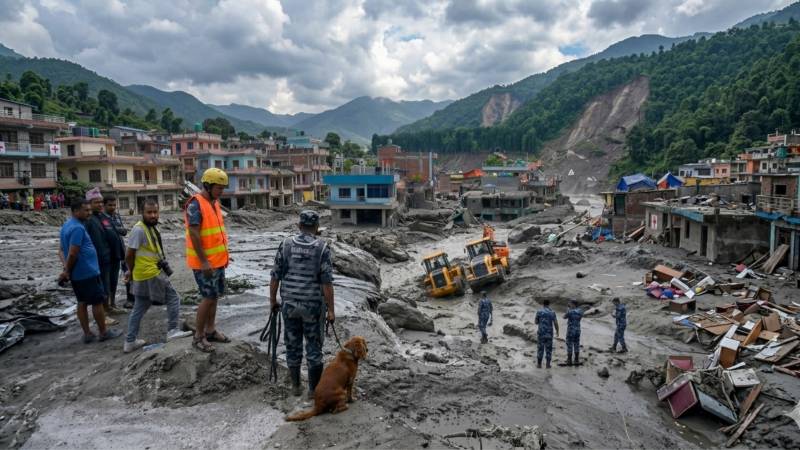
On the morning of August 26, 2026, a glacier collapsed somewhere high in the Himalayas. Within thirty minutes, river levels along the Nepal-Tibet border rose by nearly nine meters. Villages disappeared. Bridges were swallowed. At least 270 people were killed and nearly 1,500 tourists, pilgrims, local families remain missing across Nepal and Tibet. Some were found buried under metres of grey mud. Most have not been found at all.
Pakistan's 2025 monsoon season killed over 1,000 people and displaced more than 4.3 million. Floods from cloudbursts, glacial lake outbursts, and swollen rivers damaged over 12,500 houses and washed away nearly 240 bridges. Among the dead were 255 children. In Nepal this week, the trigger was a glacial collapse. In Pakistan last year, it was cloudbursts and glacial lake outbursts in Gilgit-Baltistan and KPK. The geography is different. The headlines are different. But the story is exactly the same.
Both disasters struck mountain communities that had lived beside these rivers for generations. Both sent walls of water downstream faster than any warning system could respond. Both left governments scrambling to count bodies and distribute relief. And in both cases, the people who suffered most were the ones who contributed least to the problem. Small farmers. Daily wage workers. Villagers living in valleys that had always flooded a little, but never like this.
Scientists studying the Hindu Kush Himalaya region say this is the new normal. The mountains that feed South Asia's greatest rivers are warming faster than almost anywhere else on Earth. The Himalayan region is especially vulnerable to heavy rains, floods, and landslides because of warming driven by human activity. And we are making that worse with almost every decision we take. We Are Not Innocent Bystanders
There is a comfortable story we tell ourselves after each disaster. We call it a natural calamity. We blame the rain, the glacier, the river. We hold press conferences, announce compensation, and then go back to doing exactly what we were doing before. But these floods are not purely natural. They are the result of decades of choices. Choices about how we build, where we build, what we burn, and what we destroy.
The Himalayan region is especially vulnerable to heavy rains, floods, and landslides because of warning driven by human activity.
Forests that once slowed rainfall and held soil in place have been cleared for timber, agriculture, and construction. Riverbanks that once buffered communities from seasonal flooding have been taken over by unplanned settlements and industrial units. Rivers that once ran clear now carry industrial waste and sediment that make every flood more destructive than it needs to be.
In the Himalayas, hydroelectric and infrastructure projects are being built in glacially unstable zones without serious assessment of what a warming climate will do to those zones within the next decade. The Nepal floods this week caused large-scale damage to hydropower dams, roads, buildings, and bridges across the region. These were not buildings hit by bad luck. They were buildings placed in harm's way because no one asked hard enough questions before approving them.
This is what it costs when we do not think ahead. And we are paying for it in lives. Floodwaters tear through Nepal's Himalayan valleys near Betrawati Bazaar, August 26, 2026. What we are leaving behind. The 255 who died in Pakistan's floods last year. The families in Nepal still waiting for news of the missing. And then I think about the children who are alive right now, in Lahore, in Kathmandu, in Gilgit, in Nuwakot, who will inherit whatever world we choose to leave them.
If we do not change course, here is what that world looks like. Glaciers that feed the Indus, the Ganges, and the Brahmaputra continue to shrink. Floods grow more frequent and more intense every year. Agricultural land that has fed communities for centuries gets buried under silt or drowned under rising water. Forests that once cooled our summers and held our hillsides together keep disappearing. Green valleys turn grey. And the children we raised in those valleys have nowhere left to go.
This is not a distant prediction. It is already beginning. We are already living in the early chapters of this story. The question is whether we write the rest of it differently. Grief is not enough. Neither is relief aid, as important as it is in the immediate aftermath. What South Asia needs, and what Pakistan in particular must demand, is a serious shift in how we treat our environment.
Pakistan must invest now in early warning systems for glacial lake outburst floods, particularly in Gilgit-Baltistan and Khyber Pakhtunkhwa. Every infrastructure project in mountain zones must pass a rigorous climate risk assessment before a single brick is laid. Forests must be protected with real legal enforcement, not planted for photo opportunities and then abandoned. Riverbanks must be restored and maintained as natural flood buffers, not sold off for construction.
And internationally, Pakistan contributes less than one percent of global greenhouse gas emissions yet ranks among the world's most climate-vulnerable nations. Our leaders must use every diplomatic forum available to demand that the countries most responsible for this crisis take responsibility for the damage it is causing here.
There is an old idea, shared across many of the cultures of this region, that the mountains are alive. That they watch, and remember, and respond. You do not need to believe in mysticism to understand what they are telling us right now. Nepal is burying its dead. Pakistan is still counting last year's losses. And right now, somewhere in the Himalayas, another glacier is under stress.
We can keep calling these natural disasters. Or we can start calling them consequences. Consequences of choices that could have been made differently, with the right political will and the right sense of urgency. Our green lands, our rivers, our valleys are not resources to extract. They are the inheritance of every child who comes after us. And right now, we are spending that inheritance faster than it can be replaced.
The people buried in mud in Nepal did not cause this crisis. The children killed in Buner last year did not cause this crisis. But they paid for it with their lives. The mountains are weeping. The least we can do is listen.