

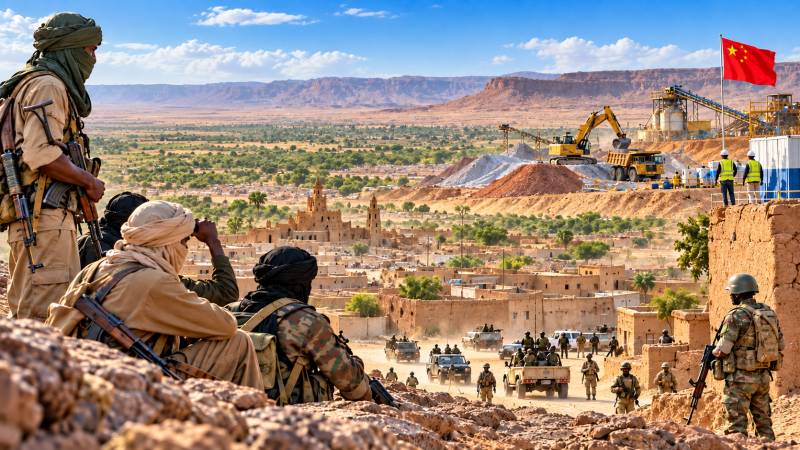
On 25 April 2026, fighters from Al-Qaeda's regional affiliate, Jama'at Nusrat al-Islam wal-Muslimin (JNIM), moved in coordination with the Tuareg-led Front for the Liberation of Azawad against Malian military positions across the country's north, killing the country's defence minister in a suicide bombing and seizing the strategic town of Kidal along with several others in the Timbuktu and Gao regions (Counter Extremism Project). Two days later, the Russian-backed Africa Corps, the successor to the Wagner Group and, until then, the junta's principal external security guarantor, announced its withdrawal from Kidal.
What followed was less dramatic but arguably more revealing: China, whose companies dominate Mali's gold and lithium sectors, did not withdraw. Within months, Beijing had deepened its financial exposure rather than reduced it, backing a majority state stake in a new explosives venture and finalising terms on one of the country's largest lithium deposits (Creamer Media; Skillings Mining Review).
That divergence- Moscow's security partner pulling back as Beijing's economic partner leaned in is the clearest test yet of an argument I have previously made: that China's economic diplomacy in Africa, built on trade, infrastructure, and targeted investment in conflict-prone states, functions as a genuine tool of peacebuilding by addressing the deprivation that drives instability (The Friday Times). That argument held up well against the cases that built it — the Democratic Republic of Congo, South Sudan, Angola, Kenya, the Horn of Africa. Mali in 2026 is a harder case, and it is worth asking honestly whether the model survives contact with it.
The economic-diplomacy thesis reasonably assumes that investment reduces the grievances that fuel conflict, jobs, infrastructure, and integration substituting for the isolation and poverty that insurgencies exploit. It has real evidence behind it: Chinese-financed mining in the Democratic Republic of Congo, oil investment in South Sudan, and the Mombasa–Nairobi railway in Kenya were all cited as cases where this logic produced measurable stabilising effects (The Friday Times). But those states, for all their fragility, were not in the middle of an active war for the capital when the Chinese capital arrived.
Mali, Burkina Faso, and Niger are different entirely: three juntas that seized power between 2020 and 2023 promising to defeat an insurgency they have instead watched grow, now governing through the Alliance of Sahel States (AES) after formally severing ties with ECOWAS, the Rome Statute, and, in Burkina Faso's case, France itself (Modern Ghana). JNIM alone is estimated to have grown from 2,000–3,000 fighters in 2022 to 5,000–6,000 by 2025, and was rated the world's second-deadliest terrorist group that year, responsible for over 1,200 deaths across four countries (NCTC; ADF Magazine). This is not a governance-and-growth problem that infrastructure spending resolves on its own timeline. It is an active counter-insurgency emergency, and China's model was not originally built for this phase.
The clearest evidence that the model is under genuine strain is that JNIM has begun deliberately targeting Chinese interests. In a 2025 offensive explicitly aimed at foreign-run industrial sites, the group struck seven such facilities in Mali's gold-rich Kayes region; six were Chinese-operated, and at least eleven Chinese nationals were abducted (CTV News). Data compiled by the conflict monitor ACLED found that of eighty-nine foreigners kidnapped in Mali and Niger in 2025, thirty-eight held Chinese passports, the largest single nationality among the victims (ADF Magazine).
The central question is no longer simply whether China should remain engaged in Mali, but whether an economic-diplomacy model designed for post-conflict stabilisation can adapt to a live counter-insurgency without inadvertently financing both sides of the conflict.
By December 2025, the Chinese embassy in Bamako was publicly instructing Chinese nationals to evacuate gold-mining sites after a string of fatal attacks, warning plainly that security in those areas was inadequate. Analysts estimate ransom payments now account for as much as 40 per cent of JNIM's annual revenue, meaning the group is, in effect, partly financing its war against the Malian state by extorting the very foreign capital that the model assumes will stabilise it.
What makes this genuinely interesting and genuinely worth writing about is that Beijing's response has not been retreat. In January 2026, Mali's government took a 51 per cent stake in a new explosives venture with Auxin Chemical Technology, a subsidiary of China's state arms manufacturer Norinco, to supply the country's gold, lithium, and quarrying sectors. Around the same time, Chinese firm Ganfeng Lithium finalised its position in the Goulamina lithium project, one of the most significant deposits in the region, with the state retaining a 35 per cent stake, a deal one industry analysis called proof that Beijing was "expanding the [supply chain] it already owns" rather than retreating from instability.
Norinco has separately become one of the principal suppliers of air-defence systems and armoured vehicles to Mali's junta (The Africa Report). The line between "economic diplomacy" and "security patron" that has defined China's public rhetoric on non-interference is, in practice, no longer especially clear. If the thesis is that investment reduces the deprivation driving conflict, then a decade of Chinese capital in Mali's gold and lithium sectors coinciding with JNIM's growth from a few thousand fighters to a force capable of threatening the capital is difficult to reconcile with success. Investment has not measurably weakened the insurgency's core appeal or capability.
China's economic-diplomacy approach was built for states moving from conflict toward stabilisation — post-war Angola, a developing South Sudan not for a live, escalating counter-insurgency crisis with a government under existential threat. Judging the model against Mali's near-collapse may simply be applying the wrong tool to the wrong phase of conflict, rather than exposing a flaw in the tool itself. The Norinco arms sales and the state's rising equity stakes in security-adjacent infrastructure like explosives production suggest China's actual posture in the Sahel has already moved well past pure non-interference, even where its declared doctrine has not caught up. What is being tested may no longer be the economic-diplomacy model at all, but an unannounced hybrid of economic and security engagement.
Beijing's decision to deepen exposure after its nationals were kidnapped and its facilities attacked may reflect less a considered peacebuilding calculation than a "too invested to leave" logic, walking away now would crystallise losses and cede strategic minerals to competitors circling the same deposits, including Western juniors and, increasingly, Gulf and Turkish capital.
The stakes here go beyond assessing one country's foreign policy. If unconditional economic engagement continues alongside — or blurs into — arms transfers to juntas fighting an insurgency that shows no sign of losing, three risks compound: Capital and weapons flowing to the government while ransom flows to the insurgency risks financing both sides of the same war without shortening it. Deepening economic entanglement without governance conditionality may help entrench juntas that have already dissolved political parties and cut off regional oversight mechanisms, trading short-term stability for long-term legitimacy problems (International Crisis Group). Third, the Sahel's rapid multi-alignment risks fragmenting diplomatic leverage. With Russia's Africa Corps, Turkish drones, Gulf financing, and a security-adjacent China all operating in the same theatre, juntas can simply play patrons off one another to avoid negotiated de-escalation (EUISS; Egmont Institute).
The counter-case deserves equal weight: China may currently be one of the only external actors still willing to keep capital flowing into a state on the edge of fiscal and territorial collapse, and a full Chinese withdrawal on top of the departures of France, the reduced US presence, and Russia's own partial pullback from Kidal could plausibly accelerate the very collapse everyone claims to want to avoid. If Beijing wants its economic-diplomacy model to retain credibility as a peacebuilding tool rather than simply a resource-security strategy dressed in that language, three shifts would matter:
Provide transparency on the scope of security-adjacent transactions like the Norinco explosives and armoured-vehicle deals, so that "economic diplomacy" and "arms sales" are not conflated under one non-interference banner. Link continued large-scale investment to demonstrable protection-of-civilians commitments from the juntas it finances, coordinated where possible through the African Union's Peace and Security Council rather than bilaterally. Replicate in the central Sahel the kind of dedicated mediation role China has used in the Horn of Africa through its special envoy model rather than treating the region as a resource-access theatre where instability is simply priced in (The Friday Times; SCMP).
None of this requires China to abandon its investments or its stated principle of non-interference outright. It requires acknowledging, as this analysis has tried to, that the model built in Kinshasa and Nairobi is now operating in Kidal and that the difference between those places is precisely the difference between a peacebuilding tool and a resource strategy that happens to coincide with peace when conditions allow it.