

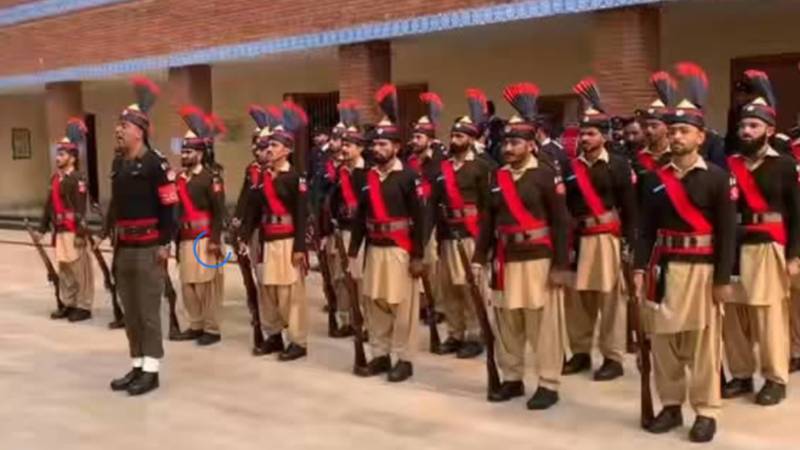
West of the Indus, where the Koh-e-Suleman range meets Balochistan, Punjab works in a geographical and social setting unlike its settled districts. The Border Military Police (BMP) is a subordinate law-enforcement agency of the Punjab Home Department and owes its existence to the Punjab Border Military Police Act, 1904. It is a civil provincial force. It has nothing to do with the Pakistan Army's Military Police.
The Act is specific about purpose and place. It extends to the notified tribal areas of Dera Ghazi Khan and Rajanpur, and it empowers the provincial government to maintain the force for the protection of those areas. The government appoints the Senior Commandant, the Commandant, and other superior officers, and those officers in turn appoint the subordinate officers and personnel under prescribed rules and administer the force. In Dera Ghazi Khan, the deputy commissioner serves as Senior Commandant, which keeps the force tied to the district administration that knows the tribes. A sister Act of the same year served the North-West Frontier, a sign that frontier forces were a deliberate colonial design and not an improvisation.
A Model Born of the Hills
The idea is older than the statute. Dera Ghazi Khan became part of Punjab in 1849, and until 1982, when Rajanpur was carved out and the BMP divided between the two, it was the province's largest district. From 1866, a British deputy commissioner posted there worked out that troops marching into the Sulaiman hills could not stop raiding. In 1868, he toured the hills for fifteen days without a military escort, in the company of tribal chiefs. He authorised stipends for leaders who kept order and enrolled their fighters as levies, and he carried the method to Balochistan, where it was formalised through the settlement of 1876 and the creation of the Baluchistan Agency in 1877.
You cannot assess a frontier force's potential by measuring its decay. The weaknesses are real. The question is whether they are inherent to the model or the product of policy choices
Historical studies that draw on the district gazetteer of 1883–84 describe chiefs appointed to lead levies raised from their own tribes. The Baloch Levies followed in 1910, headed by a police officer answerable to the deputy commissioner in his role as senior commandant, with entry limited at first to men of the tribal area and one neighbouring valley. The principle was simple, and it worked: a frontier is held most cheaply and durably by the people who live on it. In 2024, the divisional commissioner credited the BMP and the Levies with 125 years of keeping the 12,000-square-kilometre Koh-e-Suleman range free of religious and anti-state Baloch militancy.
The BMP is, above all, a human resources idea. Its men are the tribes' own sons, and that shapes everything the force can do. A sepoy raised in the hills knows which families are related and which are feuding, which routes cross the ridges, who settles a dispute, and whose word carries. He speaks the language, and he answers to a community that watches him every day. That is how the writ of the state is kept firm in the hills: a tribal man in the state's uniform is trusted in a way no outsider can quickly become. An able officer posted in from another district may be fully competent, but he cannot gather in a few years what local men inherit over generations.
The Scale of the Challenge
The 2023 census shows the scale of the ground. The tribal area of Dera Ghazi Khan has 248,683 people over about 6,475 square kilometres, and tribal Rajanpur 41,741 over 5,013. Together, nearly 290,000 people live across roughly 11,500 square kilometres, about 25 to the square kilometre, against 1,443,409 in Dera Ghazi Khan tehsil. In 1901, the tribal population was about 30,000, so it has grown roughly tenfold under a force whose strength was last raised in 1994.
In the Dera Ghazi Khan tribal area, 97.7 per cent of people speak Balochi, and literacy stands at 36.04 per cent, with only 19.45 per cent among women. In tribal Rajanpur, literacy is 8.6 per cent, and 4.14 per cent among women. A state that governs here by paperwork does not get far. A state that governs through its own tribal men, and through women recruited to reach women, does.
The crime data deserves attention. In August 2025, the Senior Commandant stated that 134 FIRs were registered in BMP jurisdiction, including four robberies, five incidents of threats or aerial firing, and ten murders. On census populations, that works out to roughly 46 FIRs per 100,000 people. A press report in November 2024 put crime in BMP-controlled tribal areas at about one-tenth of the level in the parts of Dera Ghazi Khan policed by Punjab Police. The Senior Commandant added that only one gang, the Ladi Gang, remains active in Tuman Khosa and that a comprehensive plan to neutralise it has been set in motion.
The Consequences of Institutional Neglect
The proposal to merge is not new. In September 2021, a plan to fold the BMP and the Balochistan Levies into Punjab Police went before a 17-member committee of the Punjab government. Most of its members opposed it. One tribal MPA said a decision of this weight should not rest on a single video clip. The committee was right to hesitate. Tribal representatives understood that an institution staffed by the tribes' own people is not a formality. It is the channel through which the state and the community speak to each other.
What has hurt the force is neglect. No recruitment took place between 1998 and 2025, a gap of about 27 years. The record is unambiguous on this. Sanctioned strength had been raised in 1994 and was then left to age: of 1,507 sanctioned posts, 940 stood vacant, and about 54 per cent of serving personnel were over 45.
In February 2025, the vacancies stood at 165 in BMP Dera Ghazi Khan and 120 in BMP Rajanpur, alongside 378 and 183 in the Levies. When the state finally opened the door, the tribes filled it. In Rajanpur, 2,855 candidates applied, 525 were interviewed, and 180 selected. In Dera Ghazi Khan, 10,236 applied, 771 were shortlisted, and 325 selected. Women joined the force for the first time, 40 in Dera Ghazi Khan and 12 in Rajanpur, which matters in a society where women cannot be investigated by men. Recruits completed six months of training. About sixteen candidates competed for each post in Rajanpur. The young men and women willing to serve their own communities exist in numbers. What was missing was the state's decision to keep the pipeline open.
A senior bureaucrat who previously served as Senior Commandant of the Border Military Police, speaking on condition of anonymity because he was not authorised to speak publicly, frames the matter as one of institutional neglect rather than institutional failure. His argument, stripped to its core, is this: the BMP has been judged by what it looks like after decades of abandonment. It has been given neither the training, the equipment, the communications, the mobility, nor the career structure that every other police force in Punjab takes for granted. You cannot assess a frontier force's potential by measuring its decay. The weaknesses are real. The question is whether they are inherent to the model or the product of policy choices.
A Modern Frontier Force
The record answers that question. A force starved of recruitment for 27 years has been neglected, and neglect proves nothing against the model. The Katcha shows the division of labour. In that riverine belt, Punjab Police used drones and large operations, and hundreds of criminals surrendered in early 2026. Those tools suit open, flat terrain. The hills need what the BMP already has: men who belong to them. Punjab Police has real strengths the BMP lacks at scale, including a larger workforce, specialised units, counterterrorism structures, forensic laboratories, and digital systems. Those should be available to the frontier whenever needed. Borrowing capability is different from absorbing the institution.
The choice need not be the BMP or Punjab Police. A stronger model keeps a distinct BMP and links it to Punjab Police and CTD for specialised support. Recruitment stays merit-based and rooted in the tribes. Training covers investigation, intelligence, forensics, digital policing, communications, human rights, counterterrorism, and mountain operations, with regular refreshers and not a one-time course. The force gets modern communications, vehicles, protective gear and technology, digital FIRs and sound record-keeping, and wider recruitment of women. Above all, it gets a functioning career structure and independent oversight, so that local knowledge is joined to professional discipline.
The question is not whether Punjab Police is capable. It clearly is. The question is whether every policing problem demands the same institutional answer. Where terrain, society, and threats differ, uniformity is not efficiency. The tribal man in uniform is the state's best instrument for making its writ hold in the hills. If the state wants stronger policing on the frontier, it should strengthen the institution already there: recruit locally, train professionally, equip it properly, and hold it to account.
The BMP should be judged not by what decades of underinvestment have made it, but by what it can become once the state finally invests in it.