

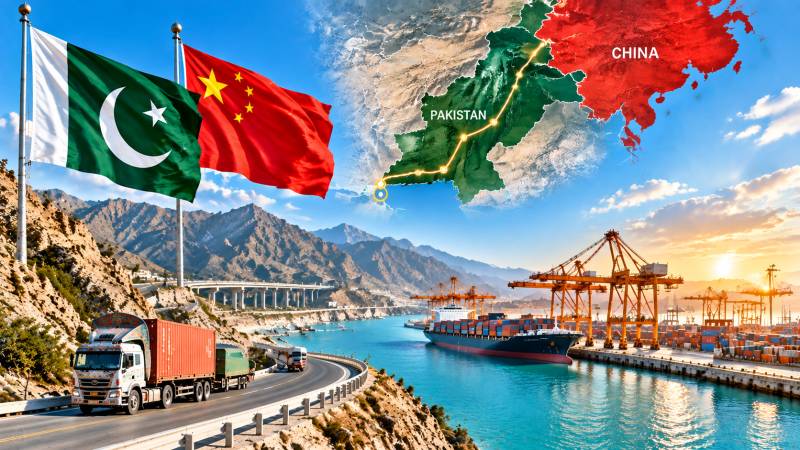
About seventy-six years ago, a newly independent Pakistan became one of the first Muslim countries to recognize the People’s Republic of China. Formal diplomatic relations between the two states were officially established in 1951. Consequently, an alliance was created between the two that has managed to outlive governments and wars on both sides. Importantly, in 1971, Islamabad helped arrange Henry Kissinger’s secret visit to Beijing to meet up with Premier Zhou Enlai. Over the years, Beijing has also reciprocated these gestures. It has repeatedly backed Pakistan up at the UN Security Council on Kashmir. Various forms of defence cooperation, such as the construction of the Karakoram Highway (KKH) and the agreement on the joint production of JF-17 Thunder jets, have given real merit to the “iron brothers” narrative. The most visible form of this partnership, however, lies in the China-Pakistan Economic Corridor (CPEC), an offshoot of China’s own Belt and Road Initiative (BRI).
Since 2015, CPEC has served as the flagship project of China’s BRI. Worth $46 billion when it was first launched in 2015, the figure has now grown to roughly $62 billion as additional financing rounds continue to be approved over the years. CPEC’s own secretariat asserts that 14 energy projects have been completed that have added around 8,020 MW to the grid. Alongside this, one HVDC transmission line has also been put into place. Additionally, six more energy projects are currently in the pipeline, which also includes a 300 MW coal-fired power project at Gwadar. Undeniably, these energy projects under CPEC’s umbrella have eased the acute blackouts and chronic shortages experienced by Pakistan's national grid prior to 2018. All in all, this demonstrates the tangible development benefits that can be achieved through such bilateral initiatives.
In contrast to this, the Gwadar and infrastructure aspects of CPEC illustrate the transitional challenges that are typical of large-scale infrastructure sequencing. For instance, the completion of transportation projects such as KKH Phase 2, the Multan-Sukkur Motorway, as well as the Orange Line Metro Train, demarcate the successful completion of CPEC’s Phase 1 infrastructure portfolio. Gwadar, meanwhile, is best understood as a project still in its early operational phase, with clear prospects ahead. While the port itself is physically completed and the new Gwadar International Airport, estimated at US $230 million, has been open for mostly domestic routes, Gwadar currently operates 3 berths against Karachi Port’s 40, and its annual throughput of 8,300 TEUs remains well below its designed capacity of 100,000 TEUs – figures that reflect a port that is ramping up rather than one that has stalled.
CPEC represents the most visible expression of the China-Pakistan partnership, transforming decades of diplomatic cooperation into a long-term framework for economic connectivity, infrastructure development, and regional integration.
More recently, Gwadar Port has witnessed a notable increase in activity amid disruptions to shipping through the Strait of Hormuz. The port processed approximately 11,000 containers in April 2026 alone, compared with roughly 8,300 containers during the whole of 2025. In addition, Gwadar handled approximately 200,000 tonnes of transit breakbulk cargo over a three-month period in 2026. These developments indicate that the port is beginning to assume greater importance as a temporary logistics and transshipment point for cargo affected by disruptions in the Gulf. The increase in activity has been supported by measures aimed at attracting transit and transshipment business, including free-storage incentives for cargo. Gwadar Port also offers around 90,000 square metres of storage capacity for general cargo, providing additional space for cargo that requires temporary handling and storage before onward shipment. Besides, The Rashakai Special Economic Zone (SEZ) is likewise progressing towards its second and third phases, with timelines being calibrated to the pace of the surrounding infrastructure build-out.
These transitional challenges are best understood within the security environment in which CPEC operates. Security remains the foremost challenge to CPEC’s progress, one that both countries continue to address together. On record, 9 Chinese engineers were killed in the 2021 Dasu bus attack, while 5 more died in the 2024 Shangla suicide attack. China’s concern regarding these security incidents has been publicly acknowledged, alongside a shared commitment to resolving them. Coordination between federal and provincial authorities continues to strengthen as CPEC matures, particularly in Balochistan, where further efforts are under way to ensure the province shares more visibly in the corridor’s socio-economic benefits.
Importantly, China and Pakistan have taken concrete joint countermeasures. The latter established the Special Security Division, a dedicated force of over 15,000 personnel tasked with protecting Chinese nationals and CPEC installations, complemented by composite battalions deployed along the corridor’s key routes. Intelligence-sharing arrangements between the two countries have also been strengthened, alongside joint counter-terrorism dialogues and periodic security reviews at the ministerial level. China, for its part, has extended support through technical assistance, surveillance equipment, and training exchanges for Pakistani security personnel. Together, these measures signal a shared recognition that safeguarding CPEC is inseparable from safeguarding the broader partnership.
These challenges, however, are far from insurmountable. Underlying local concerns, including resource distribution and employment, are known to be exploited by external actors including Indian intelligence and Gulf-based networks funding separatist groups such as the BLA to target Gwadar Port and CPEC projects. A fuller inclusion of Baloch communities in the economic gains of Gwadar would go a long way towards addressing these concerns, in keeping with both governments’ stated commitment to inclusive and shared development.
Last but not least, we postulate that more focus should be directed towards the development of SEZs so that they may be pushed into their second and third phases of development in a timely manner. Agricultural cooperation and technological exchange, especially in electric vehicles, also merit greater attention going forward. Equally crucial are cultural exchanges, especially among academics, which can help sustain the relationship beyond purely economic and security dimensions. After all, the corridor cannot survive alone on energy projects.
In spite of these occasional challenges, the roots of mutual interest run too deep for the storm to topple the tree. The relationship's ability to endure security challenges and economic pressures is, in itself, evidence of its durability. In the end, it is China’s interest in regional connectivity and energy security through Gwadar, as well as Pakistan’s economic and developmental partnership with China, that gives segue to a strong foundation for continued cooperation.
Looking ahead, CPEC is well positioned to move smoothly into a new phase of cooperation, one that shifts emphasis from large-scale infrastructure towards industrial collaboration, special economic zones, agriculture, and people-to-people exchange. This evolution does not diminish the corridor's strategic significance; rather, it reflects the natural maturation of a long-term bilateral project entering its consolidation stage. As both countries continue to address security and coordination challenges collaboratively, CPEC remains poised to reaffirm its role as a cornerstone of China-Pakistan relations and a driver of regional connectivity for years to come.