

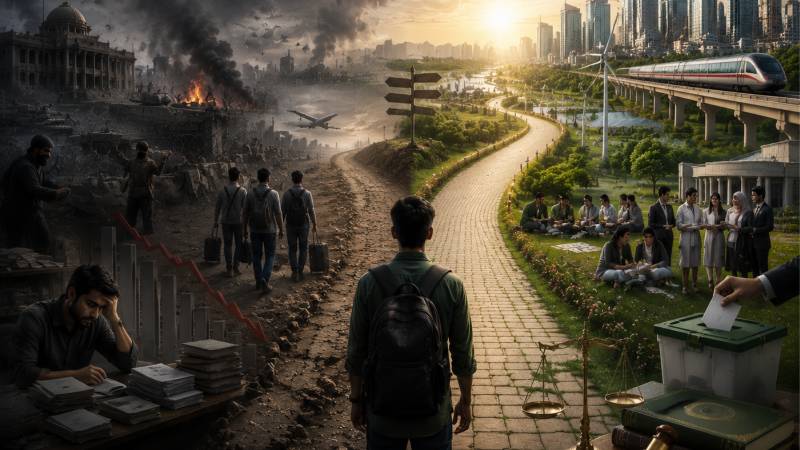
In Pakistan, there is much debate about why under successive governments, there has not been sustained economic growth. Over the last 80 years of history, Pakistan has experienced short periods of economic growth but then very quickly it is followed by long periods of economic stagnation. Every few years, there is the same balance-of-payment crisis, rising unemployment, a new IMF program, heavy taxation and this cycle repeats. What lies at the heart of this problem is often debated. Recently, I finished reading Why Nations Fail by Nobel Prize-winning economists Daron Acemoglu and James Robinson. The book argues that long-term differences in national prosperity arise primarily from whether political and economic institutions are inclusive or extractive. Geography, culture and individual policy mistakes may matter, but the distribution of political power often determines whether productive policies and broad-based economic opportunities can endure. Those nations with strong political institutions have flourished over the last several centuries whereas nations with weak political institutions even though may have achieved brief periods of economic activity, it was not sustainable. The book argues that long-term differences in national prosperity arise primarily from whether political and economic institutions are inclusive or extractive.
If you look at Pakistan’s current situation, many Pakistanis don’t believe the country is on the right track. Those in power think economic weakness is because there should be more provinces or we need to attract foreign direct investment, National Finance Commission Award needs to be fixed, there is lack of internal security, population growth is uncontrolled, political elite is corrupt etc. These factors directly constrain growth, but their persistence and the state’s inability to address them often reflect deeper weaknesses in political, legal and administrative institutions. What lies underneath these problems is a deeper structural problem of weak political and legal institutions.
History
Among the political institutions the most important one is the constitution. And the very first task of any newly formed country should be to formulate a constitution. Pakistan’s first constitution came in 1956; 9 years after the independence. Compare that to India, which adopted its constitution in 1950 and Bangladesh whose constitution came into effect one year after formation of the country. And even the first constitution of Pakistan did not last long, and martial law was established in 1958 in the name of bringing political stability to the country. Martial law in essence is evidence of institutional failure and even though it brings temporary stability, it never allows legitimate and inclusive political institutions to grow and flourish. It is just like a patient who is learning to walk is only given crutches to walk and never allowed to walk on his own feet. When the patient falls at the beginning when learning to walk on his own feet, the natural reaction is to give crutches so that it doesn’t fall. But when due to fear of failure the patient is never allowed to learn to walk, crutches become permanent. Similarly, martial laws of Pakistan and now the hybrid regime has given a semblance of stability on the surface, but there are always strong undercurrents of instability when the crutches of martial law or hybrid regime are removed. A legitimate and inclusive political system is a foundational principle of a modern state and martial law in essence is a non-inclusive order decided by the dictator and running on the whims of one individual. Similarly, a hybrid regime has the appearance of civilian facade, but at its core military leadership is the ultimate decision-maker. This never allows the political institutions to strengthen and therefore the patient i.e. the country remains on crutches of military support.
The Constitution: Core Institution
General Zia-ul-Haq once said ““What is the Constitution? It is a booklet with ten or twelve pages. I can tear them up and say that from tomorrow, we shall live under a different system. Is there anybody to stop me?”. This view misunderstands the deeper function of a constitution. It brings order to the entire society and that no one individual is considered above the law. The entire society functions under this framework which then gives way to inclusive political and economic institutions to be established and over time extractive political and economic forces are weakened. This brings a level playing field which allows progressive economic forces to move the economy forward. Yet, this issue receives insufficient public discussion in Pakistan. No country should expect stable economic growth without a strong constitutional framework that is followed by all institutions of the country. The Constitution must be supreme over all organs of the state. The US President’s oath of office states “I will faithfully execute the Office of President of the United States, and will … preserve, protect and defend the Constitution of the United States”. A central obligation of every public office-holder is to uphold the constitutional order rather than the institutional or personal interests of the office-holder. A clear illustration occurred on October 12, 1999, when Prime Minister Nawaz Sharif announced the removal of General Pervez Musharraf and appointed Lieutenant General Ziauddin Butt as army chief. Senior military commanders refused to accept the change and overthrew the elected government. Whatever political or legal disputes surrounded the prime minister’s decision, they should have been resolved through constitutional and judicial procedures rather than military intervention. Obedience to constitutional authority would have strengthened the state; the coup weakened it. The armed forces must accept the lawful authority of elected civilian institutions, while civilian leaders must exercise their constitutional powers through transparent procedures and in accordance with law. Disagreements over appointments, policy or command must never result in unconstitutional intervention. Constitutional systems are tested precisely when political actors disagree. Their strength lies in resolving such disputes through constitutional mechanisms rather than extra-constitutional intervention.
Weak institutions create uncertainty. Uncertainty reduces investment. Low investment reduces productivity. Low productivity limits exports, wages, and tax revenues. Weak tax revenues then push the country back toward borrowing and IMF programs. This is how political instability becomes economic stagnation.
Economic Symptoms of Institutional Failure
The institutional crisis also appears clearly in Pakistan’s economic indicators. GDP growth has repeatedly moved in short bursts rather than a stable path. According to Pakistan Bureau of Statistics, after growth of approximately 5.8% in FY2021 and 6.2% in FY2022, the economy contracted by about 0.2% in FY2023. Growth subsequently recovered to 2.62% in FY2024, 3.18% in FY2025 and a provisional 3.70% in FY2026. The latest Economic Survey reports an investment-to-GDP ratio of 14.38% in FY2026, compared with 14.42% in FY2025. Net FDI has remained small and volatile, while Pakistan’s 2024 IMF program is commonly counted as its 25th since the country joined IMF in 1950. The state’s fiscal capacity is also weak. Even after improvement, the federal tax collection increased to 10.3% of GDP FY25. Meanwhile, hundreds of thousands of Pakistanis continue to register for overseas employment every year, including thousands of doctors and engineers. These numbers show that Pakistan’s problem is not simply a shortage of economic policy ideas; it is a crisis of confidence in the political, legal, and constitutional order.
Failed Elections
On top of lack of recognition of the importance of constitutional framework, Pakistan has seen elections rife with problems. Pakistan’s 2024 election was marked by serious credibility concerns, including restrictions on political competition, the election-day communications shutdown, delayed results and disputes concerning results documentation. This impression has strong economic implications. Even though there is strong emphasis in Pakistan on foreign investment, I argue that the fundamental engine of growth in any country is its own people. Pakistan will rise only when Pakistanis will rise. According to Ipsos Consumer Confidence Index Q2 2026, only 2 in 10 Pakistanis believe the country is going in the right direction. It is not realistic to imagine economic growth when nearly four in five people express dissatisfaction with the country’s trajectory. A nation that is not hopeful of its future cannot be expected to invest in its future and increase economic productivity. Another worrying trend is how many youth are wanting to leave Pakistan permanently. According to Ipsos 2024 survey, 1 in 4 Pakistani youth were considering leaving Pakistan. When people see that their representatives are not in power, they lose hope in the future, and a hopeless nation will never see sustained economic growth. Persistent pessimism can discourage long-term investment, weaken willingness to take entrepreneurial risks and increase the desire of skilled citizens to leave. Restoring confidence requires tangible institutional and economic improvements too and optimism alone is not sufficient.
Law and Public Confidence
Using legal system against political enemies erodes confidence in legal system. Every investor will look at whether their investment will have sufficient legal protection or not. When the legal system is used to manage political competition, it damages confidence not only among voters but also among investors, professionals, and entrepreneurs. This follows the mindset that political parties and political forces don’t matter much in the affairs of a state and can be eliminated by force without consequences for the country. The lesson of history here is that political forces if only eliminated by the people who elect them and give them legitimate power, result in long-term political stability. Heavy-handedness to remove them tends to increase their power and results in politically weak institutions. Weak institutions create uncertainty. Uncertainty reduces investment. Low investment reduces productivity. Low productivity limits exports, wages, and tax revenues. Weak tax revenues then push the country back toward borrowing and IMF programs. This is how political instability becomes economic stagnation. Pakistan repeatedly fails to sustain economic reforms because weak institutions prevent governments, investors and citizens from making credible long-term commitments to reform.
A nation that is not hopeful of its future cannot be expected to invest in its future and increase economic productivity.
Revive the Hope
The very first thing Pakistan must do is to revive hope among its population in general and especially its youth. A hopeful nation can be expected to rise and increase its economic output if right policy framework is implemented. A hopeless and frustrated nation cannot be expected to make any meaningful economic progress. Political governments both at federal and provincial level supported by public mandate can revive hope in an otherwise hopeless nation. People must see their elected leaders in power. Hybrid regimes foster political alienation by preserving the appearance of democratic participation while weakening citizens’ ability to translate their preferences into accountable government. Public Opinion Quarterly 2024 journal article “The Dynamics of Electoral Manipulation and Institutional Trust in Democracies: Election Timing, Blatant Fraud, and the Legitimacy of Governance” surveyed data from 335,000 citizens in 58 countries found that electoral fraud undermines trust in governments and legislatures. This supplies large-scale evidence for a central mechanism of hybrid rule: elections are held, but manipulation convinces citizens that formal institutions do not genuinely represent them.
Hybrid regimes foster alienation because they retain the procedures of democracy while weakening citizens’ ability to influence actual power. Elections are conducted, parliament sits and public consultations are held, but unelected institutions, manipulated electoral processes or controlled avenues of participation restrict the public’s capacity to secure political change. Empirical studies show that electoral fraud reduces trust in governments and legislatures, that perceptions of unfair elections reduce citizens’ propensity to vote, and that managed civic participation often permits consultation without meaningful influence. Pakistan illustrates this dynamic particularly clearly. According to 2024 Ipsos survey titled “Political Participation and Landscape of Pakistani Youth”, half of surveyed young Pakistanis believed elections would have little effect on their lives, while three in five felt political leaders did not understand their priorities. When citizens are formally invited to participate but remain unable to hold the real centers of power accountable, political participation increasingly appears symbolic rather than consequential.
Tired of this hopelessness, many Pakistani youths want to find work abroad. Some have argued that it is a good thing that Pakistanis are finding jobs abroad because they will increase foreign remittances. The fact of the matter is large-scale emigration of educated and skilled citizens weakens the country’s human-capital base and policy capacity. This has resulted in weak policy decisions and weak policy implementation capacity. Large-scale emigration reduces the country's stock of technical expertise and administrative capacity, making effective policy implementation more difficult. Even though reviving hope is foundational, hope alone will not fix the problems. A renewed confidence in the country’s future needs to be accompanied by right policy framework that includes secure property and contractual rights; access to capital; reliable energy and infrastructure; human capital; predictable taxes and regulation; competitive markets; and physical security.
Establish Political Legitimacy
Re-establish respect for political leadership. Ever since the restoration of democracy in 1988, there has been a campaign of maligning politicians in general and creating this impression that all politicians in Pakistan are inherently corrupt and incompetent. As a matter of fact, this cannot be true and even if politicians might be corrupt or incompetent, their removal has to be established through legitimate court proceedings and elections. And Pakistan has seen old political dynasties collapse and new leadership emerge. Repeated cycle of free and fair elections will automatically eliminate corruption at large and bring in new faces that may not be 100% corruption-free but will definitely be better than their predecessors.
Every single institution of the country must decide once and for all that they will follow the constitution. If the prime minister decides that they need to replace an army chief, they should be empowered to do so and army as an institution must decide that if the political leadership decides that they need to replace the army chief, there must not be another coup. Similarly, the judiciary must decide they will work within the constitutional framework and will no longer give legitimacy to any future martial law. The politicians must decide that they will no longer work with ISI or army to topple any government. All these actions have weakened Pakistan as a state and has weakened political institutions resulting in economic stagnation.
A core requirement of strong institutional governance is independent and strong judiciary. Every investor wants to see their investments protected and a reasonable guarantee that if a dispute arises, courts will be there to protect. Much needs to be done to restore investor confidence in the legal system but an added problem recently that has happened after 26th and 27th amendment is that the executive has too much power over the judiciary. For the highest-stakes constitutional litigation, appointments, chief-justice selection, court structure, acting appointments, and transfers, these amendments give the executive and ruling parliamentary majority far more leverage over the judiciary than before. This has created an impression that judiciary is no longer independent and therefore in any matter involving the state or state institutions, the investor is always going to be at a disadvantage. Therefore, investor confidence might have shattered, and investment rates are declining.
Changing Incentives
Weak institutions persist because they are often politically useful to those who benefit from concentrated power. Pakistan’s weak agricultural-income taxation protects influential landowners; provincial control over local-government finance preserves politicians’ command over development funds and patronage; and discretionary appointments and transfers benefit both political leaders and well-connected officials. Similar patterns appear throughout Acemoglu and Robinson’s Why Nations Fail. Sierra Leone’s post-independence leaders retained and intensified colonial marketing boards and chieftaincy structures because these institutions generated revenue and political control. Venice’s established families closed the Great Council and restricted commercial opportunities when economic mobility began producing political competitors, while the Habsburg monarchy obstructed industrialization because factories and railways threatened the existing social order. England escaped this cycle only when the Glorious Revolution redistributed power to a broad coalition and imposed durable constraints on rulers. Institutional reform therefore requires altering the distribution of power, rents and accountability—not merely replacing one set of officeholders with another.
The lesson of the Glorious Revolution is that entrenched power rarely becomes accountable through appeals to individual goodwill. Reform occurs when social, economic and political groups develop sufficient collective power to resist arbitrary authority and establish rules that constrain whoever governs next.
Democratic Education
These ideas and concepts are generally not taught in Pakistan and therefore, youth and the society in general do not understand the importance of constitutional order and how political inclusiveness is a pre-requisite for the economic inclusiveness which in turn leads to long-term economic progress. ‘Why Nations Fail’ is an extraordinary work that Pakistan’s political elite can benefit from immensely. If Dr. Acemoglu and Dr. Robinson can be invited for lectures throughout Pakistan, that would be the best-case scenario but I believe that at a minimum ‘Why Nations Fail’ should be taught at Civil Services Academy, Judicial Academy, Defense College, Foreign Services Academy and any other political and policy institution of any consequence. The second thing that must be done is that Civic Education should be a must in every school. Children must be taught the dark constitutional history of Pakistan, why Pakistan broke up, why martial laws are not a solution and how inclusive political and economic institutions are must for long-term progress. Over a generation, things will change.
Weak political institutions are the principal reason Pakistan has struggled to sustain long-term economic growth despite repeated episodes of reform. Without constitutional supremacy, credible elections, independent courts, and legitimate civilian authority, neither citizens nor investors will have enough confidence to build a productive long-term economy. Economic policy can change in a budget cycle, but institutions evolve over generations. Countries become prosperous not because they discover a single successful policy, but because they build institutions that allow good policies to survive changes in governments, personalities, and political crises.