

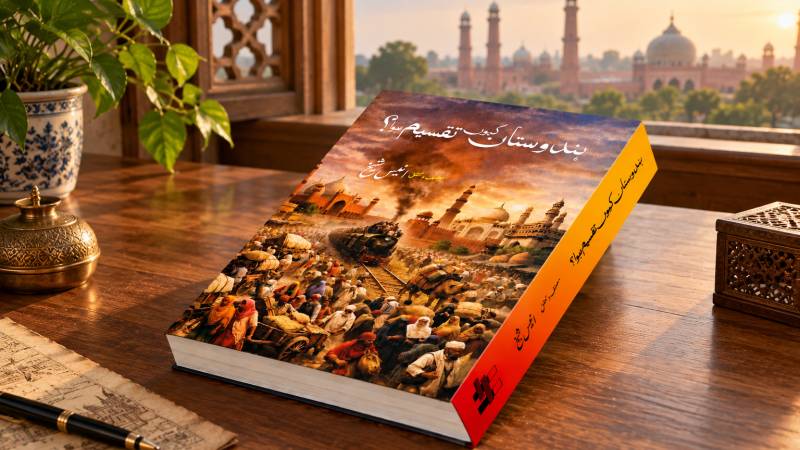
Few questions in South Asian history appear as simple in wording and as difficult in substance as the one Anees Sheikh places at the center of his book: Why was India partitioned? The temptation to answer quickly is strong. One can blame colonial policy, the Muslim League, Congress, communal politics, individual leaders, constitutional failure, or the violence of the 1940s. Each explanation contains part of the truth, yet none is sufficient on its own. The central achievement of Sheikh’s work is that it resists the comfort of monocausal history. Instead of treating 1947 as a sudden political rupture, the book approaches Partition as the outcome of a long historical process in which mistrust accumulated, constitutional arrangements repeatedly failed, political positions hardened, and the possibility of accommodation gradually narrowed.
This long view is essential because the crisis of 1947 cannot be understood adequately by beginning in 1940, 1946 or even the late 1930s. Sheikh takes the reader back through the major constitutional and political developments that shaped Muslim political consciousness in British India: the question of representation, separate electorates, the Partition and annulment of Bengal, the creation of the Muslim League, the Lucknow Pact, the Khilafat Movement, the Nehru Report, Jinnah’s constitutional demands, and the changing dynamics of provincial politics. The point is not simply to construct a chronology. It is to show how one unresolved issue can affect the next, how a failed compromise can leave behind political memory, and how fears repeatedly dismissed as exaggerated can eventually crystallise into collective political claims.
Yet the very richness of this chronology makes one distinction indispensable: Muslim political insecurity was not the same thing as the demand for a separate sovereign state. Muslims in British India expressed concerns over representation, constitutional safeguards and political power long before Pakistan emerged as an explicit demand. To read every Muslim demand before 1940 as if it were already a step towards Pakistan is to impose the known outcome of 1947 upon a past in which that outcome was not yet known. Many political actors sought, for long periods, constitutional arrangements within a united India. Separate representation, minority protection, provincial autonomy, federal restructuring and full territorial separation were different political ideas that developed at different moments. Sheikh’s work is most valuable when it reminds the reader that history must be read forward from the uncertainty of the past, not backward from the certainty of its outcome.
The treatment of the Nehru Report of 1928 illustrates both the strengths and the interpretive challenges of this kind of historical reconstruction. The report occupies an important place because it brought into sharp relief questions of constitutional structure, the powers of the center, minority safeguards and Muslim representation. These were not abstract institutional matters. They touched directly on the deeper question of whether minorities could trust a future constitutional order in which permanent numerical majorities would matter enormously. It is therefore reasonable to view the Nehru Report as a major turning point in the deterioration of political confidence. At the same time, it would be too simple to regard it as the singular beginning of Partition. The Urdu-Hindi controversy, Bengal, separate electorates and earlier disputes over representation had already exposed important tensions. A historical turning point may accelerate a process without creating it from nothing.
This is where historical method becomes crucial. Sequence is not the same as causation. The fact that one event precedes another does not prove that the first produced the second. Between chronology and explanation lies the difficult task of identifying mechanisms. If a constitutional dispute contributed to later separatist politics, the historian must show how: Did it change elite calculations? Did it alter public opinion? Did it weaken trust? Did it affect electoral strategy? Did it make compromise appear less credible? Sheikh’s reconstruction often invites precisely this sort of inquiry. The most persuasive historical narratives are those that not only arrange events in order but explain why certain events acquired consequences far beyond their immediate moment.
The book’s discussion of communal violence raises similar questions. The horrific violence of 1946 and 1947 did not materialize in a vacuum. Earlier communal tensions and riots had already created patterns of fear, retaliation and political mobilization. Sheikh’s attention to these episodes is therefore important because it challenges any notion that the collapse into violence came without antecedents. But counting riots is not enough. The real historical question is how violence transformed political possibility. Which incidents hardened communal identities? Which made populations fear domination by the other side? Which altered the rhetoric of political parties? Which convinced people that constitutional coexistence was becoming dangerous or unrealistic? Violence matters historically not simply because it happened, but because it changed what people believed was politically possible.
One of the book’s strongest qualities is its documentary temperament. Political history in South Asia is too often reduced to inherited narratives in which one community’s leaders appear farsighted and principled while the other side’s are depicted as obstinate, communal or conspiratorial. Such narratives are emotionally satisfying but analytically weak. Sheikh’s method places considerable weight on documents, political statements, resolutions and chronological evidence. This gives the book seriousness and scope. Documentary history, however, also demands caution. Documents do not speak independently of interpretation. The historian decides which document deserves emphasis, which event receives several pages and which receives a paragraph, which statement counts as decisive and which is treated as peripheral. Selection itself is interpretive.
For that reason, the real test of historical fairness is not merely how effectively an author assembles evidence in support of a thesis. It is how seriously contrary evidence is treated. If Congress is criticised for centralising impulses, evidence of accommodation within Congress must also be considered. If Muslim political fears are treated as genuine, the fears of Hindus and Sikhs in Muslim-majority regions must also be acknowledged as historically real. If the Muslim League’s position changed over time, that evolution must be explored rather than treated as proof of inconsistency or inevitability. Historical writing becomes persuasive when it resists the urge to divide the past into heroes and villains and instead asks why different political communities acted as they did under the pressures they faced.
The British role in Partition demands precisely this balance. “Divide and rule” captures an undeniable feature of imperial politics, but as a total explanation of 1947 it is insufficient. British constitutional decisions shaped the political framework within which Indian parties competed. Separate electorates, constitutional reforms, provincial arrangements, wartime decisions, the Cabinet Mission and the transfer of power all influenced the course of events. Britain was neither neutral nor powerless. Yet it would be equally misleading to reduce Indian political actors to mere instruments of colonial manipulation. Congress, the Muslim League, provincial parties, religious organisations, landed elites and regional interests pursued their own goals. A more useful historical question is not whether Britain was responsible in some abstract sense, but where British policy institutionalized differences, where it intensified them, where it attempted compromise and where it made an already difficult situation more brittle.
The political evolution of Muhammad Ali Jinnah is another area where simplistic history is inadequate. The Jinnah of the Pakistan movement was also the Jinnah who had spent an earlier phase of his political career advocating constitutional cooperation within a united India. To focus only on his later position is to miss the significance of that transformation. The more interesting question is how and why a politician once identified with Hindu-Muslim unity gradually came to support a separate political arrangement. That journey cannot be understood apart from failed negotiations, constitutional disagreements, changing electoral realities and deepening mistrust. The same approach should be applied to Gandhi, Nehru, Patel and other major leaders. None entered history with immutable positions. Political leaders evolved because circumstances, constituencies and strategic possibilities evolved around them.
Partition also looks very different when viewed from Punjab and Bengal rather than only from Delhi, Bombay or London. The line of Partition was not an abstract constitutional formula; it passed through real provinces, villages, districts and communities. Punjab contained a complex balance of Muslim majority, Sikh concentrations, Hindu urban interests, landed elites and Unionist politics. Bengal presented another configuration shaped by agrarian relations, religious identity, regional politics and Bengali nationalism. These variations matter because the “Muslim question” was never identical across British India. Muslims in minority provinces confronted different anxieties from Muslims in Punjab, Bengal or Sindh. Similarly, Sikh political fears in Punjab or Hindu concerns in Bengal cannot be understood through an all-India framework alone.
It is about the consequences of accumulated mistrust, the fragility of compromise, the danger of turning every disagreement into an existential contest, and the human cost when political systems lose the ability to contain diversity.
This provincial complexity is essential because it prevents history from becoming excessively centred on elite negotiations. The debates between national leaders mattered enormously, but they were filtered through provincial realities. Electoral politics, landed structures, local religious networks, linguistic identities and economic interests shaped how all-India constitutional proposals were received on the ground. A federation acceptable to one region could appear threatening to another. Minority protections sufficient for one community might be regarded as inadequate elsewhere. Thus Partition should not be imagined simply as an ideological clash between Congress and the Muslim League. It was also the result of multiple provincial political systems being forced into, and then pulled apart by, competing visions of sovereignty and representation.
The scale of Sheikh’s work, more than seven hundred pages reflects the magnitude of the subject. Its breadth allows the reader to encounter a large body of political material, but comprehensiveness also creates a methodological burden. Historical writing is not strengthened merely by the accumulation of facts. It must establish hierarchy. Which developments were fundamental causes? Which were symptoms? Which accelerated existing trends? Which were consequences mistaken for causes? Which events were symbolic rather than decisive? The historian’s task is not merely to construct an archive but to interpret one. The quality of a major historical work often depends on its ability to distinguish the central from the peripheral without oversimplifying either.
Perhaps the most important contribution of Why Was India Partitioned? is that it forces the reader away from single-cause explanations. “Jinnah caused Partition.” “Nehru caused Partition.” “The British engineered Partition.” “Hindus and Muslims could never live together.” Each of these statements compresses a complex historical transformation into a reassuring slogan. The evidence instead points towards interaction: accumulating mistrust, competing nationalisms, constitutional failures, imperial structures, electoral competition, provincial interests, communal mobilization, outbreaks of violence and choices made by leaders under intense pressure. No single factor explains 1947. The outcome emerged from the interaction of several forces whose significance changed over time.
This is also why the history of Partition remains relevant far beyond commemorative anniversaries. At its deepest level, the subject asks how diverse societies lose the capacity to negotiate difference. How does trust between majorities and minorities deteriorate? At what point do constitutional guarantees cease to appear credible? When does a political disagreement become a question of collective survival? How do parties gain by mobilising fear? When do citizens stop asking how they might continue living together and begin asking how they might separate? These are not questions unique to British India. They remain central to every diverse society in which demographic majorities, minority rights, regional autonomy and competing national identities must coexist within a constitutional order.
At this point, the book’s title generates a deeper question than the one with which it begins: Was Partition inevitable, or did it become inevitable only after enough alternatives had failed? The distinction is fundamental. If Partition was unavoidable from the beginning, then the preceding decades become little more than a route towards a predetermined destination. Every dispute appears retrospectively as another milestone on the road to 1947. But if genuine alternatives existed—federal compromises, power-sharing arrangements, revised constitutional settlements, then the meaning of Partition changes. It becomes not simply the fulfilment of national destiny or the inevitable collapse of a doomed union, but the cumulative result of failed negotiations, missed opportunities, escalating fears and the gradual disappearance of political space.
That distinction may be one of the most important lessons of the entire subject. Political possibilities do not remain available forever. A compromise rejected at one moment may not be recoverable ten years later. Trust, once repeatedly exhausted, becomes difficult to reconstruct. Positions harden not only because leaders become more uncompromising, but because constituencies themselves change. Fear acquires institutions, slogans, memories and electoral consequences. At some point, arrangements that once appeared possible can come to look naïve or even dangerous. Thus an event may not have been inevitable at the beginning, yet may eventually become difficult to avoid because earlier choices have narrowed the field of alternatives.
No history of Partition, however, should end at the level of constitutional theory. Behind every resolution stood millions of people who neither drafted constitutions nor negotiated at imperial conferences. When the map was redrawn, families were uprooted, homes abandoned, neighbourhoods emptied and communities that had lived together for generations were separated. Millions migrated. Countless people suffered violence, dispossession, insecurity and loss. The political language of sovereignty, nationhood and constitutional safeguards therefore has a human counterpoint that must never be forgotten. States may be created by drawing lines on maps, but human beings pay the price of those lines. The final measure of 1947 cannot be only who gained a state, who lost influence, or which political strategy succeeded. It must also ask what ordinary people lost when politics failed to preserve coexistence.
Anees Sheikh’s Why Was India Partitioned? is therefore valuable not because it closes the argument, but because it reopens it. It can be agreed with, questioned, challenged and compared with other interpretations. That is the proper fate of a serious historical work. Weak history asks the reader merely to accept. Better history asks the reader to think. The best historical writing forces readers to reconsider conclusions they once regarded as settled. Sheikh’s large documentary effort belongs to that broader tradition of inquiry because it insists that 1947 cannot be compressed into slogans or reduced to a single guilty actor.
Its enduring question is therefore not merely why India was partitioned, but whether Partition represented a destination that had always been waiting at the end of history or a destination that became progressively more likely because other routes were abandoned, blocked or allowed to disappear. That is a far more unsettling question. It shifts attention away from retrospective certainty and towards political responsibility. It asks not only what leaders wanted, but what they failed to preserve. It reminds us that constitutional systems survive not through legal formulas alone, but through trust, accommodation and the willingness of competing communities to believe that coexistence remains possible.
Seen in that light, Why Was India Partitioned? is more than a book about the end of British India. It is a study of what happens when constitutional imagination shrinks faster than political conflict. It is about the consequences of accumulated mistrust, the fragility of compromise, the danger of turning every disagreement into an existential contest, and the human cost when political systems lose the ability to contain diversity. Its subject belongs to 1947, but its warning does not. The title asks a historical question. The book ultimately leaves behind a political one: Did India have to be partitioned, or did politics gradually close so many alternatives that, in the end, Partition became the only future that enough people could still imagine?