

For many years, I had been curious to visit Jhirk. One of the main reasons behind this curiosity was the historic palace of Aga Khan I located in the town. The other was a lesson we studied in our Sindhi textbooks during our primary school years. While learning about the life and struggle of Quaid-e-Azam Muhammad Ali Jinnah, we were taught that Muhammad Ali Jinnah was born in the ancient town of Jhirk in Sindh and received his early education there.
Perhaps that is why Jhirk was never just another historic town for me. It was a place connected with our history, our schoolbooks, and our collective memory. As we approached the town, old government buildings and the remains of various structures began to appear in the distance. The scene was strikingly different from the image of Jhirk I had carried in my mind from what I had read about the city.
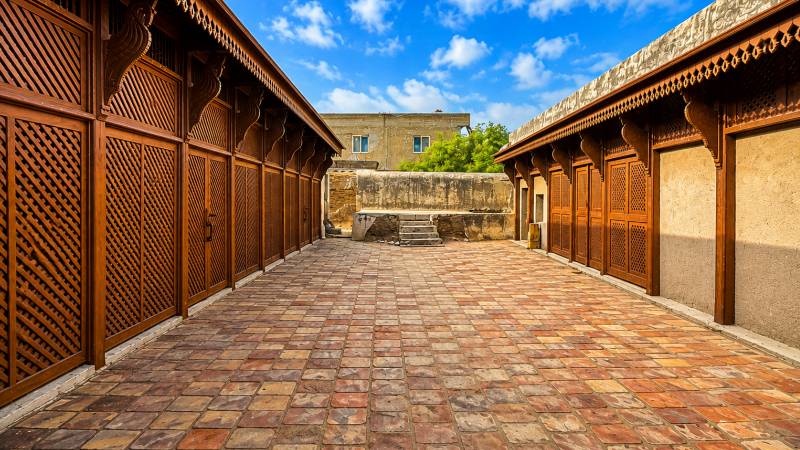
Eventually, we reached the historic palace of Aga Khan I. The caretaker showed us around the entire building. Surprisingly, many aspects of the structure have survived in their original form. Built largely with mud and wood, the palace is a beautiful reflection of traditional Sindhi architecture. It has a large courtyard, small halls attached to the rooms, a beautiful open space and an old tree standing in the courtyard. Wind catchers, designed to protect the building from the intense summer heat, also reveal the architectural wisdom of the time.
Standing inside the palace, I could imagine that Jhirk was once much more than an ordinary town. It was a place where an entire world of life, trade and culture flourished. During our visit, we also had a long conversation with Mushtaq Mallah, a local historian of Jhirk who is also associated with the Quaid-e-Azam Memorial Committee. Several local residents joined the discussion, and our conversation eventually turned to the house associated with Jinah.
We were told that the house was located only a short distance from the Aga Khan Palace. When we reached the site, however, we found that the historic house no longer existed in its original form. In a sad twist of fate, a new building has been constructed on the site, and a private school is currently operating there. For a while, I stood there in disbelief, thinking about how our institutions have ignored to a city that once held considerable historical importance.
Perhaps the greatest sadness one feels while walking through the streets of Jhirk is that we preserved our history in textbooks but failed to preserve the places where that history was actually lived.
A Once-Thriving Commercial Centre
Jhirk is an ancient city located in Thatta district, near Keenjhar Lake, along the Kotri-Thatta Road. Its proximity to the Indus River gave it considerable historical and commercial importance. During the British period, the city served as an important trading center and had a port through which commercial goods and raw materials were transported.
According to local traditions and historians , Jhirk had a diverse population, including a large Hindu community as well as Khojas and Memons. Fishing was an important source of livelihood for the people, and the trade in fish was also carried out on a significant scale. The Jhirk was known for its relatively peaceful and healthy environment. It is also said that during the Talpur period, arms-manufacturing activities existed in the area. On a small hill opposite the Aga Khan Palace, there are said to have been remains of a Buddhist place of worship, traces of which can still be seen. Faint remains of an old military cantonment can also be found among the ruins.


Jhirk’s Administrative Importance
After the British established their rule in Sindh, Jhirk gained further administrative importance because of its commercial significance. It was granted municipal status and was attached to the Karachi Collectorate. Its administrative boundaries extended towards Baggar Creek, Sehwan and included areas such as , Khanot, Manjhand and Kotri, while the area around the Sonda cemetery was also associated with Jhirk. The area was around 150 miles in length and 70 miles in breadth.
During the period when Captain Preedy served as Collector, he wrote to Commissioner R. K. Pringle describing Jhirk as a prosperous town where large quantities of maize, wheat and fish were produced. A significant number of its residents were fishermen whose livelihoods depended on fishing in the Indus River.
The city had a post office, dispensary, jail, dak bungalow, military cantonment, police station, school and Collector’s Office, among other government facilities. According to Mushtaq Mallah, Jherruck also had a complete marketplace consisting of around 200 shops, where almost everything required by the local population was available. Today, the crumbling remains of these facilities tell the story of a prosperous past.
Aga Khan I and Jhirk
During the British period, Aga Hassan Ali Shah, Aga Khan I, came to Jhirk in 1843 and settled there. Sir Charles Napier is also said to have played a significant role in the settlement of Ismailis in Jherruck. A considerable number of his followers were already living in the area, and his arrival further enhanced the town’s religious and social significance.
The historic palace associated with Aga Khan I remains one of the important symbols of Jhirk’s past. The building is not only connected with an important historical personality but is also an important example of local Sindhi architecture, traditional lifestyles and construction techniques of that era. Following Aga Khan I’s arrival in Jhirk, his followers from different parts of the subcontinent began visiting the town. It was in this historical context, according to local accounts, that the family of Quaid-e-Azam Muhammad Ali Jinnah also became associated with Jhirk.
Quaid-e-Azam and His Connection with Jhirk

The most significant and sensitive aspect of Jhirk’s history is the question surrounding the birthplace of Quaid-e-Azam Muhammad Ali Jinnah. According to local historians and some historical accounts, the Jinnah family had a strong connection with Jhirk. It is said that his grandfather, Megh Jinnah, came from Gujarat and settled there, while his maternal grandfather, Musa Jumma Walibhai, is said to have arrived from Kerman, Iran, along with Aga Khan I and subsequently settled in the area.
The family later became associated with trade. Locally, Quaid-e-Azam’s father, Poonja Jinnah, is remembered as Seth Poonja Jinnah. According to local accounts, he started his business in Jhirk and was involved in the leather trade. If historical claims regarding Quaid-e-Azam’s birth and early education in Jhirk exist, then the matter should not be determined on the basis of emotion or speculation. It should instead be examined through authentic historical records and documentary evidence.
Perhaps the most painful aspect of Jhirk is its present condition. A city that once had a port, a bustling marketplace, government institutions, a post office, a cantonment and a thriving economy linked to the Indus River is now struggling with poverty, a lack of basic facilities and the deterioration of its historic buildings.
The waters of the Indus once brought life and livelihoods to the communities living along its banks. Today, declining water availability has also affected fishermen and the local economy. Many fishermen have moved to other locations in search of livelihoods. Jhirk is not merely a collection of ruins. It is an important chapter in Sindh’s collective memory. It has the palace associated with Aga Khan I, historical traditions linked to the family of Quaid-e-Azam, British-era buildings, traces of ancient religious and military structures, and an entire cultural story connected with the Indus River. But the question remains: When will we preserve this story?
Jhirk should not be reduced merely to the debate over Quaid-e-Azam’s birthplace. It deserves to be preserved as a complete historical and cultural heritage town. Its historic buildings need to be identified, documented, restored and legally protected. At the same time, the city can be promoted as an important destination for cultural tourism.
Perhaps the greatest sadness one feels while walking through the streets of Jhirk is that we preserved our history in textbooks but failed to preserve the places where that history actually unfolded. The Aga Khan Palace still stands silently. The crumbling government buildings continue to bear witness to the town’s former glory. And the new building standing on the site associated with Quaid-e-Azam seems to ask us a question: Will we continue to read our history only in books, or will we also preserve the historic places where that history was lived?
Jhirk needs our attention, research and protection today. Because towns do not truly disappear when their memories are preserved. Their stories continue to tell future generations where they came from and who they are.