

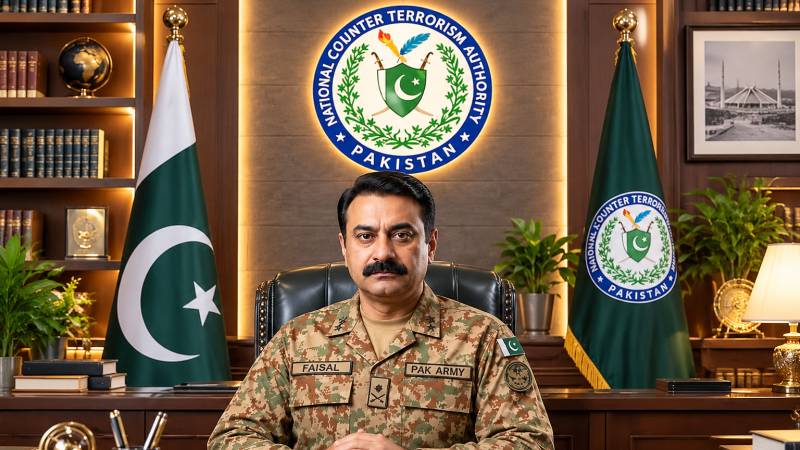
The appointment of Major General Faisal Naseer as National Coordinator of the National Counter Terrorism Authority (NACTA) may prove to be far more consequential than an ordinary bureaucratic posting. On paper, NACTA has never been a weak institution. Parliament gave it a formidable mandate through the NACTA Act, 2013, but in practice, the authority has struggled to become what its creators intended it to be: the central nervous system of Pakistan’s counter-terrorism architecture. The real question is not whether Faisal Naseer possesses the operational or intelligence background to understand Pakistan’s security challenges, but whether he can transform NACTA from a largely coordinating and policy-oriented institution into an organisation capable of making the country’s fragmented counter-terrorism machinery function as one integrated system.
NACTA was created precisely for moments like the one Pakistan faces today. Established in 2008 and given statutory status under the NACTA Act, 2013, the authority was designed to receive, analyse and disseminate intelligence, coordinate stakeholders, formulate national counter-terrorism strategies, monitor implementation, conduct research and recommend legislative reforms. It was never intended to become another police or intelligence agency. Instead, its purpose was to ensure that the military, intelligence agencies, provincial Counter Terrorism Departments, police forces and federal ministries operated within a coherent national framework.
However, NACTA’s history has been defined by the same institutional weaknesses it was created to solve. The authority suffered from a lack of political ownership, weak coordination and severe staffing shortages. When the first meeting of NACTA’s Board of Governors was held in 2018, it was revealed that no meeting of the board had taken place since the organisation’s creation, despite the board being the highest-level mechanism responsible for bringing together key ministries, intelligence leadership and provincial authorities. The problem was therefore not simply a lack of resources, but a lack of institutional commitment from the state machinery that NACTA was supposed to coordinate.
The staffing crisis further weakened the institution. NACTA’s own 2018 annual report showed that out of 841 sanctioned positions, 631 were vacant, leaving roughly three-quarters of the organisation’s approved workforce unavailable. An institution responsible for analysing terrorism, extremism, intelligence and national security threats could hardly perform effectively under such conditions. Continued reliance on officers taken on deputation from other departments also prevented NACTA from developing a permanent professional cadre specialising in counter-terrorism analysis, intelligence fusion, terror financing and strategic assessment.
Pakistan does not need another counter-terrorism institution; it needs the institutions it already has to finally operate as one, with intelligence shared, threats assessed collectively and coordinated action measured by outcomes rather than meetings.
The financial picture reflected the same institutional neglect. While Pakistan’s wider security apparatus received hundreds of billions of rupees, NACTA operated with a budget measured in hundreds of millions. A coordinating institution does not necessarily require the resources of a fighting force, but an authority expected to build databases, employ specialists, coordinate provinces and develop intelligence capabilities cannot remain administratively starved. The issue was therefore not simply that NACTA lacked power; rather, the state had never fully decided how powerful, independent and professionally equipped it wanted the organisation to become.
The National Action Plan after the 2014 Army Public School attack exposed these challenges further. Although NACTA played an important role in monitoring implementation, the plan covered areas controlled by multiple federal and provincial institutions. This highlighted the central limitation of the authority: it could coordinate, analyse and recommend, but it could not command provincial police chiefs, intelligence agencies or ministries. NACTA’s success therefore depended on cooperation from other institutions and the political importance attached to its assessments.
Despite these problems, NACTA was never entirely ineffective. The authority produced actionable intelligence, supported counter-terrorism operations and contributed to Pakistan’s efforts against terror financing during the Financial Action Task Force process. It also developed Pakistan’s first standalone National Terrorism Financing Risk Assessment. These achievements showed that the institution’s basic concept was sound; the challenge was that its successes were not transformed into a permanent system.
The establishment of the National Intelligence Fusion and Threat Assessment Centre (NIFTAC) represents the most significant opportunity for NACTA’s transformation. Designed to integrate information from federal and provincial agencies through a unified intelligence and threat-management architecture, NIFTAC could finally move Pakistan closer to the intelligence-fusion model that NACTA was originally meant to represent. The purpose of such a system is to connect information from different sources — intelligence agencies, provincial CTDs, border authorities and financial institutions before separate pieces of information develop into a terrorist threat.
Faisal Naseer’s biggest advantage is his understanding of Pakistan’s intelligence ecosystem. His experience as Director General Counter-Intelligence at the Inter-Services Intelligence Directorate gives him familiarity with how intelligence is generated, assessed and used at the highest levels of the state. This could help bridge one of NACTA’s historic weaknesses: the gap between intelligence producers and civilian policy institutions. However, the challenge will be ensuring that NACTA does not become merely an extension of any single institution. Its purpose is not to replace ISI, Intelligence Bureau, police forces or provincial CTDs, but to make all of them work together.
For Faisal Naseer to succeed, NACTA must become an institution rather than remain dependent on individuals. It needs a permanent professional cadre, regular functioning of its Board of Governors, a fully operational NIFTAC, measurable performance indicators and an integrated national terrorism database. Success should be measured through outcomes: intelligence reports fused, threats identified, operations enabled, networks disrupted and terrorist financing channels exposed. Without measurable benchmarks, NIFTAC risks becoming another government initiative defined by meetings rather than results.
Pakistan’s deteriorating security environment makes this reform urgent. Rising militant violence in Khyber Pakhtunkhwa and Balochistan demonstrates that traditional kinetic responses alone cannot defeat increasingly networked militant organisations. These groups combine violence with propaganda, financing networks, cyber capabilities and intelligence gathering. Pakistan needs an institution capable of understanding and countering the entire ecosystem rather than reacting only after attacks occur.
Faisal Naseer can succeed, but only if he is allowed to build a durable institution rather than simply occupy a powerful position. The legal framework already exists, and NACTA has the authority to coordinate, collect information and establish structures necessary for national counter-terrorism planning. What has historically been missing is institutional strength. If his tenure leaves behind a professional counter-terrorism cadre, a functioning intelligence-fusion system, an integrated database and a culture of routine cooperation among federal and provincial agencies, he may achieve what previous governments failed to deliver. For seventeen years, NACTA has existed between a powerful statutory idea and a weak bureaucratic reality. Pakistan can no longer afford that ambiguity. The country does not need another counter-terrorism institution; it needs the institutions it already has to finally operate as one.