

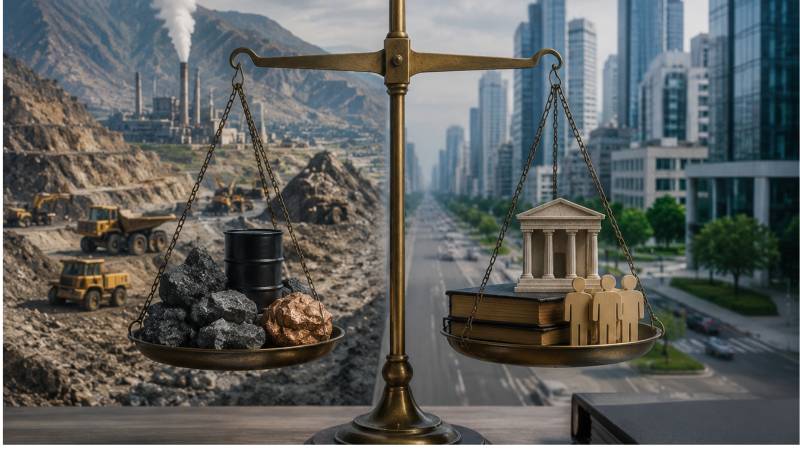
"Nations become prosperous not when they discover better economic ideas, but when they create political conditions in which those ideas can endure."
Nations do not become prosperous simply by adopting sound economic policies. If they did, many developing countries would have achieved lasting prosperity long ago. The principles of economic progress are well known. Governments everywhere speak of investment, industrialisation, exports, innovation and growth. Yet history tells a different story. While some nations transform themselves within a generation, others continue to struggle despite abundant natural resources and immense human potential.
The difference lies in something less visible but far more decisive. Prosperity rests on confidence. People invest where they trust the future, where institutions command respect, governments honour their commitments and policies remain consistent beyond changes in political leadership. Economics provides the instruments of growth; politics creates the environment in which those instruments can succeed. When confidence weakens, investment slows, entrepreneurship retreats and reform loses momentum. Markets respond to incentives, but investors respond first to credibility.
Pakistan's own economic journey illustrates this truth. At independence, the country inherited only a modest industrial base, making industrialisation an urgent national priority. Recognising that private capital alone could not meet this challenge, the government established the Pakistan Industrial Development Corporation (PIDC) in 1952 under the dynamic leadership of Ghulam Farooq. Its purpose was not to replace private enterprise but to establish industries that were essential for a young nation yet beyond the immediate capacity of private investors.
The initiative proved remarkably successful. During the 1950s, and particularly throughout the 1960s, Pakistan experienced one of Asia's fastest rates of industrial growth. New factories emerged across the country, exports expanded and a confident entrepreneurial class began to flourish. Domestic investors found opportunity, while foreign businesses increasingly viewed Pakistan as a promising destination for investment. The country's industrial progress attracted international attention, not because it possessed exceptional natural wealth, but because it projected stability, direction and economic purpose.
The lesson extends far beyond Pakistan. Investment is ultimately an act of confidence. Entrepreneurs commit their resources today because they believe in tomorrow. They do not expect governments to guarantee profits or eliminate every uncertainty. What they seek is something more fundamental: confidence that the rules will remain predictable, contracts will be honoured and economic policies will not change abruptly with shifting political winds. When that confidence exists, capital flows naturally into productive enterprise. Once it begins to fade, even generous incentives struggle to attract lasting investment.
Prosperity rests on confidence. People invest where they trust the future, where institutions command respect, governments honour their commitments and policies remain consistent beyond changes in political leadership.
The remarkable industrial momentum of Pakistan's first two decades, however, did not continue uninterrupted. The early 1970s marked a fundamental shift in economic policy. A large number of industries, banks and commercial enterprises were brought under state ownership with the objective of promoting social justice and reducing economic concentration. Whatever the political rationale behind the decision, its economic consequences proved profound. For many entrepreneurs, both domestic and foreign, the abrupt policy change raised doubts about the long-term security of private investment. Confidence, once shaken, proved difficult to rebuild.
The significance of this turning point extended well beyond the transfer of ownership from the private to the public sector. It altered the psychology of investment. Entrepreneurs began to ask a question more important than profitability itself: Will today's policy remain tomorrow? Capital can accommodate commercial risk, market fluctuations and even temporary economic downturns. What it finds far more difficult to accept is uncertainty about the rules under which it operates. Confidence, built patiently over many years, can be weakened by a single policy reversal and may take decades to restore.
In the years that followed, successive governments sought to revive private enterprise through deregulation, liberalisation and privatisation. Public enterprises that had become a burden on the national exchequer were gradually transferred back to private ownership in the hope of improving efficiency and reducing fiscal pressures. These measures were economically justified, but they could not, by themselves, restore investor confidence. Ownership can be transferred by legislation; confidence cannot. It returns only when governments demonstrate consistency, transparency and a long-term commitment to stable economic policies.
This is where politics and economics converge. Investors do not commit capital on the strength of balance sheets alone. They also assess the quality of governance, the credibility of institutions and the likelihood that policies will endure beyond changes of government. Attractive incentives, tax concessions and official assurances lose much of their value if overshadowed by political uncertainty. Lasting investment depends less on promises than on the credibility of those who make them.
The experience of successful Asian economies illustrates this principle. South Korea, Singapore, Malaysia, Vietnam and China differ widely in their political systems and development strategies. Yet they share one defining characteristic: each created an environment in which long-term national priorities remained consistent. Investors believed that development policies would survive political transitions, institutions would function effectively and governments would remain committed to economic transformation. Their success was built not only on sound economic management but also on political continuity, administrative competence and clarity of purpose.
Pakistan's challenge, therefore, is not a shortage of resources or ideas. It possesses entrepreneurial talent, strategic advantages and a young population capable of driving economic growth. What has too often been absent is the sustained political consensus needed to convert these strengths into enduring prosperity. Economic reforms require time to produce results. When policies change with political cycles, confidence weakens, investment slows and development remains frustratingly incomplete.
The changing meaning of development further reinforces this lesson. There was a time when national progress was measured largely by the number of factories established, the volume of exports or the annual rate of economic growth. Those indicators remain important, but they no longer tell the whole story. Today, successful nations are judged as much by the strength of their institutions, the quality of education, the skills of their workforce, their capacity for innovation and the confidence they inspire among citizens and investors. Development is no longer simply about producing more goods; it is about creating an environment in which enterprise, talent and ideas can flourish over generations.
Pakistan's recent experience offers a contemporary illustration. The establishment of the Special Investment Facilitation Council (SIFC) reflected a genuine effort to accelerate investment, improve institutional coordination and remove bureaucratic obstacles. The initiative identified promising opportunities in mining, agriculture, information technology, energy and other strategic sectors. Its objectives were timely and well intentioned.
Capital can accommodate commercial risk, market fluctuations and even temporary economic downturns. What it finds far more difficult to accept is uncertainty about the rules under which it operates.
Yet the experience also underlines a broader reality. Administrative efficiency, valuable though it is, cannot by itself overcome political uncertainty. Investors appreciate quicker decisions and streamlined procedures, but they continue to ask larger questions. Will policies remain consistent? Will agreements survive changes in government? Will institutions act with fairness and predictability? Facilitation can accelerate investment decisions, but only confidence can sustain them.
History offers the same lesson across continents. No nation has achieved enduring prosperity through economic policy alone. Economic reforms succeed when they are supported by political maturity, credible institutions and a shared national purpose. Governments that inspire confidence do not rely solely on incentives to attract investment; they create an environment in which enterprise feels secure enough to plan for the future.
Pakistan's future, therefore, depends upon more than sound budgets, periodic reforms or ambitious development plans. It requires a political culture that values continuity over confrontation, institutions over personalities and long-term national interest over short-term political advantage. Economic policy should begin not with annual targets but with the confidence that encourages citizens to invest, innovate and build their future at home.
Pakistan's own history provides ample reason for optimism. The industrial achievements of the 1950s and 1960s demonstrated that the country possesses entrepreneurial talent, resilience and the capacity for rapid economic transformation. Those strengths have not disappeared. They remain alive in millions of Pakistanis whose enterprise continues despite recurring uncertainty. What they seek is not extraordinary privilege but an environment of stability, fairness and trust.
Pakistan's economic difficulties are often described in terms of debt, inflation, fiscal deficits and declining investment. These are real challenges, but they are also symptoms of a deeper reality. Behind every successful economy lies a political order that commands confidence, protects institutions and provides continuity of purpose. Where those foundations are strong, enterprise flourishes. Where they are weak, even the most carefully designed economic policies struggle to deliver lasting results.
The central lesson is both simple and enduring. Nations do not become prosperous because they discover extraordinary economic theories. They prosper because they create political conditions in which sound economic policies can survive, institutions can earn public trust and investors can plan with confidence. Pakistan possesses the human talent, entrepreneurial spirit and strategic advantages needed for sustained development. What it must rebuild is confidence that policies will endure, institutions will remain credible and national priorities will rise above political expediency. In the final analysis, economics can create opportunities, but only politics can create the confidence that allows those opportunities to become lasting prosperity.