

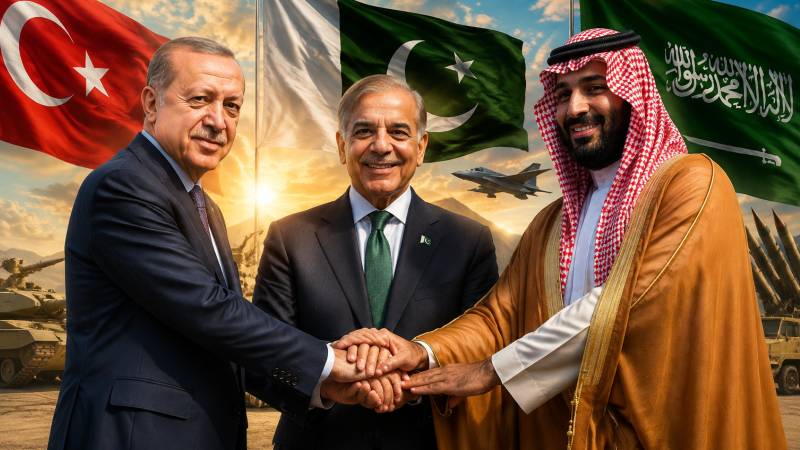
The defense understanding among Saudi Arabia, Pakistan and Türkiye represents far more than the formalization of already close relations among three influential Muslim-majority states. Its deeper significance lies in the strategic message it conveys: regional powers are no longer content merely to react to crises generated around them, nor are they prepared to place the entirety of their security in the hands of outside guarantors. They are beginning, cautiously but deliberately, to build mechanisms through which they can deter aggression, protect sovereignty, coordinate responses to emerging threats and create greater strategic space for independent decision-making.
At the center of the arrangement is a principle of collective defense: an armed attack against one participating state is to be regarded as an attack against all. That commitment gives the relationship an importance that ordinary declarations of friendship do not possess. Political goodwill is valuable; military exercises are useful; defense cooperation is important. But a declaration that the security of one is linked to the security of the others alters the calculations of both friends and potential adversaries.
The purpose of collective defense is deterrence, not war. Its success lies in convincing any potential aggressor that attacking one member would trigger the combined resolve and capabilities of all three, making aggression too costly to attempt. The partnership should therefore be measured by the conflicts it prevents, not the wars it fights. Thus, the agreement marks a shift toward greater regional responsibility for security and strategic autonomy. By treating an attack on one member as an attack on all, it seeks to strengthen deterrence, protect sovereignty and coordinate responses to emerging threats. Its real success would lie not in fighting wars together, but in preventing them by convincing potential aggressors that any attack would carry unacceptable collective costs.
The agreement reflects decades of defense and political cooperation among Saudi Arabia, Pakistan and Türkiye rather than a sudden response to the current crisis. Recent instability has accelerated the need to formalize these relationships as missiles, drones, cyberattacks, threats to shipping and attacks on critical infrastructure increasingly transcend national borders. The changing nature of conflict has therefore reinforced a shared recognition that longstanding political trust must now be supported by more structured and coordinated security mechanisms.
The strength of the Saudi Arabia–Türkiye–Pakistan arrangement lies in the complementary capabilities of its members. Saudi Arabia contributes financial resources, diplomatic influence, expanding defense capacity and a strategic position linking the Gulf, Red Sea and Arab world. Türkiye adds a powerful military, operational experience and an increasingly sophisticated indigenous defense industry, while Pakistan brings a large and experienced armed force, counterterrorism expertise, established defense-production infrastructure, strategic geography and a nuclear deterrent. Together, Saudi financing, Turkish design and engineering, and Pakistani technical and cost-effective manufacturing could support joint development of drones, missiles, radar, naval systems, electronic warfare, cybersecurity, artificial intelligence and counter-drone technologies. The longer-term objective should be technological sovereignty, reducing dependence on foreign suppliers for weapons, maintenance, software, upgrades and spare parts while increasing strategic choice.
The longer-term objective should be technological sovereignty, reducing dependence on foreign suppliers for weapons, maintenance, software, upgrades and spare parts.
This cooperation is especially relevant because modern security extends far beyond conventional warfare. Missiles, drones, proxy forces, sabotage, cyberattacks and threats to commercial shipping can target oil facilities, ports, airports, power grids, communications, banking systems and other critical infrastructure, producing economic consequences far beyond the immediate battlefield. The partnership must therefore translate political commitments into practical capabilities through integrated air and missile defense, counter-drone systems, systematic intelligence sharing, cybersecurity, naval cooperation, emergency logistics and joint exercises that simulate contemporary threats. Its credibility will ultimately depend on whether these complementary strengths can be converted into effective operational coordination before crises occur.
The real test of the defense arrangement will be whether political commitments can be converted into functioning institutions. The three countries must clarify what constitutes an attack including cyberattacks, proxy actions, attacks on shipping or overseas installations—and determine how quickly consultations, intelligence sharing and military assistance would begin. They must also establish how joint planning would operate and how the framework would coexist with Türkiye’s NATO obligations and the other strategic partnerships maintained by Saudi Arabia and Pakistan.
These questions require more than declarations. Effective cooperation will depend on clear protocols, permanent coordination mechanisms, secure communications, intelligence sharing, joint exercises and collaboration in maritime security, counterterrorism, air and missile defense, cybersecurity, logistics, advanced technology and defense production. Ultimately, a treaty creates expectations, but institutions create the capability to fulfil them.
For Pakistan, the partnership broadens a strategic outlook historically dominated by India by connecting its security interests more closely with the Gulf and wider Middle East. Pakistan’s borders with Iran and Afghanistan, its Arabian Sea coastline, the importance of Gulf trade, energy, investment and remittances, and the presence of millions of Pakistani workers in the region mean that Middle Eastern stability directly affects its national security and economy. Its ports and location also give Pakistan growing importance in maritime routes connecting Gulf energy producers with Asia and global markets.
The framework can therefore enhance Pakistan’s diplomatic and economic relevance while allowing South Asia to remain its primary security focus. More importantly, Pakistan should use defense cooperation not simply to increase arms exports but to secure technology transfer, joint intellectual property, research collaboration and participation by Pakistani scientists and engineers in advanced industrial programs. Such technological and industrial development would provide considerably greater long-term strategic value than short-term weapons sales.
Iran poses the most delicate diplomatic challenge because Pakistan cannot allow the partnership to turn Tehran into a permanent adversary. Pakistan and Iran share a long border and common concerns involving militancy, border security, smuggling and potential economic cooperation, while Saudi Arabia remains one of Pakistan’s closest strategic and economic partners. Islamabad therefore has a strong interest in avoiding any forced choice between Riyadh and Tehran. The arrangement should remain a defensive framework rather than an anti-Iran, anti-Israel or sectarian coalition. Pakistan could, in fact, strengthen its diplomatic influence by maintaining productive relations simultaneously with Riyadh, Ankara and Tehran. The partnership will be most effective if it protects its members without requiring a permanent enemy, distinguishing collective security from ideological bloc politics.
Israel is likely to watch the framework closely, but the differing positions of Saudi Arabia, Türkiye and Pakistan make a permanently anti-Israel alliance impractical. Saudi Arabia has its own strategic calculations, Türkiye maintains a complex relationship with Israel, and Pakistan does not recognize Israel and strongly supports Palestinian rights. These differences need not undermine cooperation because the arrangement does not require identical foreign policies. A more durable basis is cooperation around shared security principles: protection of sovereignty, civilians and critical infrastructure, deterrence of aggression, maritime security, counterterrorism, cyber resilience and crisis management. The Palestinian issue will remain politically important, but turning the defense framework into an ideological anti-Israel instrument would reduce its flexibility and risk deepening regional polarization.
India will closely assess the agreement because any formal security arrangement involving Pakistan inevitably affects its strategic calculations. However, it should not be assumed that Saudi Arabia and Türkiye will automatically adopt Pakistan’s entire South Asian security agenda, particularly given their own economic, diplomatic and commercial interests with India. The more important implication is that Pakistan is becoming more deeply connected to a broader regional security network beyond South Asia. This could expand Islamabad’s diplomatic reach, strengthen its bargaining position and create new opportunities for defense-industrial cooperation, making it increasingly inadequate to view Pakistan solely through the prism of India-Pakistan rivalry.
The new arrangement does not seek to replace the United States, which retains extensive military, intelligence and logistical influence in the region and important relationships with Türkiye, Saudi Arabia and Pakistan. Rather, it reflects a move away from exclusive dependence on a single security partner toward greater strategic autonomy. In an increasingly multipolar world, states can maintain security ties with Washington while simultaneously trading with China, acquiring technology from Türkiye, attracting Saudi investment and developing other partnerships. Such overlapping relationships represent not strategic confusion but strategic diversification, preserving existing alliances while expanding choices and reducing dependence. China forms an important part of the wider strategic context. Pakistan’s relationship with Beijing remains central, Saudi Arabia has deepened economic ties with China, and Türkiye continues to balance its Western commitments with growing Eurasian engagement.
Rather than creating another rigid bloc, the arrangement may reflect a more fluid multipolar order in which states maintain overlapping partnerships—security ties with one power, trade with another and technological cooperation with a third. Saudi Arabia, Pakistan and Türkiye are well positioned for this model because all three seek strategic flexibility and relationships with multiple centers of global power.
Maritime cooperation offers one of the most immediate practical benefits of the partnership because all three countries occupy strategically important maritime positions: Saudi Arabia faces both the Persian Gulf and Red Sea, Türkiye has substantial naval experience across the Mediterranean and Black Sea, and Pakistan sits on the Arabian Sea near major Indian Ocean routes and approaches to the Strait of Hormuz. With attacks on commercial vessels capable of disrupting supply chains, increasing insurance and energy costs, and threatening ports, cooperation could include naval exercises, maritime-domain awareness, intelligence sharing, protection of commercial shipping, anti-piracy operations, mine countermeasures and protection of critical port infrastructure. Such cooperation would strengthen regional security while remaining essentially defensive.
Saudi Arabia, Türkiye and Pakistan all possess substantial experience in counterterrorism, although gained under different circumstances. Pakistan has extensive operational experience against militant organizations, Türkiye has confronted terrorism across several theatres, and Saudi Arabia has developed sophisticated intelligence and counter-financing capabilities. Institutionalized intelligence sharing could therefore become one of the partnership's most valuable components, particularly because threat information is often time-sensitive. Joint databases, common threat assessments, financial intelligence, cybersecurity cooperation and rapid information-sharing mechanisms could create a durable security network useful even in the absence of conventional military conflict.
Military security should ultimately serve economic and human development rather than become an end in itself. Saudi Arabia's economic transformation, Türkiye's industrial and technological base and Pakistan's large young population and unrealised scientific potential create opportunities extending far beyond defence. Cooperation could encompass universities, engineering institutions, research laboratories, technology funds, start-ups, artificial intelligence, advanced materials, aerospace, cybersecurity and energy technologies. A durable strategic relationship will therefore depend partly on whether greater security translates into investment, innovation, employment and tangible improvements in citizens' lives.
The setting carries considerable symbolic significance because Makkah represents unity for Muslims worldwide, while Saudi Arabia, Pakistan and Türkiye share deep historical and popular bonds. This symbolism can strengthen public confidence and political trust, but it should not create the impression of a religious coalition directed against non-Muslim states or particular sects. The more constructive message is that major Muslim-majority states can cooperate effectively on security while respecting sovereignty, supporting diplomacy and maintaining productive relations with the wider international community. The objective should therefore be strategic maturity rather than civilizational confrontation.
The arrangement also illustrates the importance of combining restraint with preparedness during periods of instability. Effective leadership does not require choosing between diplomacy and deterrence, or between peace and military preparedness. States can seek peaceful relations while ensuring they are capable of defending themselves should diplomacy fail. Credible defense capabilities can actually strengthen diplomacy because countries that are difficult to coerce have greater freedom to exercise restraint and negotiate from a position of confidence rather than vulnerability.
The partnership should therefore be measured by the conflicts it prevents, not the wars it fights.
The significance of the arrangement should not be exaggerated by prematurely comparing it with a mature integrated military alliance. It does not yet possess a common command structure, integrated intelligence architecture, unified logistics system, permanent joint force or fully developed collective-defense doctrine. Its credibility will instead depend on practical achievements: rapid intelligence exchange, secure military communications, coordinated missile and air defense, protection of shipping, joint defense production and effective crisis-management mechanisms. The relevant test is therefore not whether it resembles an established alliance, but whether it develops the capabilities necessary to prevent and manage real threats.
Other states may eventually wish to participate, but enlargement should follow demonstrated effectiveness rather than become an objective in itself. A compact arrangement of three countries capable of reaching decisions and fulfilling obligations is more valuable than a larger organization paralyzed by competing interests. Any future member should strengthen collective security, accept meaningful responsibilities and possess sufficiently compatible strategic interests without importing disputes that could undermine the organization. Institutional depth should therefore precede geographical breadth.
Pakistan's nuclear capability inevitably affects perceptions of the partnership, but this issue requires considerable restraint. Pakistan's nuclear deterrent remains part of its national security doctrine and should not automatically be interpreted as an extended nuclear guarantee covering every possible contingency involving the other participants unless such a policy is explicitly established. Conventional collective defense and nuclear extended deterrence are fundamentally different concepts. The partnership should therefore initially derive its credibility from conventional military capability, intelligence, technology, political solidarity and preparedness, while nuclear decisions remain at the highest level of national policymaking.
The deeper historical significance of the arrangement lies in the gradual movement from excessive dependence on external security guarantees toward stronger indigenous capacity. Regional states have long purchased sophisticated military hardware while remaining dependent on outside powers for intelligence, logistics, maintenance, technology and strategic support. Genuine autonomy requires more than weapons: it requires research, industrial capacity, training, domestic expertise, logistics, intelligence and political coordination. Developing these capabilities need not weaken existing international partnerships; instead, it can make them more balanced by giving regional states greater strategic choice and reducing vulnerability to the decisions of outside powers.
Ultimately, the partnership should be judged by implementation rather than declarations or symbolism. Its success will depend on whether intelligence sharing improves, common threat assessments emerge, missile and drone defenses strengthen, maritime routes become safer, cybersecurity improves, military interoperability develops, defense industries produce meaningful joint projects and economic and technological cooperation expands. Above all, it should be assessed by whether stronger collective capabilities deter aggression, prevent escalation and strengthen diplomacy while producing greater security and prosperity for ordinary citizens. The ultimate strategic achievement would not be the wars the three states might fight together, but the wars their credible cooperation prevents from beginning.