

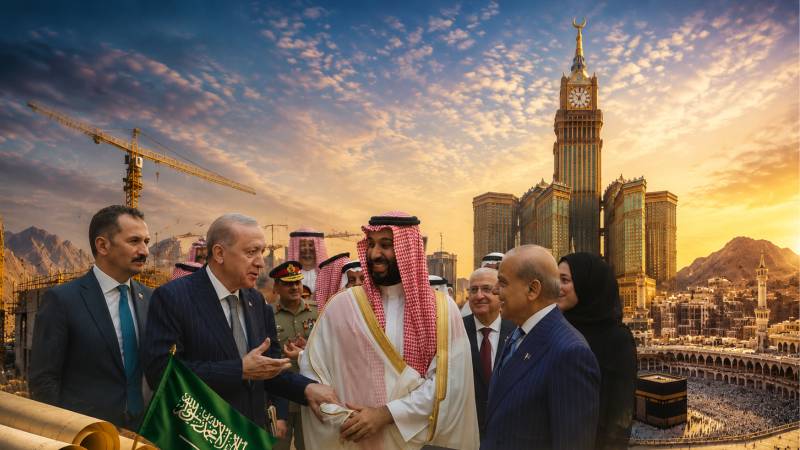
Three folders changed hands beneath a portrait of King Salman at al-Safa Palace on August 7, and with that quiet gesture, Saudi Arabia, Turkey and Pakistan committed to treating an attack on any one of them as an attack on all Al Jazeera Prime Minister Shehbaz Sharif captured the moment on X himself: Honoured to sign the Makkah Joint Defence Agreement alongside my dear brothers, HRH Crown Prince Mohammed bin Salman and H.E. President Recep Tayyip Erdoğan. Three brotherly nations, united by faith, friendship and a shared resolve for peace and security Shehbaz Sharif on X, via Express Tribune The Mecca Joint Defence Agreement deserves to be read as more than ceremony. It is the clearest evidence yet that the Middle East's most consequential actors no longer believe Washington's security guarantees are something to wait on. They believe they are something to build around.
That is the argument worth making plainly: this pact is a stabilizing structure, not a destabilizing one, precisely because it substitutes durable regional commitment for the unpredictable pattern of American crisis management that has defined the US-Iran war since February, a war that has already cost the global economy an estimated $1.3 to $2.2 trillion and pushed Brent crude past $130 a barrel at its peak. Pakistani Deputy Prime Minister and Foreign Minister Ishaq Dar was explicit in his own post on X that the agreement is "purely defensive in nature," not directed at any state, and open to others willing to resolve differences peacefully Jerusalem Post, That openness is not boilerplate. It is the mechanism through which stability is meant to spread rather than calcify into bloc confrontation. President Asif Ali Zardari echoed the same framing, saying the pact "strengthens collective deterrence, deepens defence cooperation and reaffirms the shared commitment of the three brotherly nations to a secure and prosperous future Express Tribune.
Consider what each partner contributes, because the complementary design is itself a stability argument. As Özgür Ünlühisarcıklı of the German Marshall Fund put it, the three bring "Turkey's defence-industrial capabilities, Saudi financial muscle and influence, and Pakistan's military experience and strategic deterrent Al Jazeera. This is not three militaries stacking hardware. It is three distinct forms of leverage deployed jointly, raising the cost of any further strike on Gulf territory without requiring any single capital to overextend. Sardar Masood Khan, Pakistan's former ambassador to Washington and Beijing, called the underlying September 2025 Saudi-Pakistan pact "a nucleus," noting that interest from Turkey, Egypt, Qatar and Kuwait followed almost immediately Al Jazeera. Gulf Research Center chairman Abdulaziz Sager frames this expansion potential as movement toward "a more regionally driven security architecture," which is, definitionally, the stability outcome policymakers should want The New Arab.
This is not three militaries stacking hardware. It is three distinct forms of leverage deployed jointly, raising the cost of any further strike on Gulf territory without requiring any single capital to overextend itself.
Skeptics point to Iranian parliamentarian Ebrahim Rezaei's sharp response on X, that "a paper agreement with Türkiye and Pakistan will not bring them security," as evidence the pact provokes rather than Al Jazeera, But a single legislator's post is not a government position, and it stands in contrast to Iran's own conduct eleven months earlier: President Masoud Pezeshkian told the UN General Assembly that Tehran "welcomed" the original Saudi-Pakistan pact and suggested it "could mark the beginning of a regional security framework Deccan Herald. Read together, these two data points argue for continuity, not rupture. Iran's institutional posture toward Riyadh-Islamabad defence cooperation has been accommodating even as individual rhetoric sharpens.
This is precisely where regional stability is manufactured in practice, not on paper: through Pakistan's unusual credibility with Tehran, credibility Riyadh has already leveraged once to quietly shape negotiations and manage escalation during the war's earliest weeks Atlantic Council. A trilateral pact that keeps that channel open, rather than closing it, converts what could be a purely military hedge into functioning diplomatic infrastructure; the kind that produces ceasefires rather than just deterrence postures.
The comparisons to NATO obscure this point more than they illuminate it. Islamabad-based defence analysts and Ünlühisarcıklı both caution against reading Mecca as NATO-equivalent, given the absence of unified command or integrated military planning The New Arab. That absence is not a weakness. A command-light structure is harder to mistake for an offensive coalition, which lowers the risk of the pact itself becoming an escalation trigger; the single greatest threat any new defence architecture poses to regional stability.
The honest test ahead is not whether Mecca can end the US-Iran war by force; it was never built for that. The test is whether Kuwait, Qatar, Egypt and others formally join, whether Islamabad keeps its Tehran channel functioning under the added weight of a trilateral commitment, and whether restraint visible already in India's measured "closely following" response rather than counter-mobilization The New Arab, remains the region's dominant instinct. On the evidence assembled so far, a region that spent five months absorbing an unpredictable war has chosen, deliberately, to build something steadier in its place.