

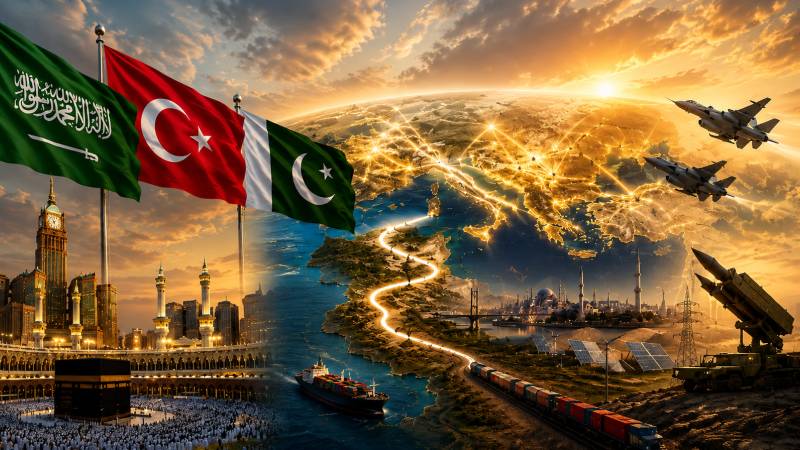
On August 7, in Mecca, the handshake of Recep Tayyip Erdogan, Mohammed bin Salman, and Shehbaz Sharif, was much more than the signing of a document. It was the establishment of a concept that regional analysts have deliberated on, since October 2023, a non-ideological, joint hard power, Sunni-majority axis. The defense pact incorporates Pakistani deterrent defense, Turkish defense industry capabilities, and Saudi financial power.
All three countries are obligated through the Mecca Joint Defense Agreement to consider an attack on one country an attack on all countries. This is similar to NATO’s Article 5; however, analysts do not compare the two. Aljazeera quoted Ozgur Unluhisarcikli of the German Marshall Fund, who stated that it is not a rigid mutual-defense treaty; instead, it is a framework to deepen military-strategic-defense industrial cooperation among three regional countries. While the differences of the two pacts do matter, they do not decrease the importance of this agreement, which was built outside of Washington: the most important realignment in the Middle Eastern security structure since the Abraham Accords.
The question is why the defence pact is signed now? Since the US and Israel intensified their attacks on Iran on February 28, Gulf oil exporters absorbed missile and drone attacks, and the Strait of Hormuz turned into a live choke point. Saudi Arabia, with US bases on its territory, absorbed the bulk of the attacks. Both the Houthis in Yemen and Iranian aligned Iraqi militias focused on the Saudi Arabia. In addition to porous US security guarantees, the US kept its troops and hardware in the region. Saudi Arabia’s experience, coupled with the visible security in US power, led the Kingdom to strike a balance.
In contrast, both Pakistan and Turkiye have not been subjected to direct attacks. However, both have been alarmed by Israel’s expansion of its military to cover a fifth of Lebanese territory, its ongoing occupation of Syria and Gaza, and its escalating hostility towards Ankara. Erdogan has accused Israel of attempting to blow apart the fragile US-Iran memorandum of understanding signed in June, and that the Netanyahu’s government should not be allow to drag the region back to its Open Warfare state.
This deal works because it is the most literal sense of the word transactional: three states with radically different comparative advantages, have pooled them into a single deterrent package.
Pakistan’s partnership with Saudi Arabia offers a resource that no other member of the alliance can contribute: a combination of nuclear weapons and a missile arsenal along with well-experienced soldiers. Pakistan’s military stature has gone to new heights after responding to India’s Operation Sindoor. Islamabad has already sent a squadron of jets and air defense systems to Riyadh during the Iran war based on already existing defence agreements with KSA. Michael Kugelman, a fellow of the Atlantic Council, states that the pact gives Pakistan a great prestige opportunity. Pakistan has the chance to demonstrate that it can act as a stabilizing regional actor, rather than a destabilizing one, to the rest of the world. Pakistan is also rewarded with more power in Washington. The Trump administration calls for allies to create and take on their own security obligations. Pakistan can advocate for a position, either if the Iran war cools, or if it restarts, arguing that a Muslim nation with nuclear weapons is creating a deterrent in the Gulf region. Pakistan has said the bilateral agreement with Saudi Arabia does not extend a nuclear umbrella. Saudi Arabia and Islamabad have also been careful to state it does not actually work in a nuclear deterrent capacity.
As such agreements need financial support and KSA is great in extending such a support. Joint defense projects in the Middle East have historically been impossible because no one country has been able to fund and execute them, except for Saudi Arabia. In order to ensure that the region’s stabilizing power is neither Iran nor Israel, but Saudi Arabia, Riyadh has positioned itself to be the stabilizing power in the region. This is why Allison Minor of the Atlantic Council says that Saudi Arabia is “stitching together a web of partnerships.” It does not trust a single partner to deal with the threats it faces, including the Untied States.
Turkiye’s military is the second largest in NATO, and their defense manufacturing has exported weapons to Saudi Arabia through what was, at the time, their largest defense contract. Rich Outzen, from the Turkiye Program at the Atlantic Council, states this deal increases deterrence against Israel for Turkiye. This is because of the increased Israeli rhetoric for confrontation with Turkiye. The deal also opens the gulf market for Turkish defense procurement.
This deal is the newest layer in the ongoing strategy of Pakistan to trilaterally deepen defense commitments in the gulf.
This deal is the newest layer in the ongoing strategy of Pakistan to trilaterally deepen defense commitments in the gulf. In September 2025, the Saudi-Pakistani defense agreement, which included a mutual defense clause for the first time in a gulf agreement, was signed after the Israeli air raid in Doha. This would have likely resulted in a similar reaction from other gulf states, and provided a defense engagement framework for Saudi Arabia and Pakistan to build active defense relations. In July 2026, Kuwait signed a defense cooperation agreement with Pakistan, which had been signed in 2023 and detailed military training, intelligence, and logistics and defense-technology cooperation, and would allow Kuwait to enhance cooperation to enter energy investments. These agreements show the defense transformation of Pakistan from past military training relationships to a defense mastery with the Mecca Pact as the essential framework to finally integrate Turkish hard power.
There are three main effects to anticipate. First, Washington becomes more of an equal partner, as opposed to a guarantor, among multiple partners. While this aligns with Minor’s assertion that the US is seeking to be an integrator rather than the provider of security, as a consequence of this, US influence over the Gulf will be drastically diminished. Second, Israel will be confronting a bloc of at least semi-organization that will be armed with nuclear weapons combined with NATO-level forces and Gulf funding. Even if this pact is not oriented against any particular country, as Turkish officials have claimed, it will be a game-changer for deterrence. Razaei’s dismissal of the agreement as a worthless pact that depends on the goodwill of the US, ignores that the agreement’s significance lies not in the possibility of Article 5 like interventions, but rather in the fact that it openly declares to Tehran, Tel Aviv, and Washington that the three nations act in unison and no longer as separate subordinates.
Third, for the rest of the Islamic world, the most important consequence will be that this agreement will be constructed as an open-ended arrangement. The most likely next candidates will be Egypt, Jordan, and Qatar. If any sign on, then speculating to informally call this agreement the “Islamic NATO,” will be less a hyperbole and more an accurate depiction of the trajectory of security arrangements in the Middle East: creating a deterrent system that will replace US-centered arrangements with multi-polar systems.