

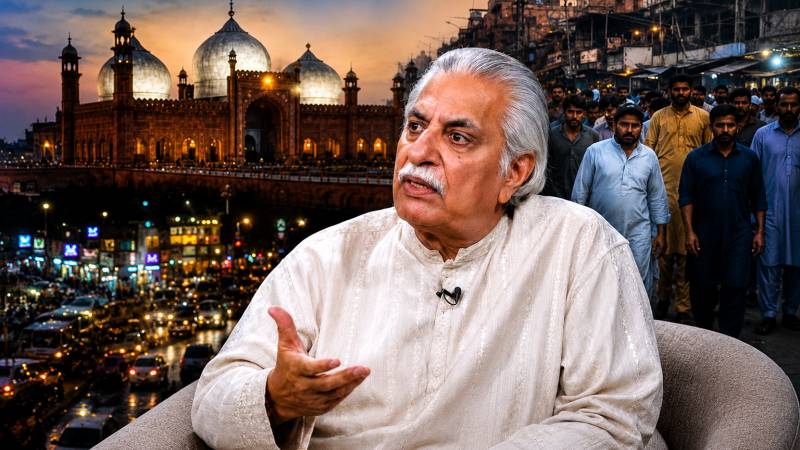
In a recent interview, veteran actor and director Usman Peerzada took a nostalgic look back at the Lahore of his youth. Born in 1951, he described a "cycle city," green and unhurried, and split it in two: the inner city behind the walls, and the "outer Lahore" the British began settling after the 1857 uprising. He was careful to say migration to a growing capital is natural. Even so, his verdict was clear. People who moved to Lahore from smaller towns, he said, could not understand the city's temperament, and their arrival left its culture damaged. Lahore's essence, he insisted, remains intact underneath that damage and always will.
Peerzada is not an outlier. He is one recent, prominent voice in a much older argument, aimed at Lahore's walled city and sometimes at Karachi's older neighbourhoods, always resting on the same idea. Call the people who hold this idea chronocentrists. The word is built the same way as ethnocentrism: where ethnocentrism treats one's own culture as the human default, chronocentrism treats one's own era as history's true form. The version of a place that existed in a chronocentrist's youth becomes the authentic one, and everything layered on after that becomes damage rather than the next chapter of the same continuous story. A chronocentrist need not be hostile about it. Peerzada's own tone was wistful rather than angry. The belief still deserves scrutiny, because decades of scholarship on culture and empire have dismantled the assumption it rests on, and because the benchmark itself keeps shifting depending on who is doing the measuring.
Whose era gets to be the standard
Start with that last point, since it undoes the argument before any theory is needed. Peerzada's "cycle city" is the Lahore of the 1950s and 1960s, by which point Mall Road and the rest of "outer Lahore" were already a century old, built by the British from the 1850s onward. His own father, playwright Rafi Peer, was born in 1898, a generation for whom that still-expanding colonial city would have been the newer, less settled part of Lahore, not yet folded into anyone's nostalgia. Push back further and Sikh-era Lahore, or the Mughal city before that, would each have had residents insisting theirs was the real Lahore. Every generation takes the version of the city it grew up in and sets it as the baseline against which all later change counts as loss. No generation's baseline has a stronger claim than any other's. That is a strong signal the claim was never really about history. It is about whoever is doing the measuring.
The idea that culture comes in pure forms
Chronocentrists assume a culture has a stable, original form that existed before contact with outsiders, and that contact damages it. This feels intuitive because it maps onto nostalgia and belonging. It is also one of the most thoroughly rejected ideas in modern cultural theory. Homi Bhabha, in The Location of Culture (1994), argued that culture is produced in the very moments of contact and negotiation between groups, not before them, in what he called a "Third Space." A culture, in this framing, is not a finished, fixed form that later contact damages, but something continuously produced through contact itself. Edward Said made a related point in "Culture and Imperialism," observing that all cultures are involved in one another, that none stands alone as single and pure, and that all are hybrid to some degree, a claim he extended to colonising societies as much as colonised ones, since British, French and American identities were themselves shaped by the empires they built. If that logic holds for the great imperial capitals, it holds for Lahore.
The version of a place that existed during a chronocentrist’s youth becomes the authentic one, while everything layered on afterward is treated as damage rather than the next chapter of the same continuous story.
The walled city was never one thing
Apply this to the walled city and the chronocentrist argument runs into its own history. Long before any wall existed, the site carried Hindu and pre-Mughal settlement. The Mughals built the fort, the mosques and the gardens that give the old city its skyline. Sikh rule under Ranjit Singh added its own layer inside the walls, including his samadhi and the neighbouring Gurdwara Dera Sahib, built to mark Guru Arjan's martyrdom. British administrators tore down large stretches of the fortification after annexing Punjab in 1849, sold the bricks, and pushed the city's centre toward the Mall — the very "outer Lahore" Peerzada now folds into his memory of an undivided city. Partition brought further upheaval, as departing Hindu and Sikh families were followed into their homes by arriving Muslim families from India. Research on the Walled City's heritage describes its architecture as a genuinely hybrid product, blending vernacular and colonial features, and notes the irony that administrators who wanted to purify the old city after independence still depended on Sikh- and colonial-era structures to keep it functioning. No single era in that history holds an original Lahori culture untouched by the world outside the walls.
Naming one layer of a layered history as the true standard is not a neutral observation. It is a choice, made in the present, about which past to treat as essential. Historians Eric Hobsbawm and Terence Ranger described this pattern in "The Invention of Tradition" (1983), showing how practices that feel ancient are often assembled fairly recently, then presented as timeless to serve current needs, from Scottish tartan to European royal ceremony. Declaring one part of a city's layered past authentic, while treating everything after a certain point as decline, follows exactly this pattern.
The move to the Kalasha
When the walled city argument runs out of road, chronocentrists sometimes reach for a different example: the Kalasha of Chitral. If mixing is fine and purity is a myth, why does the state work so hard to protect Kalasha culture from outside influence? It is worth answering directly, since it exposes the same confusion from another angle.
Protection extended to the Kalasha people is not built on the idea that their culture must be held to one era. It rests on a minority and indigenous rights framework, and the difference matters. Pakistan's National Commission for Human Rights, in its 2017 report "Saga of Survival," documented a community commonly estimated at under four thousand people, facing forced religious conversion, loss of ancestral forest land, and exclusion from higher education, with a school curriculum that teaches them nothing about their own history and language. UNESCO's recognition of Kalasha practices as intangible heritage sits inside this same protective logic, alongside international norms on indigenous peoples that emphasise land rights, language rights and free and informed consent, not cultural quarantine. What is named there is survival and self-determination for a demographically tiny, marginalised community, not the preservation of an unchanging artefact for outsiders to admire.
Kalasha culture is also not held to one era in the way chronocentrists imagine. Researchers studying the Kalasha language describe ongoing mixing with Khowar, the dominant language of surrounding Chitral, and Kalasha origin stories mix a folk memory linking the community to Alexander the Great with genetic evidence connecting them to ancient Gandharan populations. Decades of tourism have also shaped how the community presents itself to visitors. Even the group most often invoked as untouched tradition is a product of long contact and continuous change. What is being protected is a small community's right to keep existing on terms it chooses, including the right to change, the same rights-based logic applied to a different, far more vulnerable population, not its opposite.
The politics of insisting on one identity
There is a further reason to distrust the chronocentrist instinct, and it has nothing to do with heritage. Amartya Sen, in "Identity and Violence," described the solitarist error: reducing a person or group to exactly one identity and treating that identity as if it explains everything about them. This habit fuels conflict, Sen argued, since it erases the many overlapping identities people actually hold and replaces them with a single, imposed label used to draw lines between who belongs and who does not. A resident of Lahore is simultaneously Punjabi, South Asian, tied to a specific mohalla or trade, and much else besides, in the same way the Kalasha are simultaneously Chitrali, Pakistani citizens and members of a specific faith community. Reducing either group to one supposedly essential identity reproduces the same error, just applied to culture instead of religion or nationality.
What actually keeps a culture alive
The bazaars, crafts and trade networks that keep the walled city alive today exist because centuries of migration and commerce ran through it, a pattern the anthropologist Arjun Appadurai describes across his work on globalisation, where cultural vitality tends to follow flows of people, goods and ideas rather than sealed compartments. Treating mixing as damage works against the very thing that keeps a neighbourhood or a language dynamic rather than turning it into a museum piece.
Chronocentrists will sometimes say evidence for decline exists, even if it is not produced on demand. Even where such evidence exists, it can measure change. It cannot measure purity, because purity was never a historical condition to begin with. It is a story, told from whichever era the storyteller happens to be standing in. The better question, for Lahore and for the Kalasha alike, is not which era counts as the true one. It is which policies actually protect people's rights, their land, their language and their ability to shape their own future. That question has real, evidence-based answers. The purity question never did, because it was never really asking about evidence in the first place.