

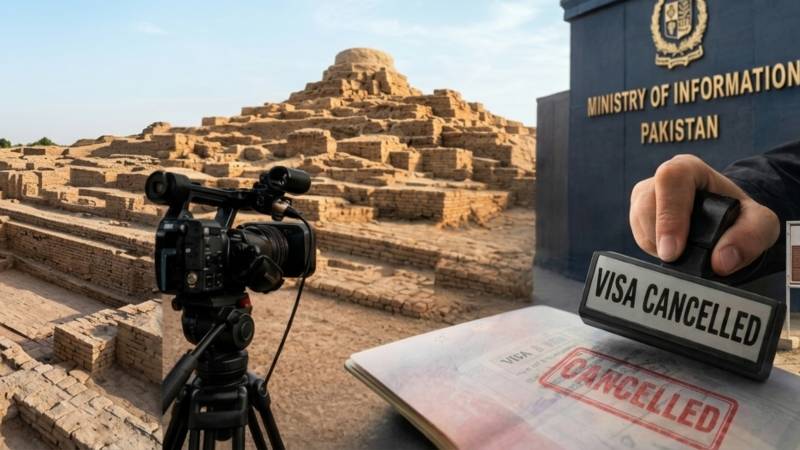
In an unprecedented move, Pakistan’s government has killed a documentary production about its historical and archaeological heritage for German television. Why would Islamabad counter its own efforts to project a different image of the country ahead of a presidential visit to Berlin and bilateral budget consultations?
Twenty years ago, I discovered modern Pakistan through the prism of its distant past. I was commissioned by ZDF, Germany’s second public TV channel, to write the script and co-direct a prime-time documentary about the Indus civilisation. The show, Terra X, has been, to this day, a regular cultural draw. Every Sunday evening, it broadcasts stories about science, history, and archaeology into the average German living room, enabling millions to travel through time to remote, enchanting places.
Like Pakistan itself, the relatively late-discovered Bronze Age civilisation along the Indus River has never been an easy sale. It cannot boast monumental structures like the Egyptian pyramids, and its suspected writing system is still waiting to be deciphered. It needs a lot of context, creative storytelling, and a high threshold of frustration. That is what we were willing to invest, and the film became a great success.
About two weeks ago, on August 12, this time as the show’s presenter and accompanied by a formidable team, I was about to embark on another journey through Pakistan. Our three-week shoot, prepared with Pakistani authorities over several months and finally approved, was to be presumably the most comprehensive and high-profile German historical and archaeological documentary about Pakistan’s cultural heritage and history, from the Bronze Age through the Mughals to the country’s national independence.
It would cover various regions of Pakistan, with the exception of Balochistan and Azad Jammu and Kashmir (AJK). Apart from a small, hardened community of Himalayan alpinists, Europeans tend to identify Pakistan with news about crime, armed conflict, and natural disasters. Our goal was to explore the treasures, hidden gems, and landmarks of its cultural diversity. But then, an inconspicuous email from Islamabad killed it. Our already issued and valid visas were cancelled without further explanation.
The broader context of this unceremonious affront was what appears to have been a media crackdown by Pakistan’s authorities, triggered partly by a rather awkward incident. A fortnight earlier, the government-sponsored, though editorially independent, German foreign TV channel DW had licensed and rebroadcast an older documentary about Pakistan’s nuclear programme.
The communication policy that we experienced seems inconsistent, unprofessional, and unfit to accompany the country’s ambitions on the global stage.
The Islamic Republic took offence. The Foreign Ministry spokesperson even held a press conference to protest against the production. It may be true or not, as some Pakistani commentators wrote in response, that the film in question was no masterpiece of investigative journalism, was quite selective in its views, and was produced under dubious circumstances. Whereas not many people had initially taken notice of the production, the noise generated by government officials gave it some unexpected attention.
The case coincided with a seemingly unflattering Al Jazeera news report about violence in AJK. In response, Pakistan introduced new and unprecedented restrictions on journalists, affecting both foreign and domestic media. This went along with statements by government officials and their surrogates, who acted as if most — if not all problems in Pakistan were the result of foreign media agendas that either produced inaccurate, provocative stories or even fabricated incidents to stir riots and tarnish the otherwise impeccable image of the country on the eve of its national Independence Day.
Now, was the destruction of our project simply collateral damage caused by the disgruntlement of some decision-maker in Islamabad? And could such anger be a reason good enough to break the commitment of the Pakistani state to us?
The visa cancellation was a drastic, though not the first, level of escalation. In the days ahead of our planned departure to the cultural and archaeological treasures between the mountains of Chitral and the sunken city of Mohenjo-Daro in Sindh, we had been notified that there was “no point” in starting our filming because our NOC was “under review”.
Every media professional dealing with Pakistan knows what lies behind the acronym. The “Non-Objection Certificate” epitomises, in a way, the country’s opaque and contradictory security bureaucracy. The NOC is a prerequisite for almost anything you do. But until you have received it after an in-person interview at the foreign media “wing” of the Ministry of Information, you actually do not possess it.
Yet, since the issuing of a press visa depends on the existence of an NOC, you can conclude that it must be there. Somehow, somewhere. To borrow an expression from Platonic philosophy, the NOC exists somewhere between the World of Ideas and the Material World. And it can be withdrawn by an invisible hand at any time, as if it had never existed.
In other words, regardless of how much time and money you have invested and how many high-ranking officials have commended your efforts and welcomed you to Pakistan, you can be sure of almost nothing.
When the authorities in Islamabad put us in this limbo, my producer and I decided to leave the crew behind in Germany on standby and travel to Islamabad. Too much was at stake here. Encouraged by some wise and otherwise influential people on the ground, we went to reason with the competent authorities in person.
We first received an oral warning that we would be deported from Islamabad airport upon our arrival and, ultimately, the visa cancellation. Even my producer, a senior filmmaker with 30 years of experience as a war and conflict correspondent, had never seen anything like this. To this day, not a single Pakistani official has cared to explain or apologise to us.
The episode comes at a time when Germany and Pakistan maintain a substantial development partnership. The active bilateral cooperation portfolio is worth several hundred million euros. Future cooperation will, as always, be subject to governmental and parliamentary scrutiny in Germany. Against that background, abrupt reversals of previously approved projects can only make it harder to build the confidence on which such partnerships depend.
For Pakistan, which is seeking greater international engagement and investment, administrative predictability and a credible environment for foreign media are part of that wider relationship.
Driven by the urgency of its own situation, Pakistan has made an unprecedentedly positive appearance on the international stage as a mediator in the Iran war in recent months. Prime Minister Sharif and Field Marshal Munir seem to have their eyes on the Nobel Peace Prize. Whatever may have been the considerations of the security apparatus, the communication policy that we experienced seems inconsistent, unprofessional, and unfit to accompany the country’s ambitions on the global stage.
Cancelling visas and effectively halting a project after months of preparation and prior engagement creates uncertainty for foreign organisations dealing with Pakistan. And, as far as Germany is concerned, it undermines the work of those who believe that this partnership is worthwhile investing in at all.
Twenty years after my first documentary in Pakistan, in the run-up to our expected shooting trip, I had returned to my notes and books about the history of the discovery of the Indus civilisation in the 1920s, or the “Harappan civilisation”, as it is also called after its first, less spectacular, excavation site.
In the 1860s, a British officer and orientalist by the name of Alexander Cunningham first documented the discovery of a peculiar clay tablet that, as we know today, dates back to the third or early second millennium BC. It would take more than 60 years for his successors to make sense of what Cunningham had found.
Tragically, the ancient adobe bricks from Harappa in Punjab had met another destiny by then: They were used as spolia to build a British railway embankment to bring civilisation to the Indus Valley.
The country’s cultural heritage paid dearly for this ignorance. The Lahore-Multan railway could be in better shape today. Yet much of Harappa, as we know it today, is forever lost.