

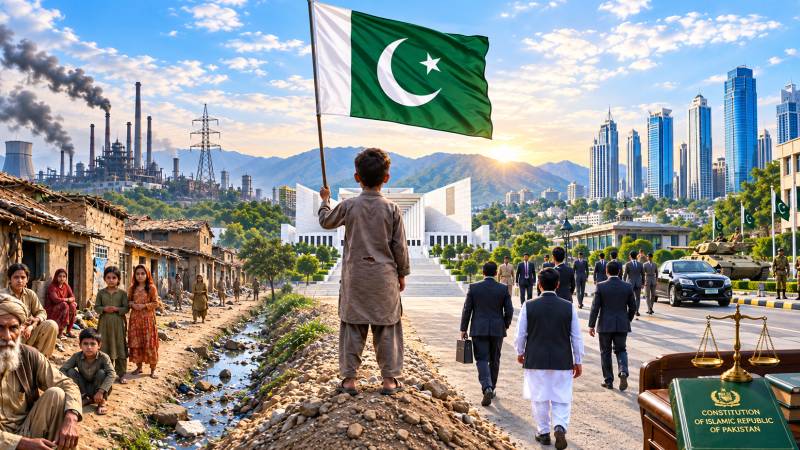
Pakistan reaches the ripe age of 79 years. Let us revisit its past, present, and future. A preferred perspective can obscure one’s view, but outcomes cannot be contested. One thing stands out: lessons remain unlearned. Context is vital. Jinnah sought to secure Muslims’ rights within a united India, but realised that they could not be obtained under Hindu hegemony. He articulated a Muslim political identity and rallied Muslims across India to support his demand for a separate state. He succeeded in creating a Muslim state separated by more than a thousand kilometres of Indian territory, which Jinnah called “moth-eaten Pakistan”; it ceased to exist in 1971. Why?
Some argue that, after Jinnah’s death, the state failed to manage the chaos of Partition amid social, political, and economic challenges. Yet, it succeeded in creating a currency, establishing a financial framework, and setting economic activity in motion. Politicians enacted the first Constitution of Pakistan in 1956, realising Jinnah’s dream.
What followed set Pakistan on a trajectory of free fall. Privileged groups aligned with state actors orchestrated instability that led the country towards authoritarian rule and the abrogation of the Constitution in 1958. The first test of constitutional democracy surfaced, but the judiciary chose power over principle, squandered its independence, and destroyed constitutional checks and balances. So-called champions of democracy looked the other way. They provided oxygen to this process and enlisted the country in the struggle against the “red revolution”. We have remained “yours truly”. Pakistan continues to suffer the consequences of that structural capture, maintained by all means. The immediate outcome was the erosion of rights, deepening ethnic tensions, and a widening cleavage between West and East Pakistan, reinforced by uneven growth from foreign capital. Blatant alienation of East Pakistan ended in the creation of Bangladesh.
For this existential tragedy, some callously argue that it was never feasible, while others considered East Pakistan a burden. Others focus on external orchestration but ignore Bengal’s two decades of systematic marginalisation and the fact that its people compromised their majority by accepting the One Unit scheme. No one was held accountable. Pakistan ignores the irony that it has done far worse, with a current per-capita income of $1,901, barely two-thirds of Bangladesh’s $3,020.
Two paths are conceivable for a complete state reset. The first is exogenous: hyperinflation, default, financing stops, climate chaos, or water conflict. The second is endogenous: extreme unemployment and poverty, demographic pressure, self-realisation, or the emergence of a reform-benefiting constituency. Pakistan should choose wisely or await a vicious reckoning.
The saga continues. The state has failed to create national cohesion. Citizens gravitate towards primordial identities: Punjabi, Pashtun, Baloch, Sindhi, Saraiki, and Mohajir, driven by grievances against the state and exploited by internal and external actors. Today, we see profound ethnic divisions in Sindh, divisions in Punjab, conflict in Balochistan, disturbances in Khyber Pakhtunkhwa, and tensions in Azad Kashmir.
What accrued? Ayub’s failed “Basic Democracies” and the 1965 war gave way to Yahya’s botched handling of the Awami League’s 1970 electoral victory. The quashing of unrest in East Pakistan led to the breakup of Jinnah’s Pakistan. Bhutto delivered the 1973 Constitution but was overthrown by Zia and executed. His Islamisation and the Afghan jihad altered the state’s character. Nawaz and Benazir both brought poor governance. Pakistan went nuclear under Nawaz in 1998, inviting isolation that deepened after Kargil. He was overthrown by Musharraf, who aligned with the West during the War on Terror, but his policy of “enlightened moderation” was later dislodged. PTI’s rise and decline recycled structural capture and patronage, followed by the emergence of PDM 1.0. Amid allegations of rigging, PDM 2.0 came to power but failed to make progress; its “Uran Pakistan” initiative lost its way. Meanwhile, the country prevailed in a brief conflict with India and has remained under a ceasefire since May 2025. Pakistan oscillates among US dependency, Chinese cover, foreign loans, IMF bailouts, and rollovers of friendly deposits.
Pakistan’s nightmare continues. Today, the country is neither at peace within nor with its neighbours. Society is immersed in poverty and inequality, while politics is poisoned by ethnocentric self-interest and majoritarian rule. Socio-political and governance dysfunctions, measured by internationally recognised indicators, reveal a dilapidated outcome. Positive milestones feel like a candle in daylight.
Global democracy indexes reflect a distorted face that has slipped into an authoritarian fascination. The ensuing political dissent has turned into social instability, ethnic strife, and armed conflict, pushing Pakistan into the high-alert zone of the Fragile States Index. On governance, the World Bank ranks Pakistan 129th for government effectiveness and 123rd for control of corruption; the Chandler Index places it 119th, near the bottom, with “Government Helping Citizens” at 115th; a severe failure to uplift citizens. On human rights, Freedom House ranks Pakistan “not free”, with civil liberties and political rights severely constrained; the Rule of Law Index places it near the bottom in terms of justice, accountability, and fundamental freedoms.
Economic dysfunction follows. The Heritage Foundation ranks Pakistan 152nd as a “repressed economy”. The outcome is collective misery borne by common people, not by those under whose watch we landed here. Nearly half the population lives under stressful conditions ($4.20/day), with high unemployment and widening inequality. Pakistan is trapped in the lowest tiers of human development, facing “serious” hunger and food insecurity. Faced with this systemic failure, we must ask: what future will our children and young people build? The outlook is bleak. Among those aged 15–29, approximately 21.8 million, or 37 percent of youth, are Not in Education, Employment, or Training (NEET), with rates climbing above 42 percent in Khyber Pakhtunkhwa and Balochistan.
More damningly, we are mortgaging Pakistan’s future to patronage politics and fiscal distress. Ethnicities are pitted against one another, which benefits those among them who enjoy power and patronage. Future earnings are consumed by debt servicing and unproductive expenditures rather than development. The state runs on credit, choking growth and neglecting human capital. The Human Capital Index shows that a child born today achieves only half of their potential due to a lack of healthcare, education, and opportunity, compounded by climate neglect and a suppressed civil society. This has structurally compromised Pakistan’s future.
No plan to put Pakistan back on track, however meaningful, can bear fruit unless it answers the “Keystone Question”: who has the power to reset state affairs? The answer: no one. Those who wield power would not use it against themselves. Two paths are conceivable for a complete state reset. The first is exogenous: hyperinflation, default, financing stops, climate chaos, or water conflict. The second is endogenous: extreme unemployment and poverty, demographic pressure, self-realisation, or the emergence of a reform-benefiting constituency. Worse still, internal strife aligned with proxies could turn into an existential threat and force a reset. Pakistan should choose wisely or await a vicious reckoning. Has this not proved enough to prompt an immediate reset and put the country back on Jinnah’s trajectory? Unfinished structural changes remain: land reform, meritocracy, and a military aligned with its constitutional role. The fix has sat in plain sight for 79 years, untouched, an ultimate outcome.