

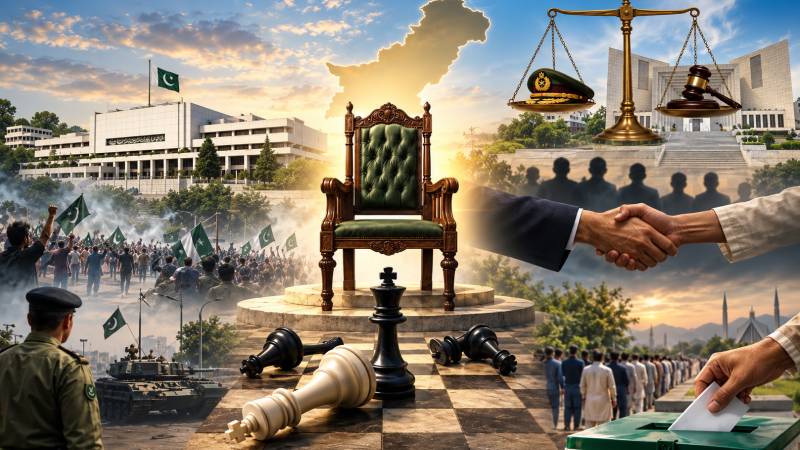
Countries do not usually weaken because they change. They weaken when they become incapable of making change cumulative. This distinction matters for Pakistan, where political life has repeatedly been organised around the idea of the reset: crisis arrives, public anger intensifies, a new political force promises a break with the past, expectations rise, institutions are bypassed or weakened, disappointment follows, and the country begins searching for another reset. The personalities change. The pattern survives.
The deeper question, therefore, is not whether a country should reform gradually or change rapidly. It is whether its institutions are strong enough to absorb change without destroying continuity. Edmund Burke understood part of this problem when he argued that society is not simply an arrangement between the living. It is also a relationship between generations. His insight was not that tradition should be preserved for its own sake. It was that institutions accumulate memory, legitimacy and practical knowledge over time. Destroying them may create the political freedom to build something new, but it can also destroy some of the capacity required to build it.
The French Revolution demonstrated the danger that can arise when the destruction of an established order outruns the construction of institutions capable of replacing it. The lesson is not that revolution is inherently illegitimate. France had profound inequalities and grievances that demanded change. The lesson is that political rupture can become destructive when the institutions required to organise the new order are weaker than the forces dismantling the old one.
Britain offers a different historical experience. Its transformation was neither painless nor uniformly gradual. It involved civil war, revolution, industrialisation and major extensions of political participation. Yet much of that transformation was absorbed through institutions that could themselves evolve. The lesson is not that Britain avoided disruption. It is that disruption did not permanently require the state to reinvent itself.
America provides another important distinction. The United States experienced a profound constitutional and moral crisis in the Civil War, followed by the abolition of slavery and a fundamental redefinition of citizenship. Yet the constitutional framework survived that radical transformation. American history therefore demonstrates that constitutional continuity can coexist with extraordinary political and moral change. Institutions do not have to prevent transformation; they have to provide a structure through which transformation can become durable.
India presents a similar, though imperfect, lesson. Its history contains wars, political upheavals, the Emergency, constitutional amendments, economic crises and major changes in political settlement. Yet significant economic and institutional reforms have generally been incorporated into an enduring constitutional framework rather than requiring repeated replacement of the state itself. Continuity does not mean the absence of conflict. It means that conflict can occur without making institutional destruction the principal instrument of political change.
The 18th Amendment and 7th NFC Award transferred major responsibilities and resources to the provinces, but important structural weaknesses remain: revenue mobilisation is weak, responsibilities and resources across levels of government remain poorly aligned, and local governments receive an inadequate share of public resources.
Saudi Arabia demonstrates another route. Its recent transformation under Vision 2030 has been exceptionally rapid, encompassing economic diversification, new industries and significant social change. But speed alone did not produce that transformation. It required administrative machinery, capital, regulatory capacity and a state capable of implementing decisions. The model is not directly transferable to Pakistan, nor does it establish that centralised transformation is inherently superior. Its narrower lesson is that even rapid reform requires institutions capable of turning decisions into sustained implementation.
Pakistan’s problem has been different. The country has repeatedly changed political direction without building sufficient institutional continuity between those changes. The World Bank has documented the major shifts from civilian to military rule in 1958, 1977 and 1999, each followed by prolonged periods of military-led government. Its analysis also links repeated regime changes to uncertainty, disrupted policy continuity and weaknesses in the construction of durable governance institutions.
The consequences extend beyond politics. Businesses invest when they can reasonably anticipate the rules under which their capital will operate. Governments reform when institutions can preserve reforms beyond the tenure of individual leaders. Investors, employers and households make long-term decisions differently when policy can be reversed with every political transition. Institutional discontinuity therefore carries an economic cost: it shortens investment horizons, weakens confidence and makes long-term reform harder to sustain.
Pakistan has too often substituted political replacement for institutional repair. That pattern remains relevant today. The country’s continuing political confrontation, including the September 2026 mobilisation around a jailed former prime minister and the security measures surrounding planned protests, illustrates how political conflict can once again become a contest over the functioning of the state itself. The identities of today’s protagonists may matter politically, but the larger institutional question is more enduring: can disagreement be absorbed through institutions, or must every major political conflict become a struggle over the state itself? This is where Burke remains relevant, but only if Burke is understood correctly. Tradition without reform becomes rigidity. Reform without continuity becomes disruption.
Pakistan does not need to preserve every institution simply because it exists. Some institutions require fundamental reform. Some laws deserve repeal. Some administrative structures should disappear. Some political arrangements should change. But reform should strengthen the capacity of the state rather than repeatedly resetting it.
The most important reforms may therefore be less dramatic than political slogans suggest. The World Bank’s July 2026 assessment of Pakistan’s fiscal federalism makes precisely this point in institutional terms. The 18th Amendment and 7th NFC Award transferred major responsibilities and resources to the provinces, but important structural weaknesses remain: revenue mobilisation is weak, responsibilities and resources across levels of government remain poorly aligned, and local governments receive an inadequate share of public resources. The Bank emphasises more predictable, rules-based transfers and stronger local accountability. This is the real architecture of reform: not another political reset, but institutions that make reform cumulative.
A functioning local government system, predictable fiscal transfers, professional public administration, independent regulation, credible taxation, judicial capacity and stable economic rules may appear less dramatic than changing governments. Yet these are the mechanisms through which a state becomes capable of learning. That is ultimately the difference between a political movement and a state.
A movement derives energy from dissatisfaction. A state must convert dissatisfaction into institutions, institutions into policy, and policy into results. Movements can mobilise millions in months. Institutions take decades to build. Destroying one can take days. The temptation of every crisis is therefore to ask who should replace whom. The harder question is what should remain standing regardless of who wins. Pakistan has spent enormous political energy changing direction and too little building the road. The ultimate test of leadership is therefore not the ability to create a political earthquake. It is the ability to make change durable enough that the next generation does not need another earthquake. A country that must be reinvented by every generation has not yet built a state; it has built political movements.