

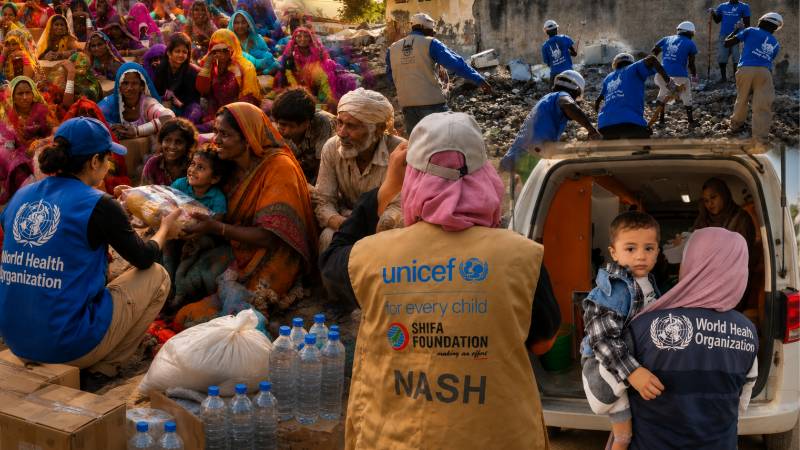
Wars, floods, earthquakes, famines, epidemics and forced displacement have always tested humanity. Yet amid every scene of devastation, there are people who willingly put themselves at risk to save others. Someone carries an injured person to an ambulance; another delivers food to a family trapped by floods; a health worker travels to a remote settlement with vaccines; a volunteer establishes a temporary classroom for displaced children; and a doctor treats the wounded amid gunfire and bombardment. It is to honour their service and sacrifice, and, more importantly, to demand their protection, that World Humanitarian Day is observed every year on 19 August.
This is not merely a day for paying tribute. Its message is more serious: those who set out to save human lives must not themselves become targets. World Humanitarian Day itself emerged from tragedy. On 19 August 2003, a bomb attack on the Canal Hotel in Baghdad killed 22 humanitarian workers, including Sergio Vieira de Mello, the United Nations Special Representative for Iraq. Five years later, the UN General Assembly designated 19 August as World Humanitarian Day. More than two decades later, the significance of the day has only increased.
The central message of World Humanitarian Day 2026 is particularly compelling: Concern is not protection. Condemnation is not accountability.
The statement challenges the conscience of the international community. Expressions of sorrow after the killing of an aid worker are not enough. Condemnation after an attack on a hospital is not enough. Nor is expressing concern when a convoy carrying food is prevented from reaching people in desperate need. If international humanitarian law exists, it must be enforced. When it is violated, responsibility must be established and those responsible must be held accountable.
The figures reveal the gravity of the situation. According to the United Nations, at least 326 humanitarian workers were killed across 21 countries in 2025. In only three years, the number of humanitarian personnel killed exceeded one thousand. These are not merely statistics. Behind every number is a family: a mother whose son never returned, a child whose father died while trying to save someone else, colleagues who lost a companion, and communities that may have lost their last remaining source of assistance. An attack on a humanitarian worker therefore extends far beyond the individual victim. When a doctor is killed, hundreds of patients may lose access to treatment. When a worker delivering food is attacked, an entire aid convoy may stop. When a local relief worker is abducted, access to remote communities may disappear.
International humanitarian law consequently establishes limits even in war. Civilians, medical personnel and humanitarian workers are entitled to protection, and parties to conflict must facilitate humanitarian assistance to populations in need. Yet in 2025, the World Health Organization verified 1,385 attacks on health care across 19 countries and territories, resulting in approximately 1,984 deaths and 1,187 injuries. Hospitals, ambulances and health workers can no longer assume that their humanitarian function alone will keep them safe.
Modern warfare is being transformed by armed drones, automated surveillance, artificial intelligence, long-range weapons and increasingly sophisticated information systems. Technology, however, does not eliminate human responsibility. Artificial intelligence may assist in identifying a target, but the moral and legal responsibility for taking human life cannot simply be transferred to a machine. Human judgement and human accountability must remain central. Equally important, information about humanitarian locations, vehicles, personnel and movements provided for their protection must never be misused to target them.
The scale of humanitarian need makes this responsibility even more urgent. By the end of May 2026, more than 252 million people required urgent humanitarian assistance and protection. Humanitarian organizations were planning to reach 143.2 million people by mid-year, prioritizing almost 89 million facing the most severe needs. Yet by the end of April, only around 45.2 million people had received at least one form of assistance or protection.
Funding is equally alarming. By May 2026, humanitarian plans required US$33.66 billion, while only US$8.21 billion had been received roughly one quarter of what was needed. Such a funding gap is not simply an accounting problem. It means food distributions are reduced, medical programs close, shelters are unavailable and vulnerable people are left without protection. There is an uncomfortable moral contradiction here: the world can find resources to acquire weapons, yet struggles to find enough money to feed the children displaced by those weapons. For Pakistan, World Humanitarian Day is not a distant international observance. Humanitarian emergencies are deeply embedded in our recent national experience.
The 2005 earthquake, the floods of 2010 and 2022, earthquakes in Balochistan, malnutrition in Thar, terrorism in Khyber Pakhtunkhwa, displacement from former tribal areas, the COVID-19 pandemic and recurring monsoon disasters have repeatedly tested Pakistan. During these crises, doctors, rescue personnel, military personnel, volunteers, welfare organizations, local communities and ordinary citizens have played indispensable roles.
The catastrophic floods of 2022 demonstrated that a natural disaster does not merely destroy houses. It can wash away education, health, nutrition, livelihoods and children's futures. According to UNICEF figures cited in the source material, around 27,000 schools were destroyed or damaged, disrupting access to education for more than two million children. In 2025, severe monsoon flooding again affected large parts of Pakistan, with approximately 6.9 million people affected. And when disaster strikes, the first people to respond are often not international personnel but local humanitarian workers.
They know the language, the terrain and the communities. Frequently, they themselves belong to the population affected by the crisis. In Pakistan, they include polio workers, Lady Health Workers, ambulance drivers, rescue personnel and countless local volunteers. During Pakistan’s national polio campaign in April 2026, more than 413,000 frontline health workers were trained and mobilised to reach approximately 45 million children. Pakistan's estimated 20,000 annual polio cases in the early 1990s had fallen to 31 cases in 2025. This achievement is not simply a triumph of medicine; it is a triumph of the women and men who go from door to door, often in difficult and dangerous circumstances.
Pakistan also knows the terrible price some of these workers have paid. Polio workers and the personnel assigned to protect them have repeatedly been attacked. Consider the human reality: a woman leaves home carrying a small vial of vaccine to protect a child from lifelong disability, only to lose her own life because she chose to perform that duty. Such violence is not merely an attack on an individual. It is an attack on health, knowledge, the future of children and ultimately on humanity itself. Pakistan’s humanitarian challenges can no longer be separated from climate change. Floods, extreme heat, drought, glacial lake outburst floods and abnormal rainfall are becoming recurring threats rather than exceptional events.
Our humanitarian model must therefore evolve. The traditional approach has been reactive: disaster occurs, and assistance follows. The future requires anticipatory humanitarian action, forecasting risks, preparing communities, positioning supplies in advance and evacuating vulnerable populations before catastrophe strikes. For a climate-vulnerable country such as Pakistan, preparedness can save more lives than even the most efficient relief operation launched after disaster has occurred. Humanitarian assistance must also be understood more broadly. It is not merely a bag of flour or a bottle of water. It includes health care, education, sanitation, child protection, psychological support and the preservation of human dignity.
Despite our many social weaknesses, crises often reveal one of Pakistan's greatest strengths: its instinct for collective assistance. After earthquakes, young people queue to donate blood. During floods, trucks loaded with food travel towards devastated communities. Edhi and Chhipa ambulances respond to accidents and emergencies. Blankets are collected for cold regions, meals are distributed to those in need, and funds are raised for families unable to afford medical treatment. This is a valuable form of humanitarian capital.
But compassion alone is not enough. Charity may be driven by emotion; professional humanitarian action requires training, coordination, transparency, reliable information, security and accountability. Pakistan must transform its traditional culture of generosity into a modern and organized humanitarian system. This requires practical action by the state. Humanitarian and health workers need better security arrangements. Police, district administrations, rescue agencies, health departments and local organizations require stronger coordination. Local volunteers in every district should receive training in first aid, search and rescue, evacuation and psychological support. Female humanitarian and health workers deserve particular protection because in many Pakistani communities they are the only workers able to enter homes and provide essential health services to women and children. The psychological well-being of humanitarian workers must also be recognised. A person who repeatedly sees dead bodies, injured children, destroyed homes and grieving families may themselves suffer severe psychological trauma.
There is an uncomfortable moral contradiction here: the world can find resources to acquire weapons, yet struggles to find enough money to feed the children displaced by those weapons.
Most importantly, when humanitarian or medical workers are attacked, condemnation must be followed by prompt, impartial and effective investigation. That is the essence of the 2026 message: the time for concern alone has passed; accountability must follow. Perhaps the greatest moral strength of humanitarian action is its impartiality. Hunger does not ask which political party a person supports. A bullet does not ask the ethnicity of the person it wounds. A flood does not inspect identity cards before destroying homes. Disease does not recognize sectarian boundaries. Humanitarian assistance must therefore never be conditional on political loyalty, religion, ethnicity or group identity. In Pakistan, need itself must be the criterion for assistance.
This principle is particularly important in Balochistan, Khyber Pakhtunkhwa and other security-sensitive regions, where humanitarian and medical activities should, as far as possible, remain separate from political and security disputes. A doctor's duty is to treat. An aid worker's duty is to deliver assistance. A volunteer's duty is to save life. Their neutrality should be respected by the state, armed actors and local power structures alike.
Statistics are necessary because they reveal the scale of a crisis, but humanity cannot be reduced to statistics. Three hundred and twenty-six humanitarian workers were killed but each had a name, a family and a story. More than 252 million people require humanitarian assistance but each has a home, fears, relationships and dreams. Millions of Pakistanis have been affected by floods, but no destroyed home is merely an “affected unit.” Humanitarianism begins when we learn to see the human being behind the number. Clean water delivered to a flood-affected woman is not simply a bottle; it is protection from disease. A temporary school for a displaced child is not merely a classroom; it is a return towards normal life. An ambulance reaching an injured person is not simply a vehicle; it may represent the narrow possibility between life and death.
Pakistan should therefore take 19 August beyond ceremonial observance. We should remember our polio workers, rescue personnel, ambulance drivers, Lady Health Workers, doctors, nurses and volunteers who have served through earthquakes, floods, epidemics and terrorism. But remembrance is not enough. Fair compensation, professional training, protective equipment, insurance, psychological care, legal protection and support for their families are also national responsibilities. It is easy to award a medal to a humanitarian worker after death. The greater achievement is to ensure that the worker returns home alive. Ultimately, protecting humanitarian workers means protecting everyone who depends upon them. Protect the health worker and the patient has a chance. Protect the polio worker and the child has a chance. Protect the volunteer and assistance can reach the disaster-stricken family. Protect humanitarian law, and perhaps even amid war some boundaries of our common humanity can survive.
Pakistan should therefore make a simple national commitment: whether the emergency is a natural disaster, epidemic, terrorist attack or armed conflict, anyone who steps forward to save human life must receive respect, resources and protection. The measure of civilization is not merely the number of buildings we construct, roads we build or technologies we acquire. Its deeper measure is whether, when one human being is in distress, another is willing to step forward and whether society is willing to protect the person who does.
That is the message of 19 August: Those who serve humanity need more than our tributes; they need protection. They need more than sympathy; they need practical support. And they need more than condemnation after an attack; they need justice. For Pakistan, perhaps the most appropriate message is also the simplest: Any hand raised to save a life must itself be protected.