

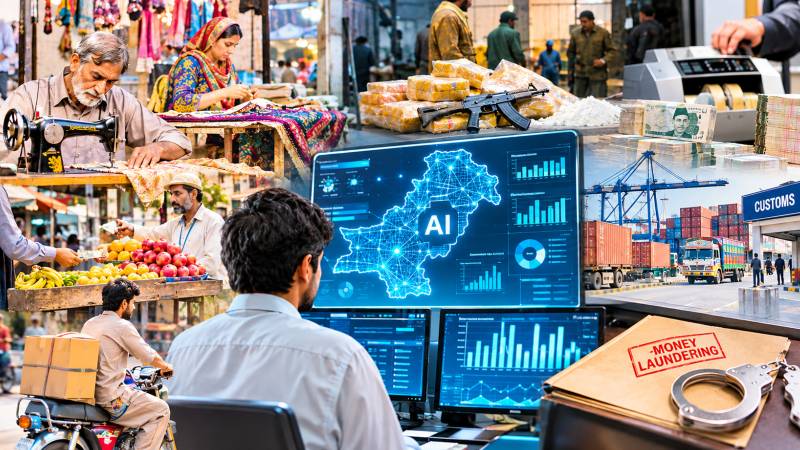
Pakistan cannot tackle its informal economy without first understanding what lies beneath that expression. For decades, policymakers have treated informality principally as a taxation problem. Their proposed remedies have included compulsory registration, higher withholding taxes, restrictions on banking transactions, documentation drives and increasingly intrusive powers for revenue officials. The results are visible: a narrow effective income-tax base, widespread distrust of the Federal Board of Revenue (FBR), and an enormous economic universe that remains largely beyond meaningful scrutiny.
The central failure is conceptual. Pakistan has two informal economies, not one. The first consists predominantly of lawful economic activities conducted outside formal institutional arrangements. It includes small traders, artisans, agricultural workers, home-based producers, transport operators, informal service providers and millions of self-employed persons. Some possess substantial taxable capacity; many survive on incomes insufficient to meet basic household needs.
The second comprises criminal economic activity: narcotics trafficking, smuggling, extortion, kidnapping for ransom, illicit arms trading, corruption, money laundering and organised financial crime. Its participants may operate through apparently legitimate businesses, acquire expensive properties and maintain connections within the formal financial and political systems.
The historical origins of Pakistan’s criminal economy deserve particular attention. Our earlier research, beginning with Pakistan: From Hash to Heroin and subsequently developed in Pakistan: From Drug-trap to Debt-trap, examined how the Afghan conflict, narcotics trafficking, weapons proliferation and underground financial transactions became intertwined with Pakistan’s political economy.
Illicit wealth could enter property, commerce, transport and other apparently respectable economic activities. Weak institutional accountability allowed sections of the criminal economy to interact with legitimate business and public authority.
The State’s own evidence confirms the seriousness of this problem. Pakistan’s National Risk Assessment of Money Laundering, 2023, identified corruption and bribery, illegal hawala/hundi operations, tax crimes, smuggling and cash smuggling among major threats. Narcotics trafficking, human trafficking, fraud and cybercrime were also identified as significant threats.[3]
An employee whose salary passes through a bank is immediately visible. A small business paying commercial electricity bills is readily identifiable. An importer operating through documented channels can be subjected to numerous advance and withholding taxes. The ultimate beneficial owner of several businesses, properties and financial arrangements may remain much harder to identify.
Repeated commercial transactions between apparently unrelated entities might reveal common beneficial ownership. Unusual trade valuations, circular payments and inconsistent declarations could generate risk indicators. These techniques do not establish guilt. They identify discrepancies requiring lawful investigation.
The lawful informal economy needs a simplified route towards economic recognition, while the criminal economy requires effective investigation, prosecution and the confiscation of proceeds of crime through established legal procedures.
The Financial Action Task Force (FATF), together with the Egmont Group, has examined trade-based money laundering and identified indicators involving suspicious trading patterns, unusual corporate structures and inconsistencies in commercial transactions.[4]
Pakistan already maintains extensive administrative databases. The problem is their fragmentation, inconsistent quality, restricted accessibility and limited analytical use. A properly designed system could enable authorised institutions to identify economic relationships without creating another coercive bureaucracy. Two economies require two different policy responses.
A woman producing garments at home should be able to establish an economic identity without being presumed liable for income tax. Small agricultural producers should be distinguished from large commercial agricultural earners. Registration must confer benefits: access to banking, affordable credit, social insurance, skills development and enforceable commercial rights. The objective should be to make formalisation economically attractive rather than administratively terrifying.
Criminal proceeds cannot be transformed into legitimate economic activity merely by offering another tax amnesty. Payment of tax does not erase the underlying criminal offence or automatically legalise property acquired through crime. Repeated amnesties also create an indefensible inequality between citizens who comply with the law and those who expect eventual immunity after concealment.
The international framework provides useful guidance. Pakistan’s removal from FATF’s increased-monitoring list in October 2022 represented recognition of substantial improvements in its anti-money-laundering and counter-terrorist-financing framework.[5] That achievement should not be confused with the elimination of underlying financial crime.
Constitutional safeguards are indispensable. Articles 4 and 10A of Pakistan’s Constitution require lawful treatment and due process. Article 14 protects human dignity and privacy, while Article 19A recognises the right to information, subject to constitutional limitations.[7]
Access to sensitive financial information must remain subject to statutory authority, defined purposes, independent oversight and meaningful remedies against misuse. A national economic registry should not become a national surveillance apparatus. A further distinction concerns the measurement of economic activity.
The National Economic Registry proposed in this series must maintain separate analytical categories for lawful production, unrecorded taxable income, suspected criminal proceeds, assets and financial transactions. This is essential for constructing a credible national revenue model.
The decisive question is whether Pakistan possesses the political will to investigate wealth rather than merely collect taxes from transactions. Artificial intelligence can identify patterns, but it cannot independently remove political protection. It can detect suspicious ownership structures, but it cannot compel an institution to investigate influential persons. It can highlight unexplained financial relationships, but it cannot guarantee honest prosecution or impartial adjudication. Those remain questions of governance.
Pakistan requires a coordinated institutional architecture linking tax authorities, financial intelligence, corporate regulation, customs and relevant provincial agencies, while preserving their respective legal jurisdictions. Information-sharing must be lawful and accountable. Investigation should follow risk-based priorities rather than political instructions. Independent courts and tribunals must remain capable of examining official action.
The ultimate measure of success should not be the number of people placed on a database. It should be the number of previously concealed substantial economic activities brought within lawful accountability, the protection extended to vulnerable informal workers, the criminal networks successfully disrupted, and the reduction of the tax burden borne by already compliant citizens.
Pakistan does not need artificial intelligence to discover that a daily-wage worker earns too little to pay income tax. It needs intelligence—technological and institutional—to identify those who accumulate extraordinary wealth while remaining beyond meaningful scrutiny.
[To be continued]
Endnotes
1. International Labour Organization, Transition from the Informal to the Formal Economy Recommendation, 2015 (No. 204), paragraph 2.
2. United Nations Office on Drugs and Crime, Afghanistan Opium Survey 2025; see also the World Drug Report series.
3. Government of Pakistan, National Risk Assessment on Money Laundering, 2023 (summarised version).
4. Financial Action Task Force and Egmont Group, Trade-Based Money Laundering: Risk Indicators (2021).
5. Financial Action Task Force, Outcomes of the FATF Plenary, 20–21 October 2022.
6. Financial Action Task Force, Opportunities and Challenges of New Technologies for AML/CFT (2021).
7. Constitution of the Islamic Republic of Pakistan, Articles 4, 10A, 14 and 19A.
8. Ikramul Haq, Pakistan: From Hash to Heroin; and Pakistan: From Drug-trap to Debt-trap (historical context).
9. Huzaima Bukhari and Ikramul Haq, Towards Broad, Flat, Low-rate and Predictable Taxes, third edition, PRIME Institute (2024), chapters on informality and tax gaps.