

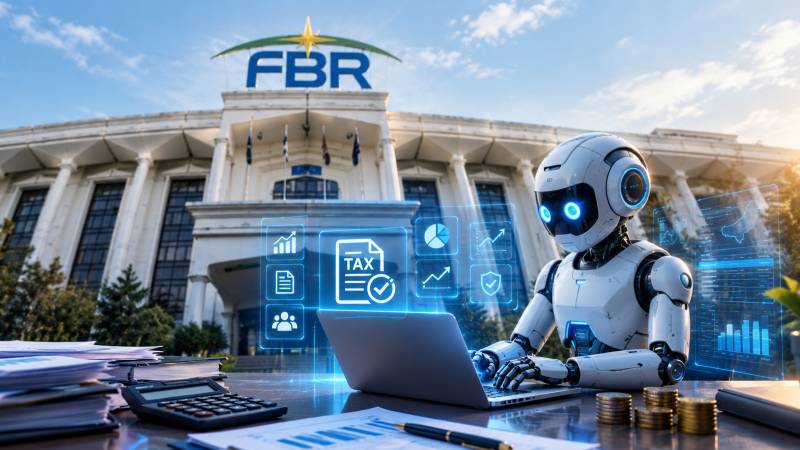
Pakistan cannot broaden its tax base by repeatedly squeezing people already visible to the State. Artificial intelligence offers a different route: build a national economic registry that can distinguish taxable capacity from dependency, lawful informality from criminal activity, and taxpayers from those entitled to social protection
Pakistan’s tax debate begins with the wrong number. Every year governments ask how many income-tax returns have been filed. They celebrate another increase with no meaning rise in tax paid with returns, announce a fresh documentation drive and then return authorised too the same narrow circle of salaried persons, incorporated businesses, importers, bank depositors and consumers already visible to the State.
By October 14, 2026, the Federal Board of Revenue (FBR) had received 6.71 million income-tax returns, up 34.38% over the comparable period last year but tax paid was lower than last time. The improvement in number is, thus, ceremonial. It also exposes the scale of the problem of voluntary compliance and tax avoidance and evasion in Pakistan.
Pakistan live population at worldometers (accessed at 10am on October 23, 2026) was 260.5 million, out of which, working-age/adult-group (15–60 years) is roughly 180 million, but active labour force officially is about 95 million. However, labour force data is highly controversial due to huge size of informal economy and correct reporting as well as faulty mythology [Aneel & Muneeb, Islamabad Policy Research Institute, October 2025].
Pakistan's total informal labour force is estimated at approximately 65.4 million to 70+ million workers, based on a national labor force of around 95 million and an informal sector share of roughly 76% to 80% (State Bank series, Gallup Pakistan and PIDE). Amongst all in formal and informal sector about 30 million earn taxable income (both agricultural and non-agricultural), yet only a fraction appears meaningfully inside the direct-tax system at FBR and provincial agencies authorise to collect agricultural income tax.1
The explanation is not simply tax evasion. Pakistan Bureau of Statistics (PBS) places informal-sector employment at 72.5% of non-agricultural employment. In rural areas the share is 76.2%; even urban Pakistan records 68.5%. The latest Labour Force Survey also shows that own-account workers form a very large share of the informal sector. Pakistan is, in economic terms, overwhelmingly informal.2
That informality contains very different worlds. A home-based seamstress paid in cash is informal. So is a mechanic without registration, a street vendor, a carpenter, a small family shop, a freelance technician and millions of self-employed workers. Their economic activity may be completely lawful although the State cannot adequately observe their incomes, assets, family dependency or eligibility for social protection.
At the other end lie kidnapping for ransom, smuggling, narcotics, bhatta (extortion), counterfeit trade, illegal currency movement, trade-based money laundering, proceeds of corruption etc. and organised crime. These two economies must never be confused.
Our work beginning with Pakistan: From Hash to Heroin and its sequel Pakistan: From Drug-trap to Debt-trap documented how narcotics, weapons, informal finance, smuggling and political protection created parallel circuits of wealth. That criminal economy does not need ordinary formalisation. It requires detection, confiscation, prosecution and disruption.
The lawful informal economy needs something entirely different: visibility without harassment. This distinction has largely disappeared from tax policy.
FBR’s habitual response has been to tax whatever it can already see. Withholding taxes on banking transactions/profits, electricity, telecommunications, imports, contracts, property and numerous other transactions collect income tax before real income has even been determined. The documented economy therefore carries an increasingly heavy compliance burden while substantial actual income remains outside assessment.
Our 2024 PRIME study, Towards Broad, Flat, Low-rate and Predictable Taxes, argues that Pakistan’s wider economic tax base is around Rs. 500 trillion after taking the informal economy into account. It estimated around 30 million persons with taxable income above Rs. 600,000 and showed how a broad base combined with low rates and credible enforcement could yield revenue far beyond present collections. The precise numbers must now be updated, but the basic point remains: Pakistan’s revenue problem is not absence of economic activity; it is failure to identify it fairly and systematically.3
It is to make the State capable of knowing which citizens can fairly contribute, which businesses should be brought into the mainstream, which economic activity is criminal—and which households should instead receive protection. That is the difference between surveillance and economic intelligence
Artificial intelligence (AI) creates an opportunity to reverse this model. Anthony Tan’s recent Finance & Development article for the International Monetary Fund (IMF) makes the central point well: AI policy in developing economies must be designed around the lives people actually lead, not around an assumption that everyone is a salaried worker with a formal employer, bank account and complete digital trail.4
Pakistan already possesses much of the identity infrastructure required for a different approach. By the end of fiscal year (FY) 2025-26 the country had roughly 164 million broadband connections, about 159.5 million of them mobile.
Telecom subscriptions crossed 210 million on August 31, 2026. Mobile SIMs are biometrically linked, while CNICs connect individuals to NADRA. Banks, property registries, vehicle records, utilities, employers, customs systems and social-protection programmes each hold fragments of economic information.5
The problem is that the State sees fragments rather than economic relationships. The answer should be a National Economic Registry, separate in purpose from a conventional tax roll.
Every adult biometric mobile user could be asked through a text message, a secure mobile or web interface, a few simple questions: Are you economically dependent? If yes, upon whom? Are you employed? If yes, identify the employer. Are you self-employed? If yes, state the profession, trade or business and, where available, its registration or tax number. Are you an employer or business owner? Are you unemployed, retired, studying or otherwise outside the labour force?
No tax should arise merely from answering these questions. The first purpose is classification, not assessment. The responses could then be matched, under strict statutory safeguards, with existing government datasets.
AI can identify inconsistencies: a person declaring complete dependency while holding several high-value assets; an unregistered business receiving substantial commercial payments; an employer paying dozens of workers who do not appear in payroll declarations; or a household receiving social assistance despite economic indicators inconsistent with eligibility.
AI should flag. A legally authorised human officer should decide. That safeguard is essential. Artificial intelligence can assist matching, anomaly detection, risk selection and forecasting; it must not autonomously determine legal liability. Every adverse tax decision must remain attributable to a human officer, supported by disclosed material and subject to appeal.
The registry should also work in the opposite direction. Tax administration and social protection are presently treated as separate worlds. They should not be. If a household genuinely has no taxable capacity, the same verified economic record that keeps it outside the income-tax net should help determine entitlement to health coverage, income support, pension, education assistance or other social protection.
The State would then stop asking only who can be taxed. It could also ask who needs support. The household dimension is critical. Pakistan’s 2023 digital census counted about 38.3 million households, with average household size around 6.3 persons. By mid 2026, it may be 45 million. A national economic registry covering every household, linked to adult CNICs and economic relationships, would be far more useful than a tax roll containing millions of returns that disclose little or no actual liability.6
The target should ultimately be an economic map of the adult population, not a mechanical demand that every adult become a taxpayer. Dependants, students, unemployed persons, subsistence workers and people below the statutory threshold belong in the registry precisely so that they can be excluded intelligently from taxation. That is the difference between a tax database and an economic registry.
The revenue implications are substantial. Our earlier work put combined federal and provincial tax potential at roughly Rs. 34 trillion under comprehensive structural reform; the PRIME study separately modelled a broad economic base of around Rs. 500 trillion.
With nominal growth, improved data and a wider registry, a collection exceeding Rs. 35 trillion is not intrinsically implausible. But it cannot be reached by applying today’s high, distortionary rates to the same narrow base. It requires lower predictable rates, withdrawal of unjustified exemptions, integration of federal and provincial information, and effective enforcement focused on genuine taxable capacity.7
The proposed eventual target of 30 million-plus taxpayers should be treated as an outcome of economic identification, not as an arbitrary filer quota. Some registered persons will owe no income tax. Others outside the present filing population will have substantial taxable capacity. AI can help distinguish the two at a scale no manual bureaucracy can achieve.
There is one further reason for urgency. Successive amnesties have taught citizens that concealment may eventually be rewarded. Complex laws and high rates encourage avoidance; oppressive enforcement encourages cash; weak prosecution protects serious evasion.
Our PRIME study has repeatedly argued that low rates must be paired with credible detection and firm action against wilful defaulters. Simplicity without enforcement fails; enforcement without fairness drives more activity underground.8
This series will separate the informal economy into its lawful and illegal components; revisit the historical narcotics, smuggling and underground-finance evidence; construct a current empirical estimate of taxable persons; and test whether an AI-enabled economic registry can broaden the tax base towards 30 million-plus taxpayers while raising combined federal and provincial revenue beyond Rs. 35 trillion. The purpose is not to make 30 million people fear FBR.
It is to make the State capable of knowing which citizens can fairly contribute, which businesses should be brought into the mainstream, which economic activity is criminal—and which households should instead receive protection. That is the difference between surveillance and economic intelligence.
Endnotes
1. Returns filing date extended to 31st, Dawn, October 16, 2026. FBR received 6.710 million returns through October 14, 2026, compared with 4.993 million in the corresponding period of the previous year.
2. Pakistan Bureau of Statistics, Labour Force Survey 2024-25. PBS reports informal-sector employment at 72.5% of non-agricultural employment, including 76.2% in rural and 68.5% in urban areas.
3. Huzaima Bukhari & Dr Ikramul Haq, Towards Broad, Flat, Low-rate and Predictable Taxes, Third Edition, PRIME Institute, 2024, especially Chapter 1, “Informal Economy and Tax Losses”, and Chapter 7, “Tax Gap & Potential”.
4. Anthony Tan, AI and the Informal Economy, Finance & Development, International Monetary Fund, September 2026.
5. Pakistan’s broadband base, Dawn, September 2026, reporting roughly 164 million broadband connections by end-FY2025-26, including around 159.5 million mobile-data connections; see also Pakistan Economic Survey 2025-26 telecom indicators. According to Pakistan Telecommunication Authority as on 31 August 2026, broadband users were 167 million including 163 million mobile broadband users.
6. Pakistan Bureau of Statistics, National Census Report 2023: approximately 38.3 million households and average household size around 6.3 persons.
7. Dr. Ikramul Haq, Paradigm shift in tax policy, and Huzaima Bukhari & Dr. Ikramul Haq, Towards Broad, Flat, Low-rate and Predictable Taxes, on combined tax potential, broadening the base and restructuring federal-provincial tax administration.
8. Huzaima Bukhari & Dr. Ikramul Haq, Towards Broad, Flat, Low-rate and Predictable Taxes, Third Edition, pp. 13-19, arguing against repeated amnesties and for a low-rate system backed by effective detection and enforcement.
[To be continued]