

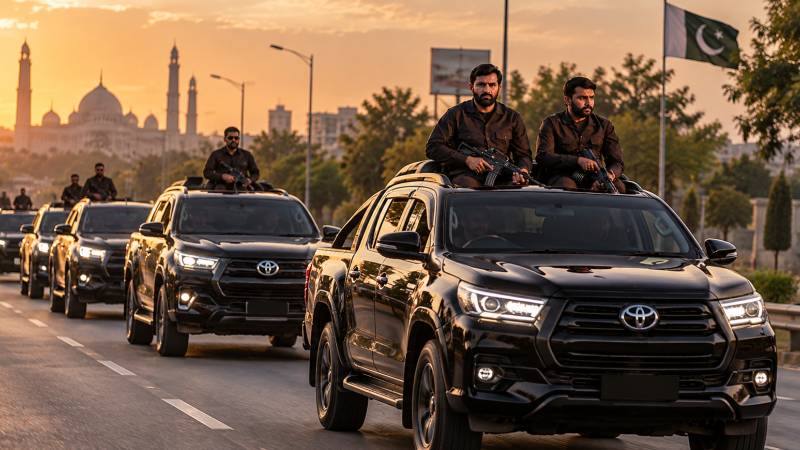
On the streets of Karachi, some vehicles appear to have acquired a meaning far beyond transportation. Their imposing size, tinted windows, armed guards and the expectation that traffic should make way convey an unwritten message: others would be wise to step aside. Nowhere in Pakistan’s statutes does the value or size of a vehicle confer additional rights upon its occupant. Yet, on our roads, there are moments when it can feel as though it does. We have used many expressions for this phenomenon: VIP culture, elite privilege, the arrogance of power, even the lingering residue of feudalism. But perhaps one of the most visually accurate descriptions of this urban phenomenon is “Dala culture”.
The “Dala” here is not a particular vehicle, manufacturer or model. It is a metaphor for a mindset in which power must not merely be possessed but displayed and felt by others. Owning an expensive vehicle is not the problem. The problem begins when the physical elevation of the vehicle appears to elevate, in the occupant’s imagination, his position before the law. The alleged incident involving Professor Dr Muhammad Arif Khan Saqi, Chairman of the Department of Islamic Learning at the University of Karachi, on September 8 brought this troubling culture sharply into focus.
According to Dr Saqi’s account, reported in the media, he was travelling to the university on an online motorcycle ride when a vehicle reversing near Safoora Chowrangi struck the motorcycle. He says his intervention was straightforward: the damage suffered by the rider should be compensated because the man earned his livelihood using a motorcycle that reportedly did not even belong to him. Until that point, it was an unremarkable traffic accident of the sort that occurs every day in Karachi. What allegedly followed transformed it into something much larger.
Dr Saqi said he was struck with the butt of a firearm, and that he and the motorcycle rider were forcibly taken inside the premises, their phones taken from them, and they were subjected to violence and unlawful confinement. Police subsequently confirmed to The Express Tribune that an altercation had occurred and that gunmen employed by the son of the hotel owner had assaulted the professor. The newspaper reported that police were registering a case on Dr Saqi’s complaint. The remaining allegations and questions of individual responsibility must, of course, be determined through investigation and due process. But the fundamental question raised by the incident requires no investigation:
Does a citizen have the right to ask an influential person to compensate someone for damage allegedly caused by his vehicle? Can he ask the name of the person involved? Can he object when he believes a weaker citizen has been wronged? Can he raise his voice without first calculating the wealth, guards, political connections or social status of the person standing opposite him? Legally, the answer is obvious: yes. Our social experience, however, sometimes offers a darker answer: first see who you are dealing with. That is where the rule of law begins to erode.
When law becomes an instruction for the weak but merely advice for the powerful, the moral foundations of the state begin to fracture.
Law is not merely a collection of sections enacted by parliament and printed in statute books. Its real strength lies in a citizen’s confidence that he can invoke it. If an ordinary person, even when convinced that he is in the right, must first assess the other party’s vehicle, armed escort, wealth and influence before deciding whether to complain, the problem is no longer the absence of law. It is the unequal presence of law. That is the essence of “Dala” culture. “Dala” culture does not mean that owning an expensive vehicle is objectionable. Wealth is not a crime. Neither is owning a large vehicle. Nor is employing security within the limits of the law. The problem begins when wealth mutates into entitlement, entitlement into intimidation and intimidation eventually into violence.
Small manifestations of this mentality are visible on our roads. A private guard steps into traffic to clear the way for his employer. A vehicle flashes its headlights repeatedly until others move aside. Tinted windows and visible weapons can themselves become a silent instruction. The ordinary motorist usually moves aside. And something psychologically significant happens each time. A person who repeatedly sees others make way because of his vehicle, guards or status may eventually stop interpreting their behaviour as courtesy and begin regarding it as entitlement. Conversely, the citizen who repeatedly gives way learns another lesson: surrendering one’s legitimate space before certain kinds of power may simply be safer.
This is no longer a traffic problem. It is the construction of a civic psychology. On one side is a man earning his living on a motorcycle. On the other is someone travelling in an expensive vehicle surrounded by armed men. The Constitution recognizes both as citizens. Before the law, their rights do not rise or fall with their bank balances. Yet reality can sometimes look very different—as though one citizen possesses only an identity card while another travels with a miniature parallel state around him. The guards become his police. The vehicle becomes his protocol. Influence becomes his insurance. And fear becomes his law. That is the point at which a society should begin asking uncomfortable questions.
There is an additional dimension to the incident involving Dr Saqi. He is a senior university professor. Pakistanis use exceptionally reverential language for teachers. We call them “builders of the nation”. We organize ceremonies in their honour, deliver speeches about their dignity and flood social media with quotations on World Teachers’ Day. But respect for a teacher is not demonstrated in speeches. It is demonstrated through social behaviour.
If a senior professor speaks for the interests of a motorcycle rider of modest means and allegedly encounters violence for doing so, the episode exposes the uncomfortable distance between our ceremonial reverence for teachers and the realities they can encounter outside university walls. There is, however, an important principle here. The alleged treatment of Dr Saqi is not objectionable merely because he is a professor.
Had the person involved been a rickshaw driver, delivery rider, student, labourer, shopkeeper or office worker, the principle would have remained exactly the same. Indeed, the true test of a civilized society is not how respectfully it treats its professors and powerful citizens. The more revealing test is how securely it protects its weakest citizen.
Damage to a poor man’s motorcycle does not become insignificant because the motorcycle itself is inexpensive. A scratch on an expensive vehicle may represent a trivial repair bill to its owner. A broken component on a motorcycle may mean a day without earnings, perhaps several days without work, and consequently less food on a family’s table. That is why Dr Saqi’s reported decision to speak for the rider is itself significant. On one side of the episode stands a voice raised on behalf of someone economically weaker; on the other, allegations of the coercive exercise of power. That contrast is what elevates the episode beyond an ordinary roadside quarrel.
Yet law, rather than emotion, must now prevail. Accountability is necessary not because the complainant happens to be a prominent professor, but because the state must demonstrate that weapons, guards, wealth or influence do not confer upon any citizen the authority to become policeman, prosecutor and judge. Relevant CCTV footage should be secured. Witnesses should be interviewed. The vehicle and security personnel involved should be properly identified. Medical and other available evidence should be preserved according to legal procedure. If allegations of assault, unlawful confinement or misuse of firearms are established, responsibility should follow according to law.
Due process matters equally in the other direction. Allegations that cannot be substantiated should not acquire the status of fact merely because they circulate widely on social media. Nor should individuals be connected to politicians, landlords or influential families without evidence. The rule of law means neither protecting the powerful because of their connections nor condemning anyone without proof. The larger issue, however, extends well beyond one individual.
Karachi is already a city of dramatic economic contrasts. Vehicles worth tens of millions of rupees share the same roads with motorcycles ridden by people struggling to earn enough for the day. Economic inequality is a reality. The essential function of law is to prevent economic inequality from becoming legal inequality. A civilized state does not abolish wealth. It prevents the law from bowing before wealth. Every society contains rich and poor citizens, business tycoons, politicians and influential families. What distinguishes a functioning state is that when something as mundane as a traffic accident occurs, the same law stands between the billionaire and the labourer, the politician and the professor, the owner of an expensive vehicle and the rider of a motorcycle.
The ‘Dala’ here is not a particular vehicle, manufacturer or model. It is a metaphor for a mindset in which power must not merely be possessed but displayed and felt by others.
When law becomes an instruction for the weak but merely advice for the powerful, the moral foundations of the state begin to fracture. There is also an uncomfortable element of collective responsibility. We have become accustomed to yielding quickly before displays of power. A large vehicle approaches, and we move aside. An armed guard gestures, and we stop. A weapon becomes visible, and the question that had reached our lips is quietly swallowed.
We call it pragmatism. Sometimes courtesy. Sometimes common sense and self-preservation. At an individual level, it may indeed be sensible. No ordinary citizen should be expected to endanger himself merely to demonstrate a constitutional principle. But collectively, repeated submission can nourish the psychology of entitlement. That is precisely why the principal responsibility belongs not to the courage of the citizen but to the state. A citizen should never have to stand before a gun and recite the Constitution in order to exercise an ordinary legal right. The purpose of the state is to ensure that such courage is unnecessary.
An ordinary person should be confident that if he calls the police, someone will respond; if he files a complaint, it will be heard; if he testifies against an influential person, he will remain protected; and if he enters a courtroom, the wealth, vehicle and connections of the opposing party will add no extra weight to the scales of justice. That confidence is the real social contract between citizen and state.
The September 8 incident is therefore a test of that confidence. Today the name is Professor Muhammad Arif Khan Saqi. Tomorrow it could be a student, a journalist, a doctor, a rickshaw driver, a labourer, or any one of us. The incident should therefore not be allowed to disappear after a few days of social-media outrage, condemnatory statements and collective forgetfulness. The facts should be established through law, responsibility should be determined through law, and the state should communicate an unequivocal principle through its response: A citizen’s status on the road is not determined by the price of the vehicle he drives.
We should have no quarrel with large vehicles. We should have a quarrel with oversized egos. We should have no quarrel with security guards when they provide lawful protection. The problem begins when a weapon intended for protection becomes an instrument for intimidating fellow citizens. Nor should we resent wealth. The problem begins when wealth carries with it the silent assumption that the law exists primarily for other people.
“Dala” culture will therefore not disappear by removing “Dala”s from Pakistani roads. It will disappear only when we dismantle the mentality that treats vehicles, weapons, wealth and connections as certificates of superior citizenship. The lesson of this episode can perhaps be reduced to one sentence: The “Dala” belongs on the road, not above the law. A gun does not make a person greater. An expensive vehicle does not make its occupant more of a citizen than the man riding beside it on a motorcycle. And power, however conspicuously displayed, does not confer exemption from law. If we cannot enforce that elementary principle, then the problem is much larger than Karachi’s traffic. It means that law exists among us but does not reach every citizen at the same height. And the day an ordinary person becomes afraid to tell someone more powerful, “You caused this damage; you must make it right,” what is endangered is no longer merely a motorcycle, a professor or one individual citizen. What is endangered is the very meaning of citizenship.