

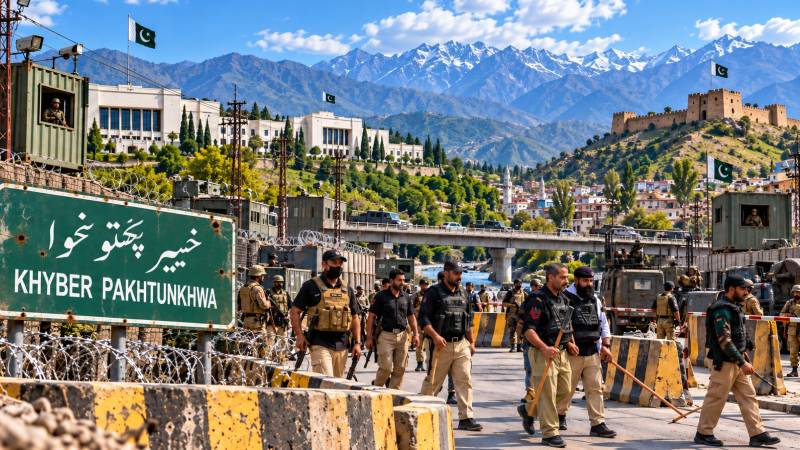
There is something almost surreal about the politics of Khyber Pakhtunkhwa (KP). While the province struggles with militancy, insecurity, economic uncertainty and the erosion of public confidence, its political leadership appears trapped in a contest of competing narratives. Each side claims to be defending the people, yet the people continue to bear the consequences. Welcome to the La La Land of KP politics, where political imagination often seems more powerful than political accountability.
The imposition of emergency and governor’s rule in KP on Oct 11, 2026, has brought this contradiction into sharp focus. The federal government, acting under Articles 232 and 234 of the Constitution, has justified the extraordinary intervention by citing the deteriorating security situation and what it describes as the provincial administration’s failure to adequately address terrorism. The PTI, which governed the province, has rejected the decision, describing it as political victimisation and an assault on democratic representation. The confrontation has now moved beyond political rhetoric into a serious constitutional and democratic crisis. But beneath the competing claims lies a question that neither side can afford to avoid: where, in all this political theatre, are the people of KP?
For years, the province has lived with the consequences of militancy, displacement, economic deprivation and fragile public security. Communities in the former tribal districts and other vulnerable areas have repeatedly faced violence, uncertainty and the loss of livelihoods. Families have paid the price in blood, while countless others continue to live with the fear that the fragile peace they have known may not last. For these citizens, politics is not an abstract contest between Islamabad and Peshawar. It is a question of whether their children can attend school safely, whether markets can operate without fear, and whether the state can protect their lives and property.
Yet political debate repeatedly returns to the familiar language of power, legitimacy and confrontation. The federal government speaks of restoring order; the provincial leadership and its supporters speak of democratic rights and political victimisation. Both arguments raise important questions, but neither can be accepted merely because it is politically convenient. Security concerns must be addressed through credible evidence and effective policy, while claims of constitutional authority must withstand legal and democratic scrutiny.
The most troubling feature of the present crisis is the apparent assumption that extraordinary political measures can resolve problems that ordinary governance has failed to address. Governor’s rule may alter the administrative chain of command, but it cannot, by itself, eliminate militancy, rebuild public trust or address the grievances that have accumulated over decades. Changing who occupies an office is not the same as changing the conditions that have made that office so consequential.
Governor’s rule may alter the administrative chain of command, but it cannot, by itself, eliminate militancy, rebuild public trust or address the grievances that have accumulated over decades. Changing who occupies an office is not the same as changing the conditions that have made that office so consequential.
The Constitution provides mechanisms for extraordinary circumstances, including situations in which a province cannot be governed in accordance with constitutional requirements. But the existence of such provisions does not make their invocation politically inconsequential. Articles 232 and 234 serve distinct constitutional purposes, and the government’s reliance on them invites serious questions about necessity, proportionality, parliamentary oversight and the protection of provincial autonomy. These are matters for constitutional scrutiny, not simply political declarations.
Equally, an elected provincial government cannot treat its electoral mandate as a substitute for performance. Democratic legitimacy carries obligations as well as rights. A government entrusted with the responsibility of protecting its citizens must be prepared to answer difficult questions about public safety, administrative capacity and the effectiveness of its policies. Opposition to federal intervention does not absolve a provincial administration of accountability for its own record.This is where KP’s political La La Land becomes most visible. One side risks presenting centralised control as a complete answer to a complex security problem; the other risks treating every challenge to its authority as an attack on democracy. Between these positions, the distinction between political survival and public service becomes dangerously blurred.
The situation also demands that the federal government recognise the limits of coercive governance. If the objective is genuinely to improve security, then the measures adopted must produce tangible improvements in the lives of citizens. Arrests, restrictions on political activity and administrative changes may demonstrate the exercise of authority, but authority alone does not establish legitimacy. The government must explain the legal basis of its actions, disclose the evidence supporting its allegations where legally appropriate, and submit its decisions to the scrutiny required by the Constitution.
Similarly, the PTI must decide whether its response will be defined primarily by confrontation or by a credible commitment to constitutional processes. Courts, parliamentary forums and peaceful political engagement provide avenues through which disputes over provincial autonomy and executive authority can be examined. The democratic character of a political movement is strengthened not by the volume of its slogans, but by its willingness to submit its claims to law and accountability.
Above all, KP must not become a laboratory for experiments in political control while its citizens remain exposed to insecurity and uncertainty. Any arrangement imposed in the name of public welfare must be judged against measurable outcomes: fewer attacks, safer communities, functioning schools, accessible healthcare, economic opportunity and the restoration of public confidence. Without such outcomes, even the most elaborate official justification risks becoming another exercise in political storytelling.
The province does not need competing fantasies of absolute authority or unquestionable victimhood. It needs institutions that function, political leaders who accept responsibility, and a security policy that places citizens rather than partisan interests at its centre. Perhaps the greatest tragedy of the La La Land of KP politics is not that its political actors inhabit different realities. It is that ordinary people are forced to live with the consequences of those realities.
For the people of KP, peace cannot remain a slogan, democracy cannot be reduced to electoral arithmetic, and constitutionalism cannot become a convenient argument invoked only when power is threatened. The real test of governance is not who controls the provincial secretariat, but whether the state can fulfil its most basic obligation to its citizens. Until that question takes precedence over the struggle for political control, KP will continue to move between promises of security and declarations of democratic injury, with neither side able to claim that the people have received the peace, dignity and accountable government they deserve.