

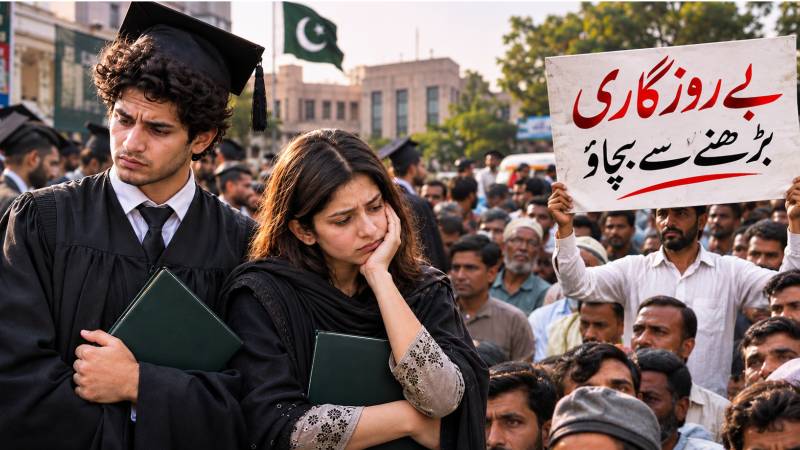
Every year, millions of families across Pakistan celebrate graduation with pride. Degree certificates are shared on social media and celebrated by families, while electronic and print media often highlight stories of years of hard work, sacrifice and perseverance. Yet behind many of these celebrations lies a more troubling reality: financial hardship, parents struggling with debt, and aspirations that remain unfulfilled. A university degree no longer guarantees employment, and education does not always translate into economic security.
Pakistan's Human Development Index has increased from 0.400 in 1991 to 0.544 in 2023. Educational attainment has improved, incomes have risen and life expectancy has increased. Yet for many graduates, their degree remains largely symbolic — a personal achievement that offers few immediate prospects of securing meaningful employment. This raises a fundamental question: how does unemployment persist in a country where education and human development continue to improve?
The latest Labour Force Survey offers a worrying answer. Pakistan's unemployment rate for 2024–25 stands at 7.1 per cent, its highest level in 21 years. In 2020–21, the unemployment rate was 6.3 per cent, while the number of unemployed people increased from 4.5 million to 5.9 million. The burden is not shared equally. Young people aged 15–24 face an unemployment rate of 12.9 per cent. Khyber Pakhtunkhwa has the highest provincial unemployment rate at 9.6 per cent, while Sindh has the lowest at 5.3 per cent. Perhaps most strikingly, the unemployment rate among people with a Bachelor's degree or higher is 10.9 per cent, demonstrating that higher education does not necessarily guarantee economic stability.
The evidence from Pakistan's economic and development trends between 1991 and 2023 suggests that the relationship between human development, innovation, industrial growth and employment is far more complicated than policymakers often assume. Improving education and health indicators does not automatically reduce unemployment. In some periods, improvements in human development have coincided with falling unemployment, while in others the relationship has been reversed. This inconsistency points towards a deeper structural problem: Pakistan's education system and labour market are poorly aligned. Producing more educated people does not automatically create more jobs for them.
The country's innovation indicators tell a similar story. The number of patents, for example, does not appear to have a straightforward relationship with unemployment. This does not mean innovation is unimportant. Rather, it highlights the limitations of Pakistan's formal innovation base and the need to translate innovation into productive economic activity and employment. Industrial growth is equally important, but the type of industry matters. An increase in industry's contribution to GDP does not necessarily translate into large-scale job creation. Capital-intensive industries can increase output and profitability without employing large numbers of workers. Labour-intensive sectors, by contrast, have greater potential to absorb Pakistan's expanding workforce. Textiles, food processing, light engineering, construction and small and medium-sized enterprises should therefore be central to any serious employment strategy.
Repairing the broken link between education and employment means moving beyond the goal of producing more graduates and building an economy capable of offering dignity, economic independence and meaningful work.
Pakistan's challenge, therefore, is not simply a lack of jobs. It is also a lack of decent and secure employment. The first priority should be reliable and timely labour-market data. The four-year gap between labour force surveys has made it difficult for policymakers to understand changing employment conditions and respond effectively. Pakistan needs regular annual labour-market data, along with detailed provincial analysis to understand why employment outcomes differ so significantly between regions. The second priority should be supporting labour-intensive businesses capable of creating employment at scale. Government policy should focus on sectors such as textiles, food processing, light engineering and construction, while also strengthening small and medium-sized enterprises. The third priority should be formalising informal employment. Workers need written contracts, accessible social security coverage and affordable, simplified registration systems. Economic growth that produces insecure and unprotected employment cannot fully deliver economic stability or social progress.
Particular attention is also needed for women's employment. The unemployment rate among women aged 25–34 stands at 14.9 per cent, suggesting that a significant portion of Pakistan's human capital remains underutilised. Improving women's participation in the labour force requires addressing barriers related to workplace access, mobility, safety, childcare and social expectations. Pakistan's demographic dividend represents an enormous opportunity, but it will only remain an opportunity if the country's growing population can be absorbed into productive employment. A young and increasingly educated population without sufficient economic opportunities can quickly become a source of frustration rather than growth.
Employment creation must therefore become a measurable objective of public policy. Federal and provincial development plans should include net employment creation as a key performance indicator and report regularly on progress. Budgetary allocations and major development projects should also be assessed according to their potential to generate sustainable employment. Provincial strategies must reflect local economic conditions. In Khyber Pakhtunkhwa, greater investment in transport infrastructure, reliable energy and security could help expand employment opportunities. Punjab's vast workforce requires stronger small cities, industrial clusters and SMEs capable of absorbing millions of workers. Sindh and Balochistan require targeted skills development and investment linked to their economic potential, including port-related industries, logistics and mining. Pakistan's fundamental problem is not a lack of people willing to work. It is a lack of sufficient productive employment opportunities.
The latest Labour Force Survey has brought this challenge into sharper focus, and job creation must become a central consideration in future economic and budgetary planning. Pakistan cannot translate its growing human capital into economic growth without investing in productive sectors and industries capable of generating employment at scale. Repairing the broken link between education and employment has become one of the most important challenges facing the government. The objective should not merely be to produce more graduates, but to build a resilient economy capable of absorbing their skills and rewarding their education. A degree should be more than a certificate of personal achievement. It should open a path towards economic independence, dignity and productive work. Decent employment transforms the promise of education into individual security and national prosperity. Pakistan's challenge is no longer simply to educate its people. It is to build an economy capable of giving them meaningful work.