

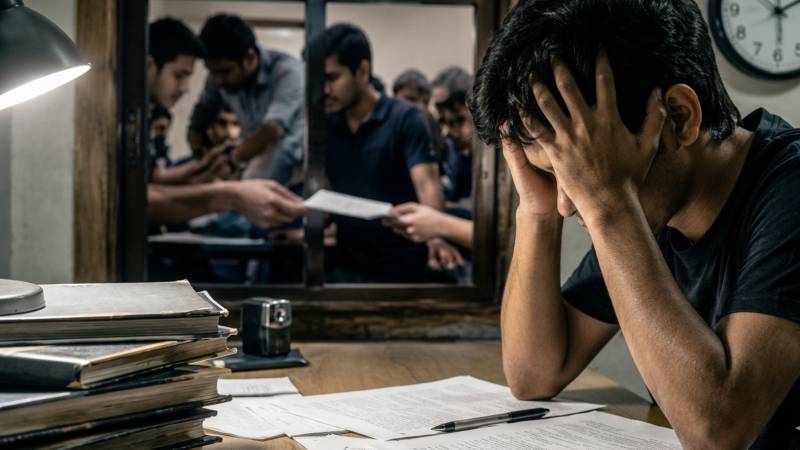
NEET-UG is India's national medical entrance exam, with more than 2.27 million students attempted in May 2026 at more than 5,400 centers in India and abroad. Nine days later, the National Testing Agency took a drastic step, canceling the exam outright for the first time in history. Investigators discovered a handwritten "guess paper" circulating before the test, which was very similar to the actual questions. A teacher from Rajasthan detected the match and got the authorities to act, resulting in the arrest of people in Jaipur, Delhi, Gurugram and elsewhere, and the eventual launch of a Central Bureau of Investigation probe.
The human cost of this incident was really high. Years of efforts of the students went in vain, savings of their families were exhausted, and they could foresee the future of their children crumbling in a moment. At least three students were reportedly found dead by suicide after the incident. This led to protests in Delhi and other cities, with slogans going "Doctor ki degree bikau hai" – medical degrees are for sale.
This recent incident could not be treated in isolation; there has been a pattern of such problems for the past ten years, starting from the Vyapam scam in 2013, the NEET controversy in 2024, and this latest one in 2026. As a result, the validity of India’s screening tests is now in question in a nation that aspires to produce doctors, engineers, and globally competitive professionals.
The NEET fiasco did not just produce protests; it has produced a hunger strike that has gripped the nation's attention. Sonam Wangchuk, the engineer-educator began fasting at Delhi's Jantar Mantar on June 28, 2026, in solidarity with the Gen Z-led Cockroach Janta Party (CJP), a satirical youth movement demanding the resignation of Education Minister Dharmendra Pradhan over the leaks.
Wangchuk is almost three weeks into his fast until very recently when he was forcibly shifted to the hospital. His health has visibly deteriorated as his blood pressure levels are extremely low and he has lost considerable weight during this time. Opposition leaders, such as Akhilesh Yadav, as well as Bollywood stars, including Shabana Azmi and Swara Bhasker, came out in the open in favor and urged him to stop, fearing for his life. But the government had little to say. This time around, the protest is significantly meaningful because this seems to be a sustained act of civil disobedience against a government which keeps on boasting about highly skilled professionals serving at key positions worldwide.
If India's crisis is about institutional failure exposed by scandal, Pakistan's is about institutional failure normalized as routine. Cheating in board exams in Pakistan is not an occasional occurrence; rather, it is an organized crime with its own supply chain. The entire system of matriculation and intermediate boards in the various provinces of the country is an old and established system, in which the role of leaked papers, impersonators, and paid examiners who turn a blind eye is very significant. Whole local networks are involved, such as teachers, invigilators, printing-press employees, and those who profit from selling papers before the exam.
At least three students were reportedly found dead by suicide after the incident. This led to protests in Delhi and other cities, with slogans going 'Doctor ki degree bikau hai' — medical degrees are for sale.
But it's not novel, and that is exactly what the issue is: exhausted resignation from the public. The exam leak in India, which led to national protests, is cause for concern and action for weeks; a similar leak or even worse in the domestic board system in Pakistan is ignored, seldom reported in the media, but is never an instigator of reform of the broken system. There is no sustained outrage because the problem is already so entrenched that scandal itself has become a dull novelty. Expectations of the system have been lowered to the point that even repeated failures barely register.
What lately jolted many Pakistani families more than the domestic board scandals is the collapse of trust in something they considered untouchable: Cambridge International Examinations. Mainly serving the elites, the O and A Levels exams were long seen as Pakistan's insulated, internationally graded alternative to a corrupted local system. That perception shattered in 2026.
The AS Level Math Paper 1 leaked in April this year, many hours before the exam was actually set, and was shared on WhatsApp, Reddit, and Google Drive, and is estimated to have impacted approximately 25,000 students. This was the third time in a row that an exam season has been ruined in this manner. Weeks later, the entire commercial website, called “Cambridge Leaks,” was found openly offering papers for cryptocurrency, with titles for Biology, Chemistry, Physics and Mathematics selling for $100 to those who purchased them, with reviews and purchase history as you would find on any real storefront. The National Cyber Crime Investigation Agency launched an investigation into the matter, and Cambridge annulled some papers, giving students "predicted" scores instead.
What is striking in comparing the two countries is not the scale of the failure, but the scale of the response. In India, despite Wangchuk's fast producing no clear government capitulation as of this writing, the sheer visibility of the protest, including hunger strikes, celebrity interventions, opposition mobilization, and Supreme Court petitions, signals that Indian civil society still treats education as sacred enough to fight publicly over. The outcome may be uncertain, but the fight itself matters: it tells an entire generation that the system's failures are not to be quietly absorbed.
In contrast, Pakistan has produced petitions, hashtags, and a handful of energetic student-led social media accounts calling for fairness and justice but absolutely nothing that can trigger a nationwide reckoning. There is no equivalent of Jantar Mantar, no public figure willing to put his body on the line, no sustained pressure that forces ministers to answer for their failures that have put the futures of generations of young students at risk. Here, the tragedy is not only the leaks themselves; it is what muted reception reveals about how little Pakistani society still expects from its education system.
The roots of this divergence run deep. India's first ‘Indian Institute of Technology’ was established in 1951, just four years after independence, planting a long-term bet that scientific and engineering education would be central to nation-building. Pakistan, facing a different set of existential pressures in its early decades security threats, partition's aftershocks, and a fragile state apparatus made different choices, arguably defensible given the regional situation at the time. But eight decades on, the gap has only widened into something closer to negligence than strategy.
This matters today more than ever, because Pakistan's international standing has genuinely risen in the recent past. Pakistan came out clean after the 3-day clash with India last year, and more importantly, the recent mediation efforts between the US and Iran have been widely appraised. Yet this diplomatic capital hasn't translated into economic weight, and a chronically underfunded, poorly governed education system is a major reason. A country cannot indefinitely trade goodwill and geography for prosperity. Among the many reforms Pakistan needs to convert its rising profile into durable strength, few would compound as powerfully, or visibly, treating education as a national priority rather than an afterthought.