

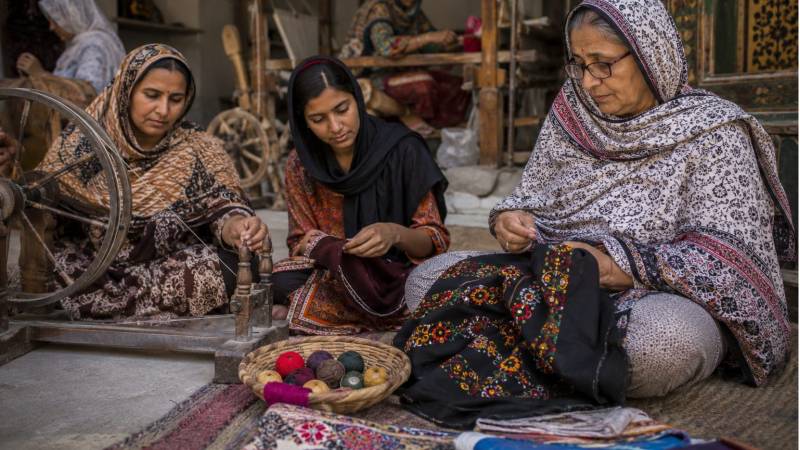
This is not, at heart, about fashion or supply chains in the conventional sense. It is about economics, specifically, about what kind of economic system best serves the people who make things by hand. Most people think of ‘the economy’ as something that happens in banks, factories and government offices. But every time a woman in a village picks up an embroidery needle, she is making an economic choice and the systems that surround that choice either support her or undermine her.
Kate Raworth, the economist behind Doughnut Economics, identified seven distinct systems that together constitute how an economy actually works: how we assign value, how things are made, how work is organised, how goods are used, who can access resources, how exchange happens and how governments regulate the whole system.
Pakistan’s craft sector is a natural place to apply this framework, because it is a sector of extraordinary size, talent and neglect. The British Council’s foundational research found that crafts and related services account for up to 15 per cent of all employment in Pakistan, making it one of the country’s most significant economic activities.
Yet it receives a fraction of the policy attention or public recognition that other sectors command. Ask most people what they think they are paying for when they buy something handmade, and they will say the object. Very few will immediately name the woman’s time, skill or her intergenerational knowledge or her community’s ecological understanding or even the cultural heritage embedded in the pattern. That gap, between what people think they are paying for and what actually goes into a piece, is the economic problem.
Economics was originally the science of running a household including activities such as managing resources, labour, time and relationships within a domestic space. This original meaning is profoundly relevant to Pakistan’s craft sector, because in Pakistan the household is not a metaphor for the economy; it is where the economy literally happens.
Women embroider at kitchen tables on rooftop terraces in the corners of rooms that serve every other domestic function simultaneously. The household is the factory. The mother is the teacher. The textile chest is the archive. Understanding Pakistan’s craft economy requires returning to this original, household-centred meaning of economics.
Any economy, in Raworth’s framework, is built from three components. The first is planetary things: land, water, cotton fields, natural dyes, silk thread, monsoon cycle, all three being the raw material conditions on which all craft production depends. Climate change such as floods in Sindh directly disrupt this layer. The second is human-made things: crafted goods, skills, services, knowledge, design and that applies not just to objects but expertise especially cultural continuity and market relationships.
The gap between what people think they are paying for and what actually goes into a piece, is the economic problem.
UNESCO’s research on cultural and creative industries emphasises that creative goods carry a dual value, both economic commodity and cultural expression, and that this dual nature requires distinctive economic frameworks that standard GDP measurement cannot capture.
The third component is the actors themselves: the women who sew, the cooperatives that aggregate, the buyers who purchase, the governments that regulate or fail to. Here too the British Council’s Pakistan research is telling: 99 per cent of Pakistan’s creative businesses are micro, small or medium enterprises. Freelancers, home-based workers and informal cooperatives are the dominant actors in the craft economy, not large corporations or state entities.
A single transaction between an artisan and a buyer involves all seven systems at once: a value system determines the price, a making system shaped the object, a work system determined who made it and under what conditions, a use system will govern what the buyer does with it, an access system shaped who could participate in producing and buying it, an exchange system facilitated the transaction and a regulatory system either protected or ignored the artisan’s rights in that moment.
The value system is the most fundamental of the seven although in mainstream economics, value is equated with price and price is determined by market transactions. Under this logic, a handmade embroidered piece is worth what someone will pay for it. Unfortunately the skill, cultural heritage, ecological knowledge and time spent on it are irrelevant to the calculation.
This creates a systematic undervaluation problem in craft economies globally and in Pakistan in particular. When a handmade rilli sells for PKR 5,000 but costs PKR 30,000 in artisan time and materials to produce, the market is not failing but it is working exactly as designed. The gap is absorbed by the artisan, typically a woman, as unpaid or underpaid labour. The value system that fails her is not accidental but in fact, it is structural.
UNESCO’s Global Report on Cultural Policies (2025) makes an argument that must be central to any discussion of craft economics: cultural and creative industries account for 3.39 per cent of global GDP and 3.55 per cent of global employment but these figures significantly undercount the sector’s actual contribution because standard GDP measurement excludes non-market cultural value.
What Pakistan’s formal GDP accounting captures and what it excludes are worth distinguishing. It includes craft exports and formally registered creative businesses but it does not count intergenerational skill transmission such as a mother teaching her daughter to embroider or the care work embedded in the act or the cultural and heritage value of traditional patterns.
Wellbeing economics frameworks, championed by Raworth and increasingly by UNESCO, propose replacing GDP growth as the primary measure of economic success with a dashboard of indicators that includes gender equity, ecology and community resilience. Under those measures, Pakistan’s craft sector is not marginal. It is central.
The global fashion and textile system produces approximately 100 billion garments a year which is roughly thirteen for every person on earth. McKinsey’s State of Fashion 2025 reported that the industry produced between 2.5 and 5 billion excess items in 2023 alone, valued at USD $70 to $140 billion in unsold inventory.
Pakistan sits at the heart of this global making system, as one of the world’s largest textile exporters. But the relationship between Pakistan’s industrial textile sector and its artisan craft sector is one of radical inequality: the industrial sector captures the export revenues while the craft sector absorbs the social and ecological costs. Craft production characteristics (small-batch, low-waste, long-life) align with global sustainability goals and artisan craft systems already practise circularity by default, without certification or external mandate.
The contrast can be stated as two models. The linear, industrial model takes raw material, mass produces, sells and disposes. This is a model that requires continuous resource extraction and externalises its costs onto workers and communities and ultimately, ecosystems. The circular, craft model uses existing materials that are made by hand and maintenance is the act of passing on repair. This is how Pakistan’s artisan economy has always operated and not because artisans are ideologically committed to sustainability but because material scarcity and economic necessity made thrift and repair rational strategies.
This system cannot be discussed honestly without acknowledging that women’s making is systematically undervalued. In Pakistan, embroidery and textile craft are overwhelmingly produced by women, often within the household interspersed with childcare and domestic labour and almost always sold through intermediaries who capture most of the margin.
This is not a market failure in the technical sense; it is a patriarchal economic structure that has always treated women’s productive labour as a supplement to household income rather than a primary economic contribution. Gender discrimination in cultural work is not only a welfare issue but is an economic inefficiency that suppresses the productive capacity of half the workforce.
Mainstream economics counts as “work” only activities that generate a monetary transaction as in employment in the formal sense. By this definition, a woman who spends three hours embroidering a garment for her daughter’s dowry has done no work. A woman who teaches her niece a traditional pattern has done no work. A grandmother who passes sixty years of textile knowledge to the next generation before she dies has done no work. Feminist economists (Marilyn Waring and Kate Raworth) have long argued that this narrow definition of work systematically obscures women’s economic contributions and helps justify their continued underpayment.
For women artisans specifically, the conditions of work sit at the intersection of economic informality and gender constraint. Mobility restrictions that limit women’s movement to markets and training centres, forcing dependence on intermediaries who extract much of the value. The absence of formal contracts or protections, meaning no recourse if a buyer fails to pay and no sick leave or maternity provision and earnings that fall below minimum wage. All of this culminates in double burden, in which craft work is done in addition to, not instead of, domestic labour.
The informal unpaid and underpaid cultural work that artisans do is what makes the formal creative economy possible. Luxury brands drawing on Pakistani craft aesthetics, international exhibitions featuring Pakistani textile art or global markets selling Pakistani embroidery, all of it depends on the foundational work of women in villages across the country. But the value flows upstream. The women at the base of the system are rarely compensated for the ecosystem they sustain.
The global fashion system is built on a model of use that prioritises velocity over depth: buy more, buy faster, discard quickly. The system is designed to generate continuous purchasing, not to create objects worth keeping. This model is ecologically catastrophic, economically unstable and culturally impoverished. An economy organised around the disposable has no place for the durable, the handed-down, the repaired.
Pakistan’s craft economy operates on an almost entirely different logic of use. Repair is the dominant pattern: a rilli quilt passed between women in a household is repaired with added patches. This is not poverty. It is an alternative economic logic in which value is extended through use rather than destroyed by it.
Objects are also shared rather than singly owned so that the assumption central to capitalist economics, that ownership equals use, simply does not apply. Longevity itself becomes the measure of value: a piece made to be worn for years (not seasons or trends) holds or increases in value with each wearing rather than depreciating. And use is climate-adaptive: artisans in Sindh describe adapting what they make and wear directly in response to changing environmental conditions.
Pakistan’s current access landscape in the craft sector cannot be understood without its colonial economic history. From the 1850s onward, the British systematically restructured Sindh’s agricultural land through canal irrigation projects designed to convert subsistence farmland into cotton-producing territory for British mills. Communities that had previously managed land and water collectively were reorganised into cash-crop systems serving imperial extraction.
That history created the material conditions such as concentrated land ownership and marginalised smallholders with women excluded from property rights that still shape who can access what in Pakistan’s craft economy today. In the post-Independence period these structural inequalities were largely preserved.
Access in Pakistan’s craft economy runs along at least three distinct dimensions. Access to materials is subject to price volatility in global commodity markets that artisans have no power to influence and is geographically uneven since artisans in rural Sindh and Balochistan may travel considerable distances to source what urban artisans can reach easily.
While digital transformation has expanded access to creative markets and audiences, it has not delivered stable livelihoods for most creators and has in some respects intensified inequality as it requires digital literacy, reliable internet and content-production skills that many artisans in remote areas do not have. This is directly relevant to Pakistan: Instagram and WhatsApp have given artisans new access to markets but without business literacy or digital and legal protection.
There is also a collective dimension to access that individual rights frameworks do not fully capture. Traditional embroidery patterns in Sindh (kashi, pakko, ralli) are not owned by individual artisans but in fact, they are community intellectual property, transmitted collectively across generations. When such patterns are reproduced commercially without community consent or compensation, the community’s access to its own cultural heritage is violated.
Pakistan’s 2022 ratification of the UNESCO 2005 Convention creates a formal obligation to protect traditional cultural expressions and ensure communities retain access to their own heritage yet no intellectual property framework in Pakistan is currently designed specifically to protect traditional artisan patterns from commercial appropriation.
The exchange system in Pakistan’s craft sector has historically operated within is far richer than a simple commercial transaction and any analysis that reduces it to price misses most of what is actually happening because at least several distinct exchange spaces can be identified. The first is local and community exchange: embroidered dowry pieces exchanged as part of marriage arrangements and this ‘gift’ economy underpins the monetary economy rather than sitting apart from it. The second is intermediary and cooperative exchange, through which most artisans sell such as traders, NGO marketing programmes or informal resellers who provide market access at the cost of capturing a large share of the value.
The third is digital and diaspora exchange: Instagram, WhatsApp, and dedicated craft platforms have created direct channels that bypass the intermediary and let a maker’s identity and knowledge travel with the product.
The industrial model captures the export revenues while the craft sector absorbs the social and ecological costs.
But there is a gap between goods exports and digital content built around it that represents a structural disadvantage for craft-producing nations like Pakistan, which export the material but not the intellectual and brand value it carries. As UNESCO’s ReShaping Policies for Creativity report puts it, ‘people are enjoying more cultural content, yet creators are struggling to make ends meet.’
Regulation is the system through which all the others are shaped. There is no dedicated Pakistani intellectual property framework for traditional craft patterns and designs, no minimum wage enforcement mechanism for home-based craft workers and no national creative economy policy. Instead we have weak or negligible cross-ministerial coordination between culture, trade, labour and education ministries and underdeveloped craft certification and quality-standards systems that limit export market access.
International regulatory pressure is now compounding these domestic gaps. The EU’s incoming ecodesign regulation, which will require garments sold in Europe to meet minimum standards of recyclability and durability, follows the same pattern: industrial fast fashion faces a compliance cost that artisan craft already meets by nature, but without formal certification artisans cannot access the regulatory advantage their practices deserve.
Pakistan is also bound by the International Labour Organization’s decent work framework, which specifically addresses home-based workers (a category that includes virtually all of Pakistan’s women artisans) yet compliance remains limited: most home-based artisans have no formal employment protection, no minimum wage enforcement and no access to social protection.
There is even a policy foundation that did not exist a decade ago. Pakistan’s 2022 ratification of the UNESCO Convention was followed by a joint project between UNESCO and Beaconhouse National University to improve data collection on the country’s cultural and creative industries, producing the first validated national data on the sector though this data infrastructure is not yet connected to a coherent policy architecture.
In sum, the craft sector remains underfunded and undervalued: exceptional talent exists across every discipline, but the absence of policy infrastructure and business skills prevents that talent from converting into economic security. And without those conditions it disperses or is simply never monetised.
Women’s economic exclusion is not a set of individual circumstances but a structural feature of their position within the sector and it requires systemic change in the work, regulation and value systems rather than individual empowerment programmes. Sectoral isolation, in which craft and associated elements including design, fashion and digital media operate independently of one another and of higher education, prevents the formation of value chains that would let artisan knowledge flow into higher-value design and export contexts.
Pakistan’s international profile, dominated by political and security narratives, creates a market access problem as much as a communications one, since buyers who might pay a premium for Pakistani craft do not currently associate the country with premium ethical beautiful objects. Even the Chloe handbag made in collaboration with a Pakistani NGO Artisan Links was never owned by the state as a model of economic empowerment or as an example of the value of handmade craft items despite the global acclaim and celebration.
And then, the 2022 Sindh floods demonstrated with brutal clarity, the sector’s exposure to climate change: disrupted cotton supply, displaced artisans, broken knowledge transmission and severed market access which makes it not only a humanitarian crisis but an economic attack on the craft sector’s foundational infrastructure.
Translating this analysis into action points toward a short list of priorities:
- Establishing intellectual property protection for traditional Pakistani craft patterns, at minimum through geographical indications
- Extending minimum wage and social protection coverage to home-based craft workers
- Connecting craft cooperatives to digital market infrastructure through training, equipment and platform access
- Developing a craft sustainability certification that recognises existing circular practices without imposing industrial certification processes
- Building the diaspora market through cultural diplomacy and digital export facilitation
- Integrating craft knowledge documentation into UNESCO’s cultural heritage frameworks to build an international recognition base for Pakistan’s living craft traditions.
Every time a woman in Pakistan picks up an embroidery needle and makes something, she is enacting a value system, deciding what is worth making and at what investment she is making. She is operating a making system, choosing materials, techniques and scale. She is doing work in creating an object that will be used, shared and inherited. She is navigating access constraints to materials, markets and training as well as engaging in exchange, whether through NGOs, intermediaries or direct digital sale. It is important that there is a return of value to the woman who made the object rather than extracting it from her.