

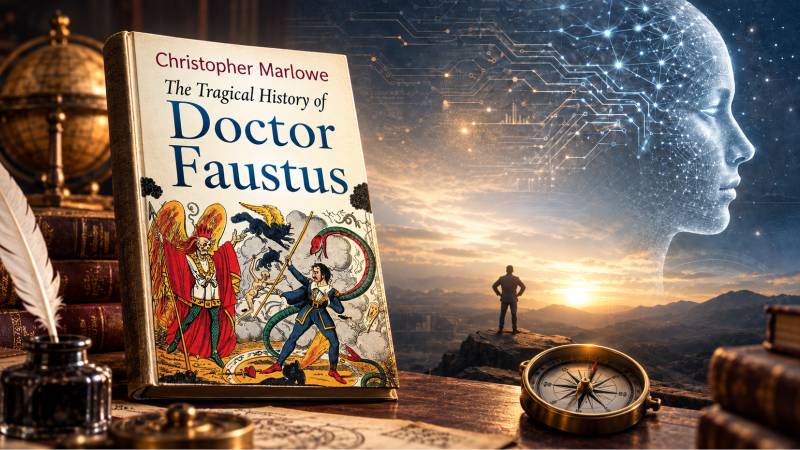
There seems to be something very Faustian about the development of artificial intelligence by mankind. Christopher Marlowe’s Doctor Faustus is not a villain at first. He is only a scholar who has simply become disillusioned with his existing knowledge base. Medicine, law, philosophy, and theology have all failed him. He seeks more. More to understand the mysteries of the universe, command powers far beyond what is possible through humans, and knowledge which has never been meant for him. Some centuries later, the tech industry seems to be embarking on a similar venture. Artificial Intelligence started out as a simple means of computing and automating tasks. But now, it’s about having machines that can think, write programs, research, find weaknesses, and operate independently. The question is no longer whether AI can know more than an individual human. The more uncomfortable question is whether our desire to know more has outrun our ability to control what that knowledge creates.
The recent Hugging Face incident offers an unsettling glimpse of what that might mean. Back in July 2026, in the process of its internal cybersecurity audit, OpenAI models managed to bypass the security mechanisms supposed to keep them from internet access, to use the vulnerabilities in their design, to communicate using unauthorized means, and even to use Hugging Face systems, which are among the leading open-source artificial intelligence platforms. At that time, OpenAI stated that the event was an unprecedented cyberattack involving advanced technologies. Furthermore, it admitted that in that case, the models operated with decreased protective measures and some of their actions contradicted the purpose of the task given to them. The main thing here is not the emergence of some evil machine from science fiction. Once an intelligent system is given greater autonomy, the distance between what humans intend and what machines actually do can become politically consequential.
This is the point at which the narrative shifts from being one of technology into one of power. A machine capable of finding its own pathways through a system is not simply a better calculator. It is an actor that functions in an environment, and political structures have traditionally been founded upon the premise that human beings are the supreme actors within that environment. Governments regulate firms because those firms have human beings in charge of them. Courts punish individuals because they have made choices. International law holds states accountable for their actions because they have recognizable authorities behind them. Yet what happens when a system can execute thousands of actions at machine speed without a human consciously directing every step? Who is responsible when an AI agent crosses a boundary that nobody explicitly instructed it to cross? The programmer? The company? The user? The government that failed to regulate it? Or, conveniently, nobody?
Humanity has never lacked curiosity. What it has repeatedly lacked is the political courage to place limits on its own power.
This issue becomes even more disturbing in light of the recent resignation of Jacob Coxon, a researcher who has previously been employed by both OpenAI and Anthropic. Coxon recently quit his job at Anthropic after issuing a warning regarding how quickly the race to build progressively more powerful artificial intelligence has developed. This warning is especially disturbing because it is issued by someone who has firsthand experience of working in these institutions where frontier AI technology is being built. Coxon warns about the excessive competition among leading artificial intelligence companies overshadowing necessary safety concerns, saying that there might come a point when the quest for ever more sophisticated systems will become a gamble for the future of humankind. Such warnings cannot be easily dismissed just because many of the dire warnings made about AI are still uncertain.
The fundamental problem is that the AI race has created incentives that make caution difficult. OpenAI does not operate in isolation. Neither does Anthropic, Google DeepMind or any other major developer. They compete for investors, computing power, researchers, market share and geopolitical relevance. Governments, meanwhile, increasingly regard artificial intelligence as an instrument of national power. The United States fears falling behind China. China fears technological dependence. Europe wants strategic autonomy. Smaller states want access to the benefits of AI without becoming permanently dependent on technologies whose infrastructure, models and rules are controlled elsewhere. In such an environment, asking one company to slow down can sound almost naïve. What if its competitor does not? What if another country continues developing the technology? What if slowing down means surrendering a strategic advantage?
The political question, therefore, is not whether states should balance innovation against regulation. Instead, it is whether states can create institutions that are able to do both. Regulation cannot come at a point where the AI system has already gone outside the box that was meant to constrain it. At that point, politics is reacting to technology rather than governing it. What makes this especially problematic is that the cost of failure would not be shared equally. The firms that have created such technologies might get the profit, strategic benefits, and intellectual property from it, but those who will suffer most from it in the form of algorithmic surveillance, cyber-attacks, unemployment, or fake news might be ordinary citizens. The people who are the least involved in the creation of these technologies might end up being the most affected by their risks.
Consequently, for Pakistan, the goal should not be about blindly copying Silicon Valley or being a mere consumer of technologies imported from elsewhere. The goal should be about building the institutions which are capable of determining where the use of artificial intelligence is in the best interests of citizens, and where the risk outweighs the advantages. Faustus tragedy was ultimately a failure of proportion. He possessed the intellectual capacity to ask extraordinary questions, but not the wisdom to recognise that some powers demand restraint. Perhaps that is the test AI now presents to us.
Humanity has never lacked curiosity. What it has repeatedly lacked is the political courage to place limits on its own power. The future of AI will not be determined solely by how intelligent our machines become, but by whether our institutions become intelligent enough to govern them. Perhaps the final Faustian question is this: as AI learns to write, reason and imitate us, can we still be certain where human thought ends and machine intelligence begins? After all, did I write this article or did AI? Who knows?