

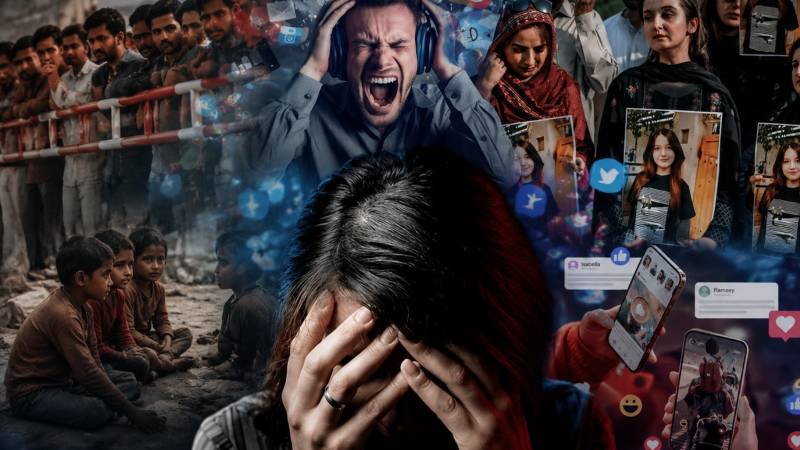
The tragic and brutal murder of social media personality Sana Yusuf has sent shockwaves across Pakistan—not merely because of its graphic horror, but because of what it exposes about the perilous mental and emotional state of our youth. This was not an isolated incident nor the act of a singular "disturbed" individual. It was, in truth, a devastating manifestation of a deepening psychological crisis engulfing a generation, scared by alienation, emotional deprivation, and the silent failure of multiple social institutions.
We often speak of Pakistan’s challenges in terms of economic instability, political upheaval, or educational shortcomings. Yet lurking beneath these visible crises is a far more insidious affliction: the psychological fracturing of our younger generation. Its roots are not planted in poverty alone, but in emotional, parental, and institutional neglect.
Every day, headlines echo with stories that reveal the frayed mental fabric of our society: suicides among students, crimes of passion, self-harm, rising drug abuse, and now, increasingly, violent outbursts with irreparable consequences. At the center of this unraveling is a youth segment increasingly starved for emotional security, burdened by social comparisons, and relentlessly judged by digital metrics—likes, comments, followers. In a society that prizes appearances over authenticity, performance over emotional literacy, and grades over grace, our young are crumbling inside.
This painful reality is searingly portrayed in the recent independent film Adolescence, a cinematic exploration of one young man’s internal decay. He is ordinary—unnoticed by girls, neglected at home, and unremarkable by academic or social standards. Yet, within him, an emotional tempest brews: he craves validation, affection, and meaning. The absence of nurturing bonds, especially from the father figure, hollows his sense of worth. His unspoken traumas fester in silence, eventually distorting his identity and sense of self. Adolescence is not just a character study; it is a damning allegory of thousands of Pakistani boys and girls suffering quietly behind closed doors.
To reduce Sana Yusuf’s murder to an act of momentary rage is to dangerously misread the signs. This was not a crime born in a vacuum. The accused, reportedly plagued by lifelong romantic failures, repeated social rejections, and a crippling inferiority complex, was not simply driven by jealousy or passion; he was consumed by an ego bruised beyond repair. His emotional deprivation, unaddressed and dismissed, mutated into resentment, hatred, and eventually, lethal violence. His psyche had long been collapsing under the weight of rejection, and tragically, it was another’s life that bore the cost of his unhealed wounds.
Is this the future we are crafting for our youth? One where rejection equates to annihilation—of self or others? Have we failed so profoundly in equipping our young with resilience, empathy, and emotional literacy that the smallest tremor in life causes their entire identity to implode?
We must urgently challenge toxic masculinity, which valorises dominance, emotional repression, and entitlement to women’s attention.
Our collective failure stems from three foundational structures: the home, the school, and the wider social fabric. In too many households, fathers remain emotionally unavailable, embodying only financial or disciplinary roles. Genuine dialogue is rare; affirmations even rarer. Children grow up unpraised, unloved, unacknowledged in their emotional complexity. The culture of shame, especially around male vulnerability, ensures boys suppress rather than share, pretend rather than express. In schools, academic excellence is elevated above all else. A student’s emotional world, their battles with self-image, peer rejection, or familial pressure, are not deemed worthy of attention. There is little room for conversations about mental health, romantic disappointment, or failure. The result? Youth who are successful on paper but shattered in spirit. Socially, we have turned platforms like Instagram and TikTok into arenas of self-worth. Validation is algorithmic. Love is performative. The pressures are immense and unrelenting. When young people, already battling inadequacy, fail to meet these hyper-curated ideals, their collapse is near inevitable. The difference now is that their collapse can cost lives—not just their own.
We are long past the point of awareness. The time for intervention is now; it must be holistic, urgent, and unapologetically bold. Fathers must shed outdated, authoritarian roles and embrace emotionally engaged fatherhood. Children, particularly sons, must hear and feel they are valued not just when they achieve, but when they simply exist. Parents must normalize emotional expression, validate their children’s struggles, and create space for open, honest communication.
It is imperative that our schools integrate comprehensive mental health education into the curriculum. Teach students how to handle rejection, process grief, navigate identity crises, and understand their own emotional landscapes. Normalize therapy. Train teachers to be sensitive to emotional cues. Promote empathy as actively as arithmetic. We must urgently challenge toxic masculinity, which valorises dominance, emotional repression, and entitlement to women’s attention. Rejection is a human experience, not a personal affront or humiliation. Failure, too, must be seen not as a verdict on one’s worth but as a rite of passage. These are lessons our youth must hear at mosques, in classrooms, on television dramas, and at dinner tables. Influencers, artists, filmmakers, and writers carry an enormous responsibility. They must champion stories of healing, not just heartbreak. Share real stories of failure overcome, of lives rebuilt, of emotional journeys navigated with grace. We must normalize imperfection and promote kindness—both to others and to oneself. Adolescence holds up a mirror to our society, and what it reflects is chilling. The murder of Sana Yusuf is not just a news headline. It is a bloodstained shard of that mirror. It compels us to confront our collective apathy toward emotional suffering. We can no longer afford to dismiss such tragedies as aberrations or pathologies the few while ignoring the many.
Pakistan’s youth deserve better. They deserve homes where they are heard, schools where they are nurtured, and a society that values their emotional well-being as much as their economic productivity. If we continue down this path of indifference, we risk losing an entire generation not to poverty or drugs alone, but to emotional implosion and psychic violence. We must ask ourselves with painful urgency: How many more Sana Yusufs perish before we act? How many more broken boys and girls must carry their wounds in silence before we choose to listen? The time to respond is not tomorrow. It is now.