

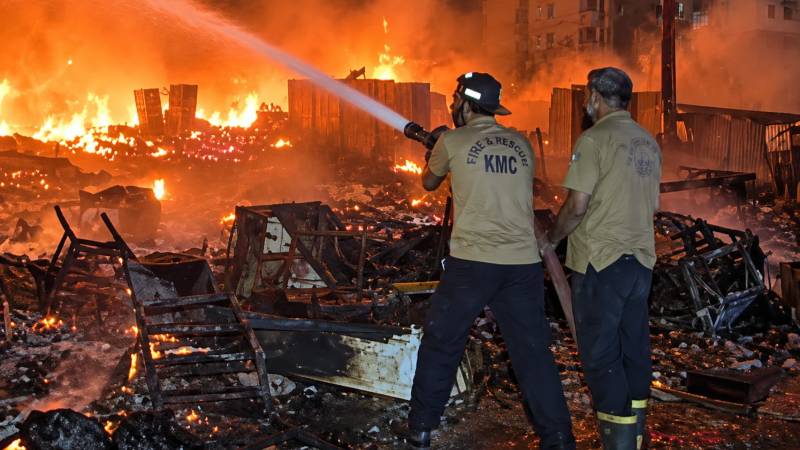
When a furniture market catches fire, the flames consume more than timber, upholstery and merchandise. They destroy the patient labour of carpenters, the modest investments of shopkeepers and the economic security of families whose survival depends upon the work of their hands. In the early hours of October 30, 2026, a devastating fire swept through a furniture market near Kamran Chowrangi in Gulistan-e-Jauhar, destroying approximately 35 shops and 10 to 12 makeshift dwellings while threatening nearby residential buildings. Although firefighters responded promptly and no casualties were reported, years of investment, labour and livelihoods were reduced to ashes. Strong winds, dry conditions and combustible merchandise accelerated the blaze, whose cause remained under investigation. More troublingly, the same market had suffered a major fire in December 2024, raising serious questions about inadequate preventive measures and institutional accountability. The first fire may be considered a warning, but the second exposes the failure to learn from it. Fire has no memory, but institutions are expected to possess one.
Karachi's history provides ample reason for concern. The September 2012 Baldia factory fire, which claimed more than 260 lives, remains among Pakistan's darkest industrial tragedies. Although deliberate arson was subsequently established through criminal proceedings, the catastrophe also exposed grave deficiencies in workplace safety and emergency escape arrangements. More than a decade later, in November 2023, a fire at RJ Shopping Mall on Rashid Minhas Road killed 11 people. Investigators identified substandard electrical installations as the origin, while inadequate ventilation contributed to deadly smoke exposure. These tragedies differed in their immediate circumstances, but both demonstrated how dangerous environments can turn an emergency into a human catastrophe.
The devastating Gul Plaza fire of January 17, 2026, added another painful chapter to this history. More than 70 people lost their lives, while businesses and merchandise accumulated over decades were destroyed. Subsequent inquiry findings revealed that serious safety deficiencies had been identified before the catastrophe, yet effective corrective action had not followed. The tragedy therefore raised questions extending far beyond the immediate cause of ignition. It exposed weaknesses in inspection, enforcement, commercial management and the institutional understanding of public safety. A warning that produces no response is little more than an official record of a disaster waiting to happen.
These incidents should not be treated as interchangeable, nor should responsibility for the latest furniture market fire be presumed before the investigation is completed. Nevertheless, their cumulative significance is difficult to ignore. Karachi has witnessed destructive fires in factories, shopping centres, wholesale markets and residential-commercial buildings. Each incident generates expressions of sorrow, emergency meetings, promises of inquiries and temporary public concern. Gradually, attention moves elsewhere. The damaged structures are repaired or abandoned, businesses attempt to recover, and the city resumes its hurried existence. What frequently remains uncertain is whether the underlying vulnerabilities have been systematically addressed.
The economic consequences of the Gulistan-e-Jauhar fire extend considerably beyond the value of destroyed furniture. A commercial market is not merely a collection of shops; it is an interconnected network of production, employment and consumption. Carpenters manufacture frames, polishers prepare surfaces, upholsterers fit fabrics, suppliers deliver materials, transporters move finished products, and retailers connect this chain with customers. Each enterprise supports activities far beyond its immediate premises. When 35 shops disappear, the consequences travel through this wider network, affecting individuals who may never have visited the market.
Economists distinguish between direct and indirect losses. Direct losses include destroyed premises, tools, equipment, inventories and other physical assets. Indirect losses arise when businesses cannot operate, workers lose wages, deliveries are cancelled, customers withdraw orders and suppliers face interruptions in payment. Recovery introduces further expenditure through debris removal, reconstruction, replacement of merchandise and the search for temporary accommodation. The full economic impact of a fire can consequently be considerably greater than its immediately visible destruction. In the present case, traders reported losses worth millions of rupees, although a comprehensive verified assessment remained necessary.
Consider a small furniture retailer whose inventory was purchased through borrowed money. The merchandise may have disappeared, but the financial obligations remain. Suppliers still expect payment, creditors demand repayment, and customers may seek the return of advances. The shopkeeper faces the prospect of rebuilding a business while struggling with debts incurred before the disaster. Employees may lose their jobs, families may postpone medical treatment, and children may face interruptions in education. The loss of commercial property can thus become a chain of personal crises that continue long after the fire has been extinguished.
For skilled workers, the consequences can be equally severe. A carpenter's tools represent both economic capital and years of accumulated professional experience. A workshop contains specialised equipment, familiar working arrangements and customer relationships developed through patience and reliability. Replacing a damaged machine may be possible; recovering lost orders, customers and financial confidence may take much longer. The tragedy lies in the destruction of not only existing wealth but also the capacity to generate future income. In an economy already burdened by inflation, uncertain employment and limited access to affordable credit, such losses can push vulnerable households towards prolonged financial distress.
This is also why responsibility must be established through evidence rather than social prejudice. Reports mentioned the possibility that a spark originating near the makeshift dwellings contributed to the fire, but such suggestions should not be mistaken for established conclusions. Informal residents must not become convenient targets for blame simply because they possess less social influence. A credible inquiry must examine all relevant evidence, including possible ignition sources, previous incidents, commercial arrangements and preventive measures. Poverty is neither proof of negligence nor a justification for denying people protection.
The question of insurance deserves particular attention. Many small traders may lack adequate coverage against fire and other disasters, whether because of affordability, limited documentation, insufficient awareness or difficulties obtaining suitable policies. Without insurance, a single incident can erase decades of accumulated capital. Compensation from government authorities may offer temporary relief, but it cannot replace a comprehensive system of economic protection. Affordable commercial insurance, simplified documentation, accessible credit and transparent disaster-assistance mechanisms could help prevent an emergency from developing into permanent financial ruin.
The real tragedy is not merely that Karachi's markets continue to burn, but that the lessons written in their ashes are so easily forgotten. A city that repeatedly rebuilds what has been destroyed must eventually ask why it failed to protect what already existed.
Preventive investment is equally important. Fire-safety arrangements, reliable electrical systems, accessible water supplies, emergency training and suitable commercial infrastructure require resources. For businesses operating on narrow profit margins, such expenditure may initially appear burdensome. Yet the apparent savings achieved by neglecting prevention can prove extraordinarily expensive. One major fire may destroy far more economic value than years of systematic safety improvements would have required. A society that regards prevention as unnecessary expenditure eventually pays for neglect through reconstruction costs, lost employment, medical treatment and human suffering.
The consequences are not confined to economics. Large commercial fires can also create environmental problems through smoke, soot, ash and residues from burned manufactured materials. Contaminated firefighting water may enter drains and surrounding soil. Residents, emergency workers and nearby businesses can face temporary exposure to polluted air, while damaged neighbourhoods may require extensive cleaning. The environmental effects of the Gulistan-e-Jauhar fire have not been comprehensively quantified, but their potential significance illustrates why emergency management should include environmental assessment and public-health precautions rather than ending when the visible flames disappear.
An additional concern is the psychological burden imposed upon affected communities. Financial loss is often accompanied by anxiety, disturbed sleep, uncertainty and fear of another disaster. A shopkeeper returning to a damaged marketplace encounters not merely broken structures but reminders of personal vulnerability. Workers who depend upon daily wages may experience immediate insecurity about food, rent and family expenses. Children living near the affected site may remember the flames and confusion long after ordinary commercial activity resumes. Economic rehabilitation therefore needs to be accompanied by humane administration, social support and recognition of emotional distress.
Urban governance cannot be limited to issuing licences and collecting municipal charges. It must include sustained inspections, enforceable safety standards, accessible emergency services and transparent responsibility for compliance. Commercial associations should participate actively in prevention rather than treating safety as the exclusive concern of government departments. Authorities, in turn, must recognise that small enterprises may require technical assistance and reasonable implementation schedules. Effective regulation should be firm enough to protect the public and practical enough to encourage compliance.
A particularly useful initiative would be an independent assessment of Karachi's major commercial markets, beginning with those that have already experienced destructive fires. The purpose should not be to produce another report destined for administrative shelves, but to establish an actionable programme with clearly defined responsibilities and publicly accessible progress. Previous inspection findings should be reviewed, deficiencies classified according to urgency, and remedial measures monitored. The lesson from Gul Plaza is that identifying danger is insufficient when institutions fail to act upon what they already know.
The affected traders of Gulistan-e-Jauhar also deserve immediate attention. An independently verified inventory of losses should distinguish between damaged commercial structures, destroyed inventories, tools, equipment and interrupted livelihoods. Workers and displaced residents must not be excluded simply because their losses are less formally documented. Temporary business arrangements, affordable reconstruction loans, accessible assistance and guidance on safer rebuilding could help restore economic activity. Relief should be allocated through transparent criteria rather than political connections or publicity.
Beyond these practical considerations lies a deeper moral question. Why does the sight of towering flames generate greater urgency than the evidence of conditions that make such destruction possible? Why are emergency responses celebrated more readily than successful prevention? Firefighters risking their lives deserve recognition, but a well-managed market that never experiences a catastrophic fire is also a public achievement. Prevention rarely produces dramatic photographs or television headlines. Its success is measured through tragedies that do not occur, workers who return home safely and businesses that continue operating without interruption.
The Gulistan-e-Jauhar fire ended without reported loss of life, and Karachi should be grateful for that outcome. But the survival of residents does not erase the destruction of livelihoods. Behind the 35 damaged shops are individuals whose ambitions were built upon years of work, modest savings and uncertain commercial opportunities. Behind the destroyed dwellings are families confronting the possibility of beginning again with little more than what they carried away. Their experiences deserve more than temporary sympathy.
When dawn arrived over Kamran Chowrangi, the flames had subsided, but the larger questions remained. The fire had consumed merchandise, buildings and the accumulated earnings of ordinary citizens. It had also exposed vulnerabilities that Karachi has encountered repeatedly without consistently overcoming them. The real tragedy is not merely that Karachi's markets continue to burn, but that the lessons written in their ashes are so easily forgotten. A city that repeatedly rebuilds what has been destroyed must eventually ask why it failed to protect what already existed. For the shopkeeper who has lost a lifetime of labour, the fire ends when the flames disappear; the suffering begins when the rebuilding starts.