

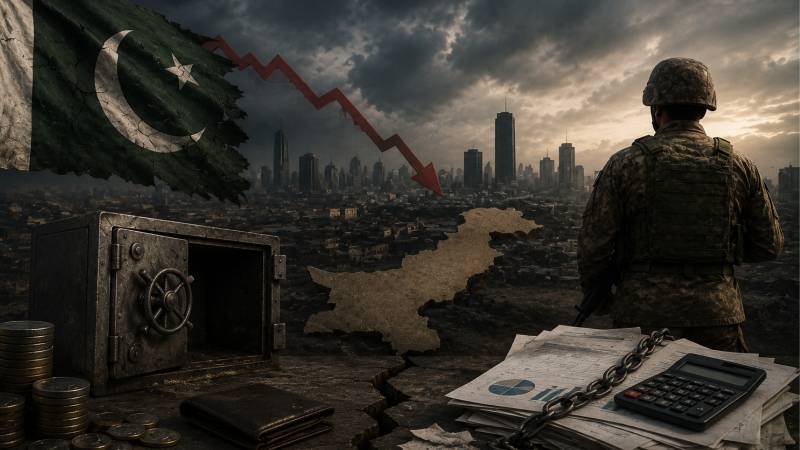
Pakistan is not stable. It is stalled — and mistaking one for the other is the central error in our economic policy debate. The only practical way to break this cycle is to stop managing decline quietly and instead declare a controlled default, backed by a financial emergency, on our own terms.
Headline reserves near $22 billion look reassuring. But a substantial share — commonly estimated at $12 billion or more — is not earned foreign exchange. It is rolled-over deposits from China, Saudi Arabia, the UAE and Qatar, plus IMF disbursements: liabilities dressed as assets, renewed at the pleasure of foreign governments. When the UAE grew unhappy with Islamabad's Iran policy earlier this year, it simply demanded repayment of $3.5 billion instead of the customary rollover, forcing an emergency scramble that Saudi Arabia and Qatar filled. Strip out this borrowed cushion, and import cover — already at roughly 2.7 to 3 months, below the accepted three-month safety threshold — looks considerably thinner. We are renting stability, not holding it.
Even China, our steadiest creditor, is turning cautious. In July 2026, Chinese lenders and power producers refused to waive nearly Rs. 170 billion in late-payment surcharges on CPEC energy projects, insisting existing contracts be honoured rather than renegotiated, leaving government dues to eighteen CPEC power plants at Rs. 423 billion. Separately, an estimated $28.1 billion in Chinese commercial bank loans to the government sector is now overdue, with no clarity on whether Beijing will roll it over, defer it, or attach new conditions. The assumption that Chinese patience is bottomless can no longer be relied upon.
This stability has been purchased by strangling growth. Pakistan's import bill is dominated by energy, raw materials and machinery — exactly what a growing economy needs more of. Every time the State Bank tightens imports to defend the rupee, it starves manufacturing of the inputs needed to expand and hire. The results are visible: total investment sits at just 14.4 percent of GDP, near the lowest since the early 1970s. Government borrowing absorbs roughly 72 percent of domestic bank credit, crowding out private firms, whose share of lending has collapsed from 35 to 21 percent since 2016. Average annual growth has run at roughly 2.3 percent — the weakest six-decade pace on record, barely outrunning population growth. We are not managing an economy. We are managing its decline so the decline doesn't show up in the reserve figures.
Here economics becomes a security file. Poverty has climbed to roughly 29 percent — nearly 70 million people. Roughly a third of Pakistanis aged 15 to 24 are neither employed, in school, nor in training, in a country with a median age of 20. Pakistan's own security researchers note that poverty, joblessness and inequality are direct drivers of radicalisation; idle, disenfranchised youth are precisely who militant recruiters target. And yet even as poverty rose and welfare spending was cut, security spending increased over 20 percent in the last budget — financing hardware while starving the human development spending that might shrink the pool of recruits.
Nowhere is this playing out more visibly than in Balochistan and Azad Jammu and Kashmir. In the first week of July 2026 alone, militants carried out thirty-seven attacks nationwide, killing 108 people; Balochistan accounted for twenty-five attacks and 102 deaths. Pakistan's own military leadership has repeatedly attributed much of this violence to India-backed militants operating from Afghan soil, while analysts separately note Baloch militant sanctuaries across the Iranian border. In AJK, the banned Joint Awami Action Committee has sustained region-wide protests against a security-first response, with no political dialogue underway. This is not coincidence. Balochistan sits at the intersection of Chinese, American, Indian, Iranian and Afghan interests, and instability there has become a tool for keeping Islamabad weak and dependent. A poorer, more indebted Pakistan has less capacity to secure its own frontier — an arithmetic every regional power with an interest in a compliant Islamabad understands well.
Pakistan is not stable. It is stalled — and mistaking one for the other is the central error in our economic policy debate.
The clearest proof came when Saudi Arabia actually invoked its Strategic Mutual Defence Agreement, not merely signed it. When the 2026 Iran war erupted, Islamabad deployed at least 8,000 troops, sixteen aircraft and two drone squadrons to the Kingdom — far beyond symbolic. Pakistan found itself simultaneously mediating between Washington and Tehran while honouring a defence obligation to a combatant in the same war; our own deputy prime minister told parliament he had personally reminded Iranian officials of Pakistan's obligations under the pact. That is financial leverage converting directly into strategic leverage: a country whose survival depends on Gulf goodwill deploys troops and shapes its diplomacy around creditor preferences, not its own judgment. A wealthier Pakistan could have stayed out of that war. We could not afford to.
Pakistan should stop treating default as an unthinkable catastrophe and start treating it as a deliberate instrument — a controlled restructuring of unsustainable obligations, undertaken on our terms, paired with a formally declared financial emergency that forces the fiscal and structural discipline our politics has never managed to impose on itself voluntarily. A declared, negotiated default with bondholders and bilateral creditors would be painful: market access would tighten, ratings would fall further before recovering. But it is the only mechanism strong enough to break a self-reinforcing cycle that six decades of rollovers, compression and diplomatic concession have failed to fix — a cycle where stagnation breeds poverty, poverty breeds militancy, militancy scares off investment, and the resulting financing gap is plugged by foreign creditors who then extract political and strategic concessions in return.
Continuing to manage decline quietly — one Gulf rollover and one Chinese negotiation at a time — is not the safer path. It only feels safer because its costs are diffuse: poverty statistics, youth unemployment surveys, militancy reports, troop deployments to wars we did not choose. A declared default is a single, visible, controlled decision made by us. The current trajectory is an uncontrolled one, arriving in instalments, each chipping away a little more of the room we have left to decide our own future. Given that choice, national security — not economic management alone — argues for choosing default and financial emergency before our creditors, and the regional powers who benefit from our instability, choose it for us.