

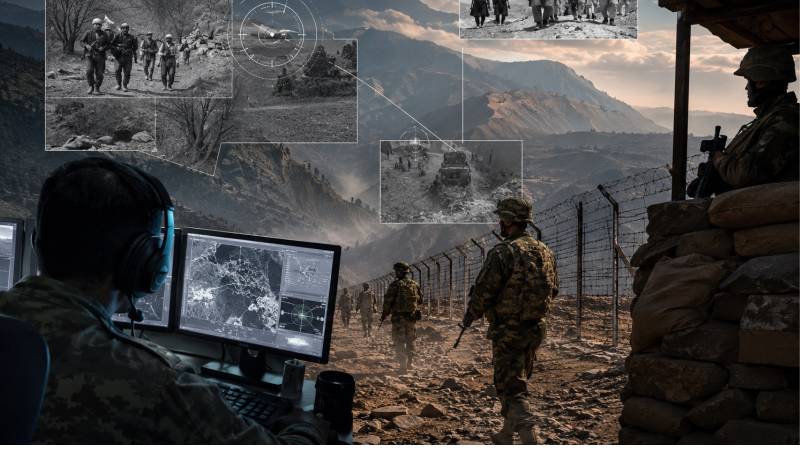
The recent wave of coordinated attacks across Balochistan and Khyber Pakhtunkhwa has brought immense grief to Pakistan. From the blowing up of a critical bridge in Harnai and an ambush in Lasbela, to the tragic storming of a police post in Ziarat and attacks in Bannu, we are losing our brave personnel and citizens at a rate that should alarm every single one of us.
In response, the state has launched a large-scale military counter-offensive named Operation Shaban, which has reportedly neutralized over a hundred militants. Alongside this, the top military leadership has taken a much tougher stance against the Afghan Taliban, directly accusing them of hosting and directing terrorism against Pakistan, and warning that future cross-border responses will be unyielding and disproportionate.
As a Pakistani who loves this country and works to analyze these threats, I believe it is time for an honest, heartfelt conversation about our approach. Naming a new operation or holding a strong press conference is a familiar pattern. But if we want to truly break this cycle of violence, we have to look closely at what is failing on the ground and change how we fight.
For a long time, we treated religious militancy in the northwest and separatist groups in the southwest as two entirely separate problems. That is no longer the case. The Tehreek-e-Taliban Pakistan (TTP) and the Baloch Liberation Army (BLA) have formed a dangerous operational alliance. The TTP has expanded its footprint deep into Balochistan, allowing both groups to share logistics, coordinate simultaneous attacks, and exploit our fragmented security lines. Furthermore, our frontline forces are facing a massive technological gap. When Western forces left Afghanistan, an immense amount of advanced military equipment flooded the region. Today, militant cells are using advanced night-vision gear and high-powered rifles to attack in total darkness. They are targeting our weakest link: the civilian provincial police and local checkposts, who are often left to defend themselves with basic weapons and no night-visibility.
To stop an enemy that melts into the mountains, you need the trust and cooperation of the local people. This is where we are struggling the most. Years of heavy-handed conventional operations have alienated the local population in these border areas. When the local populace feels viewed with suspicion by the state, they stop sharing the early-warning information that could stop a terrorist plot before it happens. It creates a tragic paradox: this is what it has come to, and then people are blamed for not standing with the state.
The true cost of this trust deficit is visible right now on Airport Road at Koila Phatak in Quetta. Grieving families of the police officers martyred at the Ziarat Mangi Dam have been sitting in the open with the coffins of their loved ones, refusing to bury them. The provincial government has sent committees to negotiate and has agreed in principle to an independent judicial inquiry. But the fact that families must protest with the bodies of their sons just to demand proper ammunition, equipment, and security guarantees shows how deep the divide has become. We cannot expect to build effective local intelligence networks if our frontline protectors are treated as sitting ducks, and their families are left unheard.
Our official national defense policy has now shifted its focus across the border. By declaring the Afghan Taliban directly responsible and stating that "proportionality will not be an impediment," the state is signaling a major shift. We are no longer just chasing low-level foot soldiers; the groundwork is being laid to directly target the leadership and command structures inside Afghanistan. While taking a firm stance against a neighboring country that harbors proxies is a valid defensive choice, it carries massive risks. It could pull us into a conventional border war or trigger an even worse wave of retaliatory bombings inside our main cities. Most importantly, a sharp sword swung abroad will do very little if our domestic shield at home remains full of holes. Striking a camp across the border means nothing if a small cell can still easily walk past a vulnerable local checkpoint and blow up a bridge.
Success in stabilizing the region depends on a dual approach: fortifying domestic security infrastructure... and strengthening the relationship between the state and the local population.
A Strategic Path Forward: For security initiatives like Operation Shaban to achieve lasting results, focus must shift toward modernizing tactical and social frameworks within the affected regions:
Enhancing Frontline Protection: Improving the safety of personnel in rural or isolated areas is a primary requirement. Providing local units with modern defensive equipment, such as night-vision technology and reinforced transport, can help address the technological gap currently exploited by militant groups.
Modernizing Border and Highway Security: Transitioning toward smart security, utilizing biometric verification, digital surveillance, and high-mobility patrols, allows for effective monitoring of movement while reducing the risk to personnel stationed at fixed points.
Addressing Local Grievances: Effective security often relies on the cooperation of local communities. Ensuring that the state is perceived as a consistent protector and addressing the socio-economic and security concerns of residents can help bridge the trust deficit. This cooperation is essential for the flow of human intelligence needed to preempt threats.
Agile Operational Tactics: Utilizing specialized units capable of operating in rugged terrain may prove more effective than large-scale conventional movements. These agile teams can focus on disrupting logistics and networks with greater precision.
Addressing current security challenges requires a shift from traditional, static defensive methods to a fluid and modernized playbook. Success in stabilizing the region depends on a dual approach: fortifying domestic security infrastructure through better equipment and tactics, and strengthening the relationship between the state and the local population. By securing the home front and modernizing the frontline response, the cycle of violence can be more effectively addressed.