

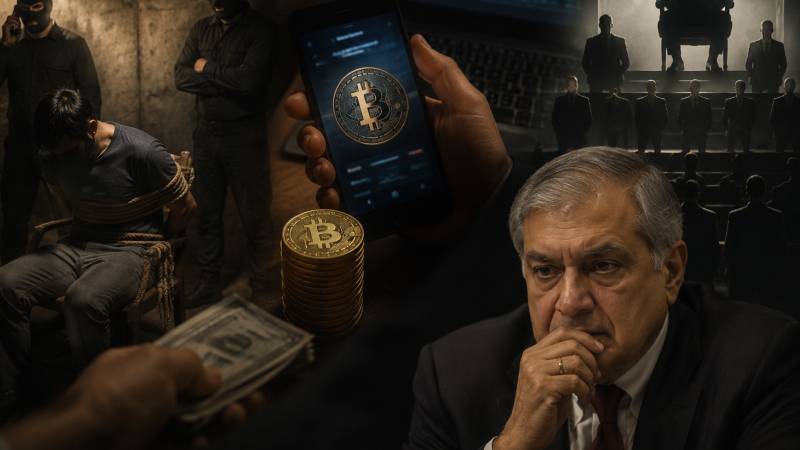
Two foreign women flew into Lahore carrying a birthday cake for a party that did not exist. That detail should stop you before anything else does like the names and the ransom figure. And especially the word "grandson” of the bigshot Deputy Prime Minister, which every headline in the country has now used as shorthand for a story it barely bothered to report properly. A cake. An aunt's birthday, invented for the occasion. Two entrepreneurs, one Dutch and one Venezuelan, walked into an empty house in DHA Lahore expecting candles and small talk, and instead found men with rope waiting for them.
By now the outline is familiar to anyone who has opened a newspaper this month. Muhammad Raza Dar, grandson of Deputy Prime Minister and Foreign Minister Ishaq Dar, stands accused along with three other men of kidnapping, gang rape and extortion. A fifth suspect remains unnamed, referred to in the FIR only as "Boss," and Pakistani Twitter has spent two weeks convinced his identity will be the real scandal. The obvious commentary writes itself: ‘rasookh’, that particular Urdu word for the kind of influence that bends outcomes, protects sons and grandsons, and the case moves fast only because embassies got involved. All true. All already said ad nauseum in every op-ed that ran the week the story broke.
What nobody has sat with properly is where this began. Dar met both women in Singapore in October, through a cryptocurrency venture the three of them were building together. When the venture stopped making money, police say, he decided to "teach his business partner a lesson." That sentence is doing more work than anyone has given it credit for. Crypto sells itself as the most modern thing in the world, borderless, meritocratic, built on code rather than connections. And it became, in this case, exactly the same old machinery it always claims to have replaced: a man who felt cheated by a woman in business, converting that grievance into her body, and calling the whole arrangement a partnership until the moment it stopped being profitable. The birthday cake was theatre. The real invitation had been extended months earlier, in a WhatsApp thread about digital assets.
Researchers state that sexual violence in business disputes functions less as an act of desire and more as an act of power to restore a threatened hierarchy.
There is a specific psychology behind the phrase "teach a lesson" that deserves more attention than a headline gives it. Researchers who study sexual violence in the context of business and financial disputes have long noted a pattern where rape functions less as an act of desire and more as an act of coercion or power, a way of restoring a hierarchy that felt threatened. A man who entered a venture as an equal partner, and watched it fail, experiences that failure differently when the partner sitting across from him is a woman. The loss points to a particular kind of ego, of the natural order he assumed he was operating in. Violence becomes the tool that restores what the balance sheet couldn't. This is not a uniquely Pakistani pathology. It shows up in courtrooms from Lahore to Los Angeles wherever men have used coercion to punish women for the specific offence of not needing them. What makes it worth writing about here is the costume it wore. Crypto culture markets itself as flat, modern, gender-blind, a meritocracy of code and capital. And yet the oldest impulse in the world, the instinct to discipline a woman who stopped being useful, found a perfectly comfortable home inside it.
Then there is the speed of it. The Anti-Rape Act of 2021 got invoked within days. The investigating officer sought a fourteen-day remand. A court granted five. Compare that to how long the Eshal Fatima case in Jhang sat waiting for anyone in power to treat it as urgent, or how many women in this country file a report and then spend years watching it gather dust in a thana drawer built, quite literally, by a colonial administration that designed policing to protect property and order rather than people. The instinct is to call this a double standard, and it certainly is one, but that framing lets the state off too easy. It suggests unwillingness. What actually happened here is that a Dutch family used a code word during a monitored phone call, triggered Rescue 15 from another country, and an embassy applied pressure that no local victim has ever had access to.
The machinery moved solely because someone outside the system had the leverage to force it open. That is a much bleaker finding than "the rich get away with it less when foreigners are involved." It means the capacity was always there. It has just never once been aimed inward. A doctored quote attributed to Information Minister Attaullah Tarar, supposedly defending Dar's grandson, circulated widely enough that a formal fact check had to be issued. Nobody said it, but by the time that mattered, thousands of people had already decided what they believed about power protecting its own, because that belief needed almost no persuading.
What I keep returning to, though, is the two women. Buried under the grandson, the ministry, the missing "Boss," is a fact that deserves its own paragraph and has barely gotten a sentence anywhere. Held for two days, threatened, extorted for an amount that kept climbing, Mau-Arun still found the composure during a monitored call to slip in a family code word, "carlitos," and trust that the people who loved her would understand exactly what it meant. That is sheer nerves of steel under conditions designed to strip it from her. She and Bracho got themselves out using the one tool their captors couldn't search for or confiscate, which was each other's trust and her own intelligence. Everyone else in this story needed rasookh, an embassy, or a courtroom to be taken seriously. She needed one word and the wits to say it at the right moment. The state showed up for her eventually. She had already showed up for herself.