

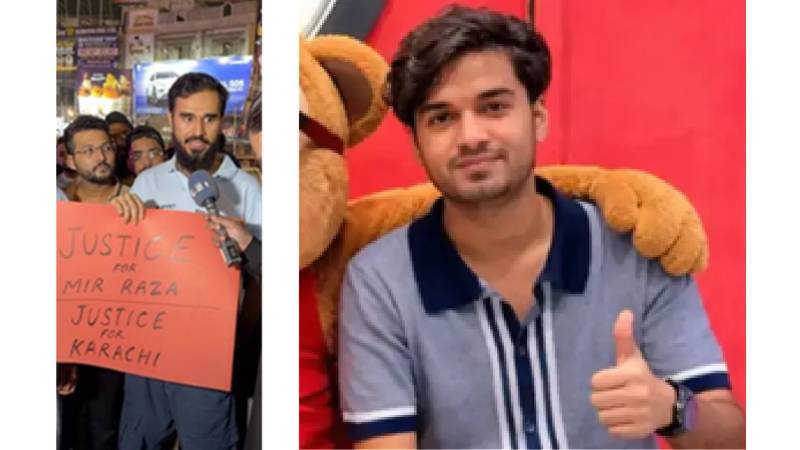
For the past few weeks, the tragedy of Mir Raza has cast a shadow over Karachi. At 25 years old, he was a reflection of the youth we see in ourselves and our peers. An IBA graduate and the proud owner of a local eatery called Wafflix, his life represented the very ambition so many of us still hold on to in this country. We go to universities, we dream up businesses, we hustle through the economic despair, hoping that hard work and education will buy us a ticket to a safe, prosperous life.
Mir Raza’s brutal end, and the subsequent institutional circus surrounding his death, stripped away that illusion entirely. His story is a reminder that in this country, neither education nor ambition can save you.
The Anatomy of a Cover-Up
On the 28th of July 2026, Mir Raza went missing from the PECHS area. The very next day, his body was found discarded in the bushes near the Shahi Qila Ground in Gulistan-i-Jauhar, bearing a fatal gunshot wound. Initially, a First Information Report (FIR) was registered under Section 365, indicating kidnapping. But almost immediately, the gears of a machine began to turn, attempting to manufacture a narrative that was convenient for the authorities and devastating for the grieving family.
Investigators began aggressively pushing the theory of suicide. Leaked narratives suggested that Raza was heavily in debt, a young man driven to despair by financial ruin. To those of us watching from the outside, the dishonesty felt palpable and overwhelmingly familiar. As a woman in Pakistan, I am acutely aware of how institutions manipulate narratives to absolve themselves of responsibility. When victims of violence seek justice, they are routinely blamed, their characters assassinated, and their traumas rebranded as self-inflicted wounds or "accidents."
Here, they were trying to do it to a murdered boy.
The initial post-mortem report was a masterclass in bureaucratic negligence. However, the façade cracked when Karachi Police Surgeon Dr Summaiya Syed refused to play along. She raised 14 glaring objections to the autopsy, pointing out that the body hadn't even been X-rayed. Gunshot residue swabs were ignored, the trajectory of the bullet was undocumented, and the injuries were not scientifically measured. Dr Syed’s professional defiance was a rare, desperately needed spark of integrity in a system designed to swallow the truth whole.
We go to universities, we dream up businesses, we hustle through the economic despair, hoping that hard work and education will buy us a ticket to a safe, prosperous life – and Mir Raza’s brutal end stripped away that illusion entirely
Because of the blatantly flawed autopsy, Raza’s father, Mir Hussain Ali, filed an application before a judicial magistrate demanding an exhumation and a fresh post-mortem. There is unspeakable cruelty in forcing a family to dig up their son’s grave because the state failed to do its job the first time.
When death takes someone, the burial is supposed to be the final, sacred laying to rest. But eleven days after he was lowered into the earth of the Rehmania Masjid graveyard, Mir Raza’s grave was reopened. For days, the provincial government had shuffled the composition of the medical board back and forth, fuelling intense public rumours of a deliberate cover-up. The psychological torture inflicted on the family during this period is unfathomable. They stood over that soil, refusing to let institutional silence be the final word on their son’s life.
The findings of the second autopsy were horrifying, shattering the suicide narrative once and for all.
Truth Exhumed
The re-postmortem confirmed what the family had insisted all along: Mir Raza did not take his own life. He was brutally taken from them.
The medical board found severe physical trauma inflicted before death, including fractured ribs, teeth, and skull. They found multiple ante-mortem wounds, signs of internal bleeding, and a firearm entry wound on the upper right side of his back, with the exit wound on the left side of his chest.
Could he have shot himself in the back while simultaneously suffering catastrophic blunt force trauma to the face and head?
Furthermore, chemical analysis of samples taken during the exhumation gave chilling details. Traces of acid were found on his shirt, and the chemical examiner's report detected bupivacaine, which is an anaesthetic and painkiller, in his blood. The presence of an anaesthetic points to a calculated crime, far from a spontaneous act of violence.
Following these undeniable revelations, the police were finally forced to add Section 302 (murder) to the FIR. The original investigation team was disbanded, and a new team, headed by DIG Crime and Investigation Amir Farooqi, was constituted.
The Illusion of Safety
What happens to a young person’s psyche when they realise that the state infrastructure—the very people whose salaries are paid to protect us—will actively work to bury evidence of our murders?
Mir Raza’s case is terrifying because it highlights our extreme vulnerability. If a young, well-educated man from a respectable family, with the resources to hire a prominent lawyer like Jibran Nasir, has to fight this hard just to prove he was murdered, what hope is there for the marginalised? What happens to the young girls found dead in rural Sindh or Punjab, whose families have no access to the media, no voice on Twitter, and no money for legal counsel? Their bodies are swallowed by the earth, their murders written off as suicides, honour killings, or tragic accidents. The system never even blinks.
Karachi is a city that demands resilience from its youth, but there is a breaking point. We are told to keep our heads down, build our careers, and mind our own business. Raza did everything "right." He went to a top-tier business school, he became an entrepreneur, he contributed to the local economy. And yet, he was snatched from a prominent neighbourhood, tortured, shot in the back, and thrown into the bushes. The subsequent attempt to write off his murder as a suicide was a message to all of us: Your life is cheap, and your death will be an inconvenience we will swiftly sweep under the rug.
Mir Raza’s family refused to be gaslit. His father’s unwavering pursuit of the truth, supported by relentless advocacy from Jibran Nasir and civil society, forced the system to correct its course. The public outrage on social media kept the spotlight on the investigators. People who had never met Raza felt a profound kinship with him, refusing to let his case fade into the endless scroll of Pakistani news cycles.
When the Sindh government proposed a judicial commission to investigate the killing, the family and their counsel made a powerful decision: they declined it. Jibran Nasir rightly pointed out that the government had finally acknowledged it was a murder, and that the constitutional and legal responsibility for investigating a murder lies with the police.
Judicial commissions in Pakistan have a notorious history of acting as bureaucratic black holes, where reports are filed away in secret and accountability goes to die. By placing complete confidence in the judiciary and demanding the police do their actual jobs, the family refused to let the case be sidelined into a hopeless inquiry.
The investigation is now moving forward, with geo-fencing and call data records being analysed to track down the perpetrators. We do not yet know the names of the people who tortured and killed Mir Raza, nor do we know exactly why they did it. But the scope of the tragedy is already a part of the consciousness of our generation.
We are watching closely. We are watching to see if the powerful people who may be hiding behind this brutal crime are brought into the light. We are watching to see if the police officers and medical personnel who deliberately attempted to sabotage the first autopsy are held accountable for their complicity. A murder requires killers, but a cover-up requires an entire ecosystem of willing participants.
Mir Raza Ali’s grave is no longer a silent one. It has become a loud indictment of a system that views the youth of this country as expendable collateral. The earth may have taken his body, but the facts of what was done to him will not decay.
If this country will not promise us safety, the bare minimum it owes us is the truth.