

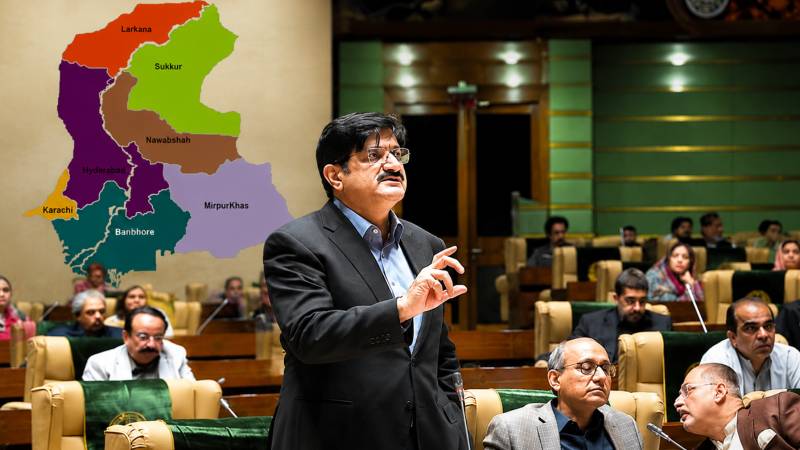
In my last op-ed, I argued that wholesale provincial reorganization and a one-size-fits-all approach to creating new administrative units are unsuitable for Pakistan. In this piece, I focus specifically on the question of new provinces or administrative units in Sindh.
Consequently, opposition to the division of Sindh cannot simply be dismissed as resistance to an administrative reform. For many people, the issue is closely connected with questions of identity, history, political representation, resources, and the integrity of their homeland. This is why there remains a strong and deeply rooted sentiment in Sindh that the province should not be divided.
سندھ ہمارا ناقابلِ تقسیم تاریخی وطن ہے
“Sindh is our indivisible historic homeland.”
These two statements demonstrate the deep emotional and psychological attachment of the Sindhi intelligentsia and wider society to the territorial integrity of Sindh—an attachment that, in some respects, resembles the value that a nation-state places on the integrity of its national territory.
Sindhis including the Chief Minister of Sindh, Sayed Murad Ali Shah frequently describe Sindh as a “Tareekhi Wattan” (historic homeland) and argue that Sindh, with its existing territorial boundaries, became part of Pakistan through the social contract of the Lahore Resolution of 1940, which later came to be known as the Pakistan Resolution. They emphasize that the original Lahore Resolution envisaged autonomous and sovereign constituent units, and therefore argue that the territorial integrity of Sindh cannot be altered.
Sindh also occupies a distinctive place in the history of Pakistan's creation. The Sindh Legislative Assembly was the first provincial legislature in British India to formally pass a resolution in support of the creation of Pakistan, on 3 March 1943. The resolution stated that Muslims were “justly entitled to the right, as a single, separate nation, to have independent national states of their own, carved out in the zones where they are in majority in the sub-continent of India.” It should also be noted that the Lahore Resolution used the phrase “independent states” in describing the political units to be constituted in the Muslim-majority areas of British India. From the perspective of Sindhi nationalist discourse, the phrase is understood to mean that the provinces were not merely administrative divisions of a centralized Pakistani state but constituent political units with their own historical and territorial identities within the broader Pakistani nation-state.
The debate over the division of Sindh is considerably more sensitive than a conventional discussion about administrative efficiency, population size, or service delivery alone.
This historical episode has acquired considerable symbolic significance in Sindh and reinforces the perception among Sindhis that Sindh's decision to join Pakistan was based on a political understanding concerning the character of the future federation. This historical memory associated with the Lahore Resolution and the 1943 Sindh Assembly resolution has contributed to a powerful sense of territorial ownership and collective identity among majority Sindhis. Consequently, proposals to divide Sindh are often perceived not merely as administrative reforms but as challenges to a historically constituted homeland.
This emotional dimension is important for understanding why the debate over the division of Sindh is considerably more sensitive than a conventional discussion about administrative efficiency. As Nadav G. Shelef argues in Homelands: Shifting Borders and Territorial Disputes, “The emotive power of homelands stems from these symbolic, almost religious, beliefs more than any economic or strategic value of the land.” The concept of Tareekhi Wattan similarly gives the territorial question in Sindh a symbolic and emotional significance that cannot be adequately captured through arguments about administrative efficiency, population size, or service delivery alone.
The Tareekhi Wattan argument, however, does not provide an absolute constitutional or legal bar against altering the boundaries of Sindh. History itself demonstrates that the territorial boundaries of historical homelands are neither permanent nor immutable. The historic homeland of Punjab, for example, is today divided between India and Pakistan, while the broader Pashtun homeland has been divided among present-day Khyber Pakhtunkhwa, Balochistan, and Afghanistan. Sindh provides another illustration of this changing territorial imagination. The historical boundaries of Sindh once extended much farther north, including areas around present-day Multan, whereas the contemporary province extends only up to Ubaro in Ghotki district.
This demonstrates that the geographical imagination of a homeland is not necessarily fixed for all time. The political boundaries of a territory can change while its historical, cultural, and emotional significance continues to survive. In other words, homelands have historical memories, but their territorial contours can and do change over time.
In the terminology of federalism, many Sindhis tend to perceive Sindh as a constituent unit that joined Pakistan through a process which can be termed as “coming-together” federalism, analogous to the formation of the United States by the thirteen original states, rather than “holding-together” federalism. This distinction is important for understanding the Sindhi perception of Pakistan and the sensitivity surrounding any proposal to alter the territorial boundaries of Sindh.
From this perspective, Sindh was not simply an administrative territory created by the Pakistani state; rather, it was a historically constituted political unit that entered the federation through the political process associated with the Pakistan Movement. The Sindh Legislative Assembly's 1943 resolution in favour of Pakistan is particularly significant in this historical narrative. Consequently, many Sindhis perceive Sindh as a constituent unit of the federation with its own distinct historical and territorial identity, and therefore believe that its territorial integrity must be protected.
Proponents of creating new provinces in Pakistan often invoke the example of the United States, arguing that the present fifty states emerged from the original thirteen states and that the American experience therefore demonstrates the benefits of repeatedly dividing large constituent units. On the contrary, the fact is 45 out of 50 U.S. states were never partitioned and they have retained their territorial integrity since their admission. The United States expanded primarily through the admission of new states, and not from division of states. Out of the thirteen original states, only Virginia and Massachusetts were subsequently divided, largely because of their own internal political and territorial circumstances rather than through any externally imposed scheme of federal reorganization.
The U.S. example is particularly relevant to the debate over Sindh because, like the Constitution of Pakistan, the U.S. Constitution places a significant constitutional safeguard around changes to the territorial boundaries of an existing state. Article IV, Section 3 of the U.S. Constitution requires the consent of the legislature of the state concerned as well as the consent of Congress before a new state can be formed within existing states. This reflects an important federal principle: the territorial integrity of a constituent unit cannot be altered unilaterally by the federal government.
A similar principle is embedded in the Constitution of Pakistan. Under Article 239(4), a constitutional amendment that would alter the limits of a province cannot be passed by Parliament unless it has also been approved by the provincial assembly concerned by a two-thirds majority. Thus, constitutionally speaking, the consent of the Sindh Assembly is not merely politically desirable; it is an essential constitutional requirement for any proposal that seeks to alter the territorial boundaries of Sindh.
This constitutional principle gives particular significance to the Sindh Assembly's resolution of 21 February 2026, in which the Assembly “unequivocally condemns and rejects any conspiracy aimed at the division of Sindh or the creation of a separate province comprising Karachi.” While the resolution itself does not constitute an absolute legal bar against any future proposal, it represents the formally expressed position of the province's elected legislature and demonstrates the absence of the provincial political consensus required for any constitutional reorganization of Sindh.