

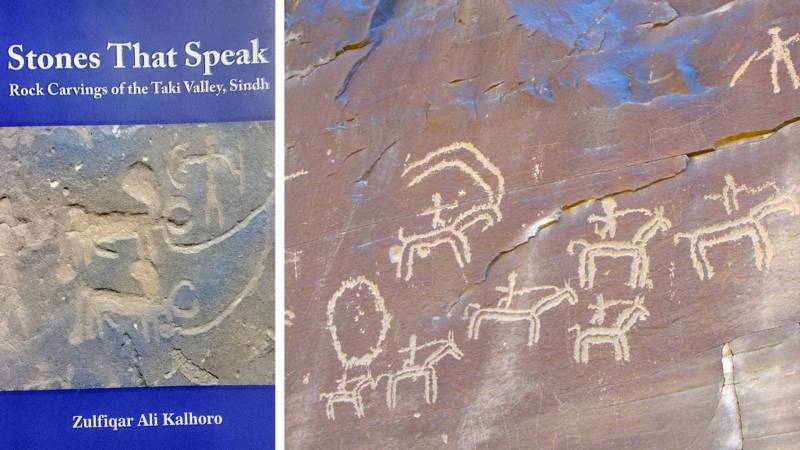
The discovery of rock art in the mountains of the Sindh province of Pakistan owes largely to Dr Zulfiqar Ali Kalhoro. A distinguished scholar and notable cultural anthropologist of Pakistan, Dr Kalhoro is known for his works on the history and cultural heritage of Pakistan. Particularly, his contribution to rock art research in Sindh stands out as one of his most significant works.
The mountainous region of Sindh has remained underexplored in terms of archaeological research. Dr Kalhoro’s continuous and systematic explorations in the region during the past nearly three decades have brought to light thousands of rock carvings and paintings at different sites in the mountains of Sindh.
In Sindh, rock art has been found in almost every part of the Kohistan and Khirthar mountains, where, apart from rock depictions, several other structures and objects of bygone ages have also been discovered. These remains, dated to the ancient and contemporary periods, bear testimony to the human occupation of the region, and the rock art was a result of it.
Documenting the Heritage
Dr Kalhoro has revealed its archaeological heritage and extant cultural traditions in his following four books: Symbols in Stone: The Rock Art of Sindh; The Rock Art of Karachi; Ancient Karachi: Reflections on Rock Art and Megaliths; and Stones That Speak: Rock Carvings of the Taki Valley, Sindh. Through these works, we come to know that the rock art of Sindh belongs to various peoples and cultures that have inhabited and thrived in this region.
This book is an invitation to see the mountains of Sindh not as empty wilderness, but as a manuscript written by thousands of hands over millennia
Dr Kalhoro’s recent book, Stones That Speak: Rock Carvings of the Taki Valley, Sindh, discusses rock art from ethnographic and landscape perspectives. It explores the engravings found along the Khashani, Mamani, Heegan, and Loondo streams in the Taki valley in Dadu District. All of them are tributaries of Nai Taki, and together they form the Taki Valley. In this book, they are described as the rock art sites of Loondo Dhoro, Mamani, Dhoro, Heegan Dhoro, and Khashani Dhoro, where symbols and images from prehistoric to present times are made on rock walls, cliffs, boulders, and so on.
A Tapestry of Ancient Depictions
Moreover, there are multiple depictions at these sites, including human and animal figures, structural and geometric designs, hunting, domestication, and fighting scenes, cup-marks, grooves, and engravings of a gun, a shoe, and an aircraft. These carvings also include a partly identified Brahmi inscription.
Of all these, the engravings of the scenes of the domestication of bulls at the upper Khashani valley are unique occurrences in the rock art of Pakistan, as such depictions are not found elsewhere in the country. Another equally captivating carving shows the scene of a shaman performing magic or rituals with a bull. Furthermore, the figures of animals include camels, horses, goats, and others. Meanwhile, some carvings of structures have been identified as stupas by Dr Kalhoro, and these stupas of the Taki Valley are not decorated as compared to the stupa images found at other sites in Sindh. In addition to this, a few anthropomorphic engravings have also been discovered in the rock art of the Taki Valley.
Stones That Speak is a very valuable addition to rock art studies, as it documents new rock art sites and brings them to the attention of scholars studying the history and cultural heritage of Pakistan. It significantly contributes to our understanding of the rock art of Sindh.
As in the words of Dr Kalhoro: ‘this book is an invitation to see the mountains of Sindh not as empty wilderness, but as a manuscript written by thousands of hands over millennia. It encourages us to walk gently, to look closely, and to listen to the enduring whispers of the stones. These stones speak, carrying stories from the distant past into the present.’