

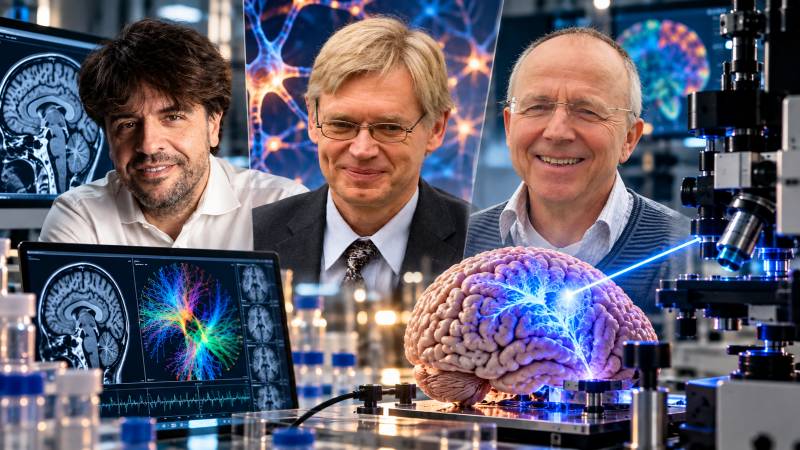
For centuries, light has served as humanity’s favourite metaphor for knowledge. We speak of illuminating a mystery, shedding light on a problem and emerging from the darkness of ignorance. Occasionally, however, science takes a metaphor literally. The 2026 Nobel Prize in Physiology or Medicine celebrates an achievement in which light became an instrument for investigating the brain itself. Awarded to Karl Deisseroth, Peter Hegemann and Georg Nagel for their discoveries concerning light-gated ion channels and optogenetics, the prize recognizes a remarkable capacity: scientists can use light to activate or suppress the activity of selected nerve cells. A poetic image has become an experimental method. Light can now help researchers ask how particular cells contribute to the memories, emotions and behaviours through which we experience the world.
There is something profoundly moving about this development. The brain is the organ through which we investigate everything else, yet understanding its own workings remains an extraordinary challenge. It enables us to calculate the motions of planets, compose poetry, recognize a familiar voice and grieve for someone whose voice we will never hear again. These experiences differ enormously, but each depends on biological activity. How does the activity of nerve cells become a movement, a perception or an emotional response? Such questions sit at the meeting point of laboratory science and human self-understanding. Their difficulty should encourage humility. Describing the brain as an electrical network may explain part of its operation, but understanding the relationships within that network requires instruments capable of testing very specific questions.
The route towards one such instrument began far from the apparent grandeur of human thought. Hegemann and Nagel investigated the light responses of a single-celled green alga, Chlamydomonas. Their work helped identify channelrhodopsins, proteins that allow light to influence the movement of electrically charged particles across a cell membrane. In channelrhodopsin-2, illumination opens a channel through which ions can flow. This provides a biological connection between light and electrical activity. Deisseroth and his collaborators subsequently adapted that connection for mammalian nerve cells. An organism easily overlooked outside a laboratory helped supply a tool for investigating one of biology’s most demanding problems.
That journey deserves attention beyond the names of the laureates. Imagine asking a scientist investigating the light sensitivity of algae to justify the work solely by identifying an immediate treatment for a neurological illness. The eventual application might have been impossible to predict. Yet the question was scientifically worthwhile long before its medical possibilities became visible. This is an enduring argument for supporting fundamental research. Nature does not organize its secrets according to ministry budgets, departmental boundaries or commercial deadlines. A discovery in one organism may become useful in another; a question about a membrane protein may eventually change the methods available to neuroscience. The usefulness of knowledge often emerges through connections that no original funding proposal could fully anticipate.
The basic idea of optogenetics is accessible even when its implementation is technically demanding. Scientists introduce genetic instructions that enable selected cells to produce a light-sensitive protein. Appropriate illumination then changes those cells’ electrical activity. In the landmark 2005 study, researchers used channelrhodopsin-2 to control nerve-cell firing on a millisecond timescale. The paper’s authors included Edward Boyden, Feng Zhang, Ernst Bamberg, Georg Nagel and Karl Deisseroth—a reminder that the experimental foundations of a Nobel-recognized achievement extend across a research team. The technique joined genetic targeting with rapid optical stimulation, providing a new way to investigate neural signals with exceptional timing.
Why should timing and targeting matter so much? Consider an orchestra performing a complicated composition. Hearing the entire performance tells us something about the music, but identifying the contribution of a particular instrument requires a more selective approach. Similarly, studying brain activity demands attention to which cells are involved and when they act. Optogenetic experiments depend on both the expression of suitable proteins in the intended cells and the delivery of light to the intended location. Different tools can support activation or inhibition. Precision therefore comes from an entire experimental arrangement, rather than from illumination alone. The scientific achievement lies in making a carefully chosen biological intervention possible at a carefully chosen moment.
A poetic image has become an experimental method. Light can now help researchers ask how particular cells contribute to the memories, emotions and behaviours through which we experience the world.
This ability changes the kinds of questions a researcher can ask. Observing that a group of cells becomes active during a behaviour establishes an association. It does not, by itself, establish what those cells contribute. They might help initiate the behaviour, respond to it or participate in another process occurring alongside it. By altering the activity of a selected cell population and examining the consequences, scientists can investigate causal involvement more directly. Optogenetics has consequently strengthened research into the neural circuits associated with memory, motivation, emotion and behaviour. Its intellectual importance rests in this movement from observing a relationship towards experimentally testing it. Even then, the answer remains bounded by the design and conditions of the experiment.
Here, scientific language must retain its discipline. A successful intervention in a particular circuit does not explain the whole of a human experience. Neither does an experiment in an animal automatically establish a treatment for a patient. The temptation to turn an elegant discovery into an extravagant headline is considerable, especially when the brain is involved. Claims about controlling thoughts or curing complex psychiatric conditions attract attention, but they can obscure what the research actually demonstrates. A Nobel Prize recognizes a major achievement; it does not remove the need for careful interpretation. Public communication should preserve the distinction between a powerful research method, a promising therapeutic direction and a treatment supported by sufficient clinical evidence.
Nevertheless, the medical possibilities are substantial enough to command serious interest. At Stanford, optogenetic research has been used to investigate circuits associated with conditions including Parkinson’s disease and depression, with experimental findings in mice helping researchers explore how specific patterns of neural activity affect behaviour. Such work offers routes towards more precise biological questions about illness. Its eventual contribution may include identifying targets for treatments that use other methods to influence those circuits. The clinical value of optogenetics therefore need not depend exclusively on installing light-sensitive proteins in the human brain. Knowledge obtained through the technique may help guide the development of other interventions.
One especially striking clinical example concerns vision. A study published in Nature Medicine in 2021 reported partial recovery of visual function in a blind patient following optogenetic therapy. The approach combined delivery of genetic instructions for a light-sensitive protein with stimulation through specially engineered goggles. The qualification “partial” matters: the result was an important demonstration, not a restoration of ordinary vision or proof of a universal treatment for blindness. Even within those limits, the achievement carries considerable human significance. A modest functional gain can matter greatly to someone living with profound impairment. Scientific progress should be measured both through the strength of its evidence and through the practical difference it may eventually make in a person’s life.
The discovery also invites reflection on how we understand mental suffering. Better knowledge of neural circuits can deepen biological explanations of illness, but compassion must remain central to care. A person experiencing depression, disturbed perception or disabling anxiety lives within a family, a community and a particular set of circumstances. Biological research and attention to those circumstances can enrich each other. The ethical ambition of neuroscience should be to understand suffering more accurately and relieve it more effectively. Patients should never become secondary to the fascination of the instrument. The worth of increasingly precise tools ultimately depends on the wisdom with which their findings are interpreted and used.
For Pakistan, this Nobel announcement offers a useful occasion to examine our own scientific ambitions. The lesson is not that every university should immediately attempt to establish an advanced optogenetics laboratory. A more practical beginning would be to strengthen the foundations that make demanding research possible: sound teaching, functioning equipment, skilled technical staff, reliable access to scholarly literature and sustained collaboration. A research programme requires continuity. It needs time for students to learn, experiments to fail constructively and methods to improve. Institutions should assess their success through the quality of the questions they enable and the evidence their researchers produce. Purchasing an instrument is an event; building the capacity to use it well is a continuing responsibility.
The interdisciplinary character of optogenetics is particularly relevant to university education. A technique connecting light, proteins, electrical activity and behaviour draws attention to the value of conversation across physics, biology, medicine and engineering. Universities could encourage such encounters through jointly supervised projects, shared laboratory training and seminars that make different disciplines intelligible to one another. A physics student should have opportunities to understand biological applications of optics; a medical student should be able to explore the physical principles behind a research instrument. These encounters can help students discover questions that remain invisible within a single course outline. Intellectual ambition grows when disciplinary expertise is accompanied by curiosity about neighbouring fields.
The institutional patience behind such research also deserves recognition. The European Research Council reports that it supported Hegemann’s work through major grants, including funding to explore new light-sensitive proteins and extend optogenetics to broader biological systems. Such support illustrates the importance of allowing an established scientific question to develop over time. For countries seeking stronger research cultures, the implication is clear: continuity of support should be treated as part of scientific infrastructure. Researchers need confidence that worthwhile work can survive administrative transitions and that carefully documented progress will carry weight even before a dramatic application appears.
Through experiments, collaboration and refinement, a biological observation became an instrument capable of opening new questions about the brain. The recognition belongs to particular scientists, while the deeper lesson belongs to every society deciding what kinds of inquiry deserve encouragement. We cannot know in advance which modest question will lead towards a major discovery. We can, however, create conditions in which good questions receive a fair opportunity to grow. Light has helped science speak more precisely to the brain. Our responsibility is to ensure that curiosity continues to find somewhere to shine.