

Mr. Asmat, in a small town in Khyber Pakhtunkhwa, has put solar panels on his roof. He did not do it for the environment. He did it because the grid goes dark for hours at a stretch, and because the bill for the little power that still arrives, climbs higher every few months. The panels carry the house through most days; the petrol generator in the yard is for the hours when even the sun is not enough. Piece by piece, out of his own pocket, he has built the electricity supply the state was meant to provide and never did.
A few hundred kilometers away, Mr. Irfan has just sold his plot, two hundred and fifty square yards bought over a lifetime, one saved rupee at a time. It was meant to be his legacy. Instead, it has become a ticket. His son has won admission to a university abroad, and the money is just enough for the admission and the first two semesters. After that, the boy will have to work to stay. A lifetime of savings, converted into a runway of a few months.
Neither is a remarkable story. That is the point. Mr. Asmat's petrol and Mr. Irfan's plot are not exceptions; they are the quiet arithmetic of ordinary life in Pakistan, repeated in every second house. And once you begin to see it, you cannot stop, because it is no longer a collection of individual misfortunes. It is a description of how the state now works. Pakistan has, gradually and quietly, begun to privatize citizenship.
Citizens pay taxes and, in return, expect a basic framework of security, infrastructure, health, education and opportunity. In Pakistan, that bargain is increasingly replaced by another: pay your taxes, and then pay again, privately, for what the state cannot reliably provide. The family that can afford it buys private security, installs generators, drills a borehole or buys water from tankers, sends its children to private schools, and turns to private hospitals when public ones cannot cope. The better-off build a parallel system around themselves; the middle class does the same by sacrificing its savings; the poor have much less room, and that is where the real institutional problem begins.
Pakistan's public health expenditure remains below one per cent of GDP, well under the five per cent of GDP widely regarded as necessary for universal health coverage, while millions of households are pushed towards financial hardship by out-of-pocket medical costs. The result is visible in the hospitals: overcrowded public wards for those who cannot afford anything else, and private care for those who can. It produces a peculiar inequality. Those with means escape the failing system; those without are trapped inside it.
The tax system deepens it. Pakistan relies heavily on indirect taxation, so the burden falls on those who spend the largest share of their income on necessities, not on those who hold the most wealth. Debt servicing absorbs an enormous share of public resources, leaving little to improve the services citizens actually experience. This is where Pakistan's shrinking middle class matters. A middle class is more than an income bracket. It is a group that believes effort, education and work can still produce a reasonably secure future. That belief is weakening, and the clearest evidence is not in the surveys but at the airport.
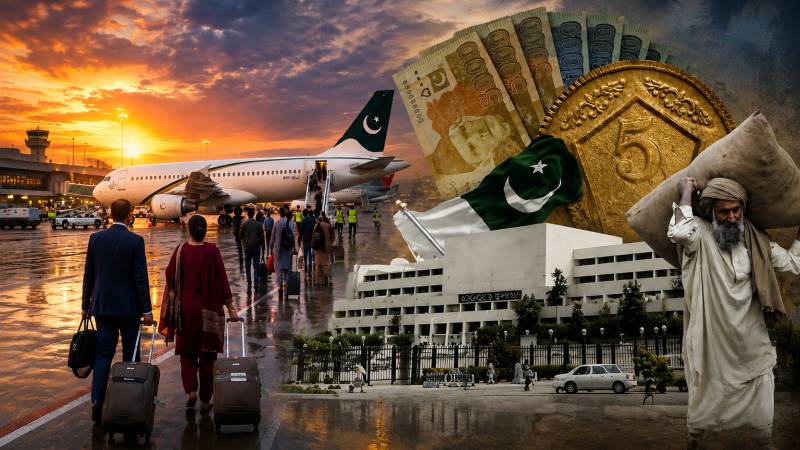
Pakistanis are leaving. In 2025, more than 760,000 reportedly left for work abroad, among them doctors, engineers, accountants and managers. This is not simply migration. Albert O. Hirschman offered a way of understanding it through his distinction between "exit" and "voice": when an institution deteriorates, people can stay and try to change it, or they can leave. In Pakistan, exit is becoming the rational choice for those with the means to exercise it.
And the decision is rarely made lightly. Parents sell land, mortgage property and borrow from relatives so that a son or daughter can obtain a degree, a visa and a job abroad. The country then receives the remittances, a record $41.6 billion in 2025–26, essential to the economy and to millions of families. The irony is that we celebrate the remittances without asking why so many had to leave. The young person who becomes an economic asset abroad was often treated as a burden while looking for work at home. When leaving becomes the rational response to a system that offers too little hope, migration stops being an individual decision and becomes a national development indicator.
The tax system deepens it. Pakistan relies heavily on indirect taxation, so the burden falls on those who spend the largest share of their income on necessities, not on those who hold the most wealth.
The crisis cannot be solved by another package, commission or tax measure. The question is more fundamental: what does the citizen actually receive in return for being a citizen? The economist Amartya Sen argued that development is not merely growth in income, but the expansion of the real freedoms people has to live lives they have reason to value, and that a society is measured by what its institutions allow ordinary people to be and to do. By that measure, a state that leaves its citizens to buy their own security, water, electricity, health and education is not developing. It is quietly narrowing the freedoms it was built to widen.
There is a deeper trap. A state that cannot provide basic services forces citizens into private arrangements, and those arrangements then reduce the pressure to reform, because the people with the greatest capacity to demand change have already protected themselves. The result is institutional fragmentation. Inequality is only its surface. Once it becomes normal, people stop asking why the public system does not work; they simply ask how much it costs to bypass it. Perhaps this is the most dangerous stage of institutional decline: once people lose faith in the possibility of improvement, they stop demanding a better state. They build a life around the absence of one.
Pakistan does not lack intelligent people, capable professionals or reform ideas; it does not lack policy papers, commissions or strategies. Having spent my professional life working with governments and development partners on institutional reform, I have seen that the country can diagnose its problems. The harder task is converting diagnosis into institutions ordinary citizens can actually experience. Reform is not successful because a policy is approved in a cabinet meeting. It is successful when a mother does not have to worry whether she can afford treatment for her child, when a worker can turn on the light without planning his evening around the outage, and when a young professional can look at Pakistan and see a future worth building here.
The way back is narrower than the size of the problem, but it is real. It does not begin with a larger budget, which the country does not have, nor with another reform announced at a press conference. It begins with delivery that people can actually see: a public hospital that treats the patients who walk into it, a stretch of the grid that stays on through the evening, and a government school good enough that a middle-class family would choose it over the private one down the road. These are small things, but they are visible, and they are real.
This matters because the trap I have described runs in one direction, and it can be made to run in the other. Each time the state delivers something people can see, one more family finds a reason to stay and demand better rather than build a private system around itself. Trust is not rebuilt through speeches or strategy documents; it is rebuilt when institutions begin to work, one at a time, in places where ordinary people can feel the difference. A government that wants its citizens to stop privatizing their citizenship has to earn that trust back where they live, and let the results accumulate. It is slower and less impressive than a rescue package, but it is the only approach that has ever truly worked.
This is the real test of the state. Its clearest warning sign is not that its people are angry. It is that so many of those who can afford to are quietly learning how to live without it, putting panels on their roofs to replace a grid they no longer count on, and selling the ground beneath them to buy their children a way out.
A country cannot survive indefinitely by taxing its citizens for public services, making them buy those services privately, and then leaning on the same citizens to leave and send the money back. That cycle has to end. The state must make citizenship feel like an asset again, not an obligation. Otherwise, the most ambitious will keep choosing exit, the fortunate will keep building private islands of comfort, and everyone else will carry the cost. The question is not how to raise more revenue, attract more investment or increase remittances. It is more basic. Can we rebuild a state that gives people a reason to stay?